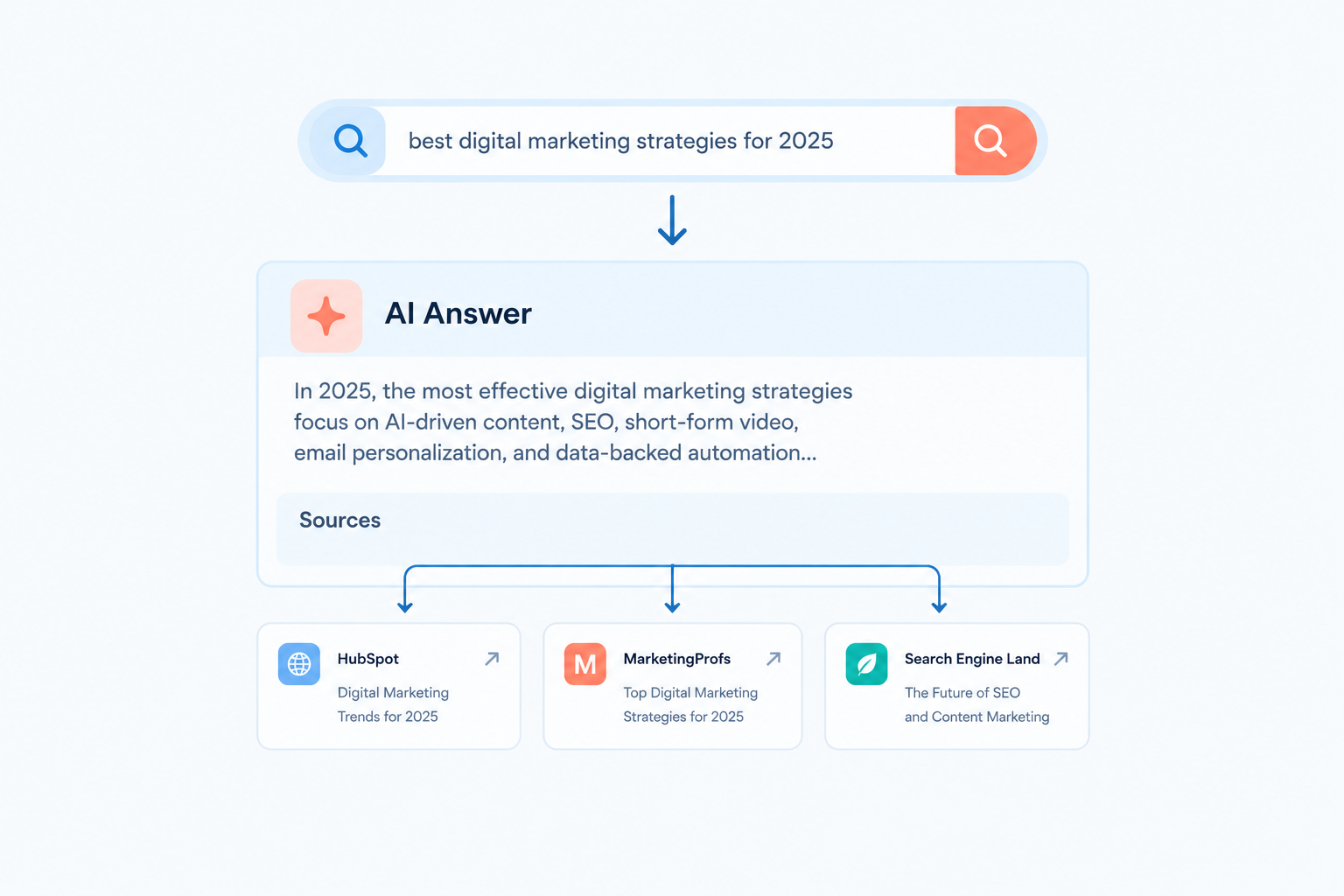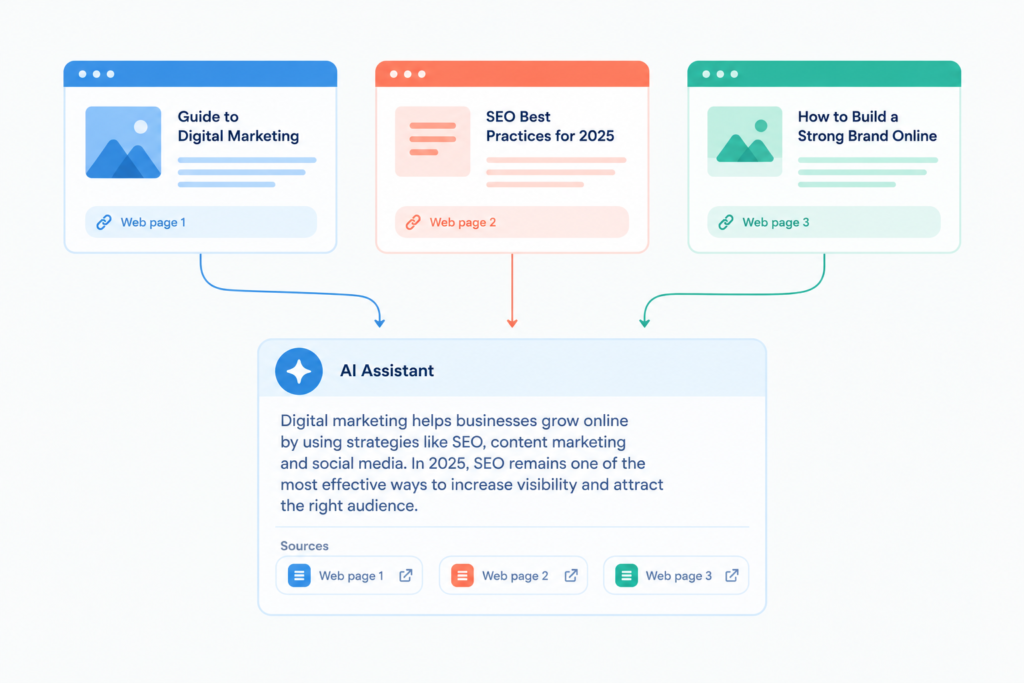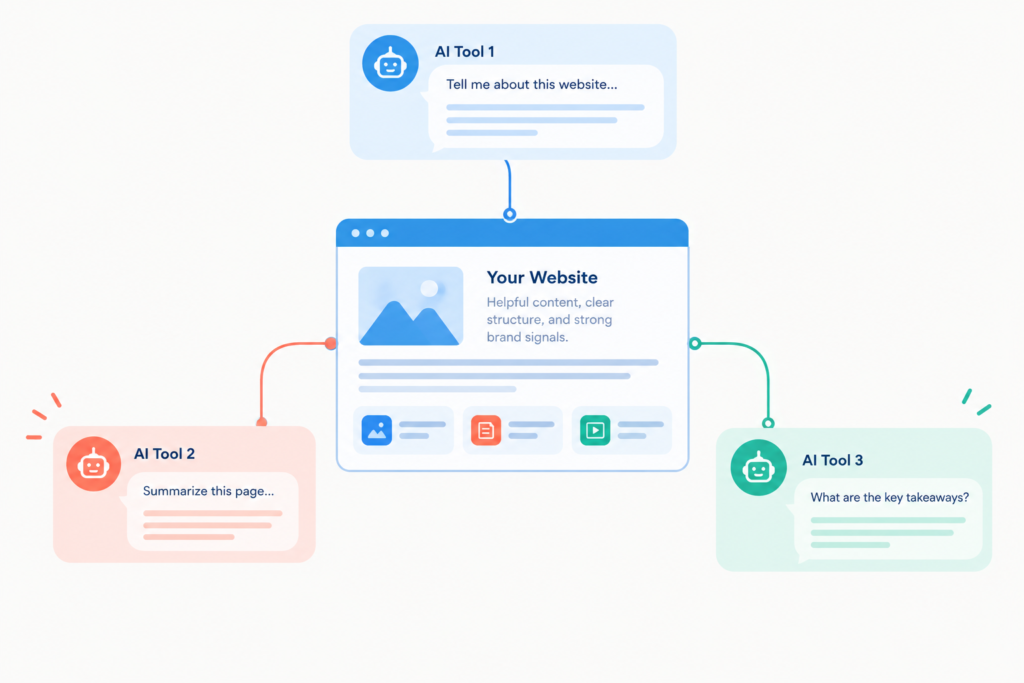
Search now has two kinds of results. One is the familiar list of links. The other is an AI-written answer that pulls from several sources and, in many tools, names a few of them. Customers move between both, and that has left many business owners asking a fair question: if AI tools are answering more of our customers’ questions, should we stop investing in SEO and switch to generative engine optimization (GEO)?
The short answer is no, but a slogan is not much help when you are deciding where to put your budget. SEO and GEO share most of their foundations. They differ in what they aim for, how they are measured, and which extra tasks they add. This guide compares them directly, shows what research and official documentation actually support, and gives you a way to decide which one your business needs first.
GEO vs SEO in short: SEO aims to rank pages in search results so people click through. GEO aims to make content easy for AI tools to retrieve and cite inside generated answers. They overlap heavily, and Google says that for its own AI features, optimizing is still SEO. Most businesses should build SEO foundations first, then add GEO measurement and credibility work.
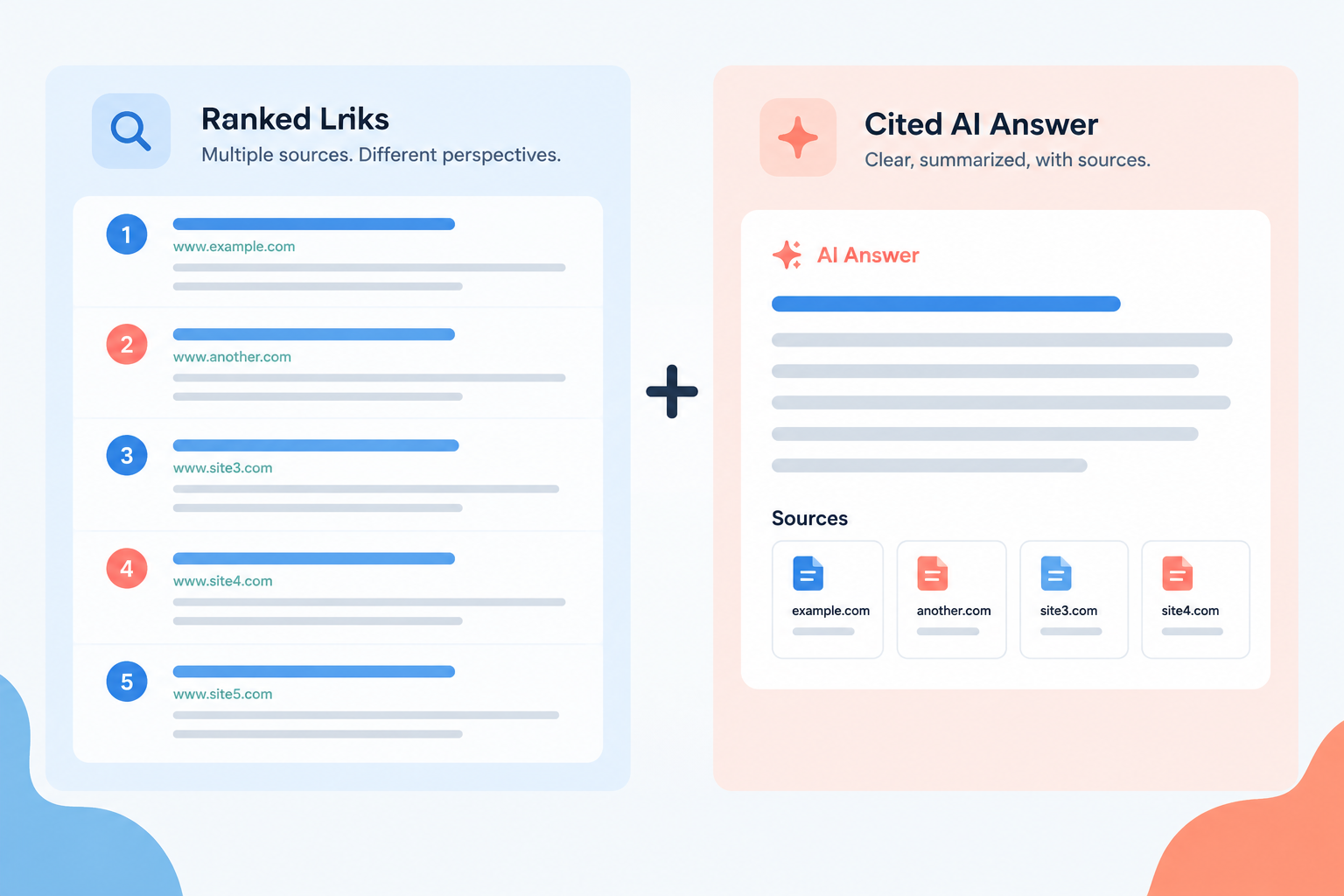
GEO vs SEO at a Glance
| Factor | SEO | GEO |
|---|---|---|
| Main goal | Rank pages and earn clicks | Be retrieved, cited, and described accurately in AI answers |
| Where success appears | Search results pages, snippets, local packs | AI Overviews, AI Mode, ChatGPT, Perplexity, Gemini, Copilot |
| Unit of visibility | A ranked link | A citation, a mention, or a recommendation |
| Core inputs | Technical health, helpful content, relevance, page experience | The same inputs, plus crawler access choices, evidence, and credibility signals |
| Main measures | Rankings, impressions, clicks, conversions | Citation rate, brand mentions, answer accuracy, AI referral traffic |
| Official guidance | Extensive and mature | Growing for Google, thinner for other platforms |
| Predictability | Moderate. Rankings are tracked daily. | Lower. Answers can change between runs. |
What Is SEO?
Search engine optimization is the work of helping search engines find, understand, and appropriately rank your pages, and helping people who arrive on them get what they came for. It covers technical foundations such as crawlability, indexing, and page experience, content that matches what people are searching for, and local or product information where it applies.
Its success measures are well established: rankings, impressions, click-through rate, organic traffic, and the conversions that follow. Google’s documentation on the subject is extensive, and tools like Search Console report directly on how your pages perform.
What Is Generative Engine Optimization?
Generative engine optimization is the practice of making your content easier for AI search tools to find, understand, and cite in generated answers. A generative engine is any search or answer tool that uses a large language model to gather information from multiple sources and write one combined response.
The term was introduced in a research paper accepted to ACM KDD 2024, which proposed GEO as a framework for improving content visibility in generative engine responses and reported gains of up to 40% in its experiments. You can read the paper on arXiv. Since then the label has spread widely. You will also see AEO (answer engine optimization), LLM SEO, and AI search optimization, which overlap heavily with GEO and are used inconsistently. For a deeper definition, see our guide to [generative engine optimization (link to the Digital Brand Rise pillar article)].
The Key Differences Between GEO and SEO
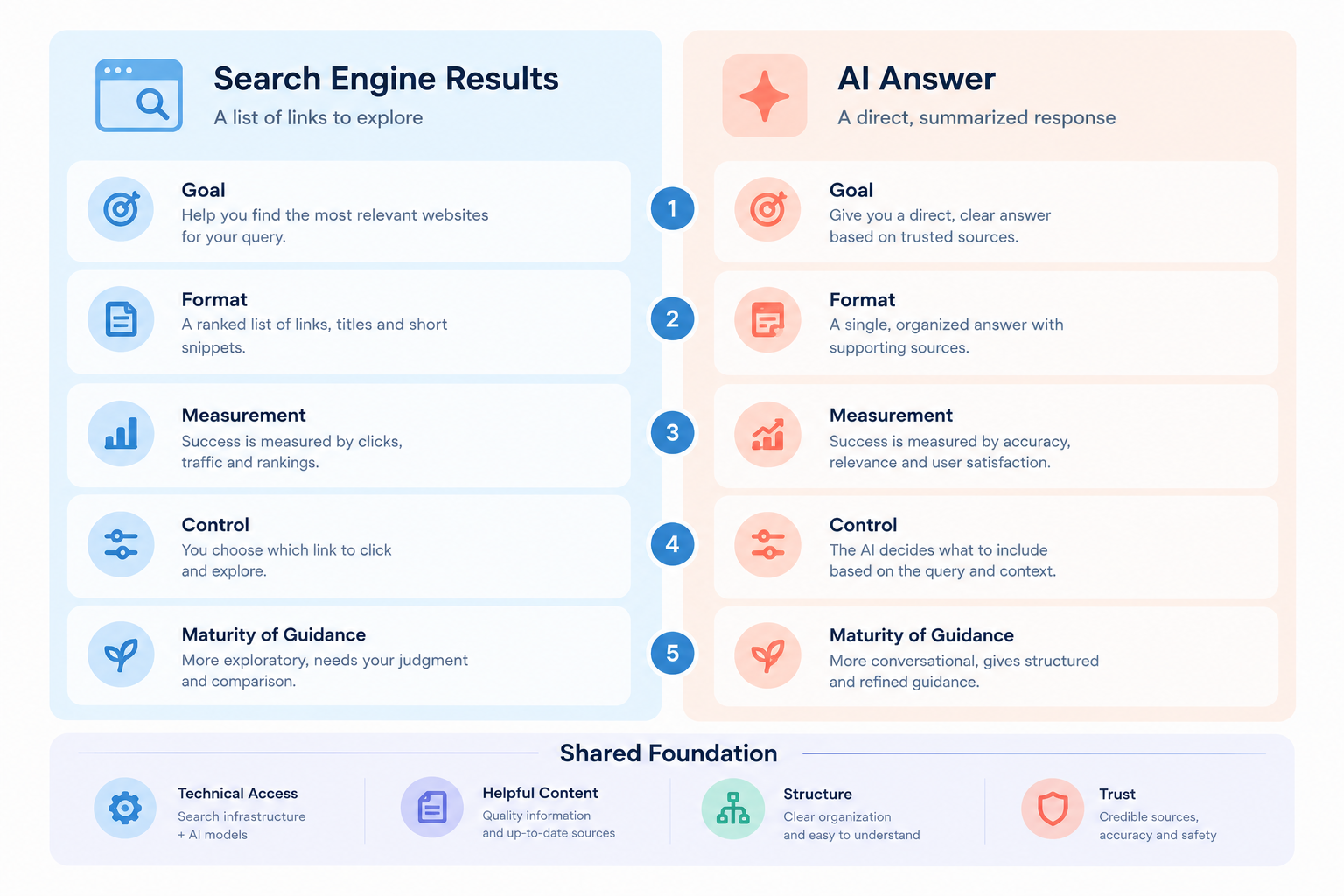
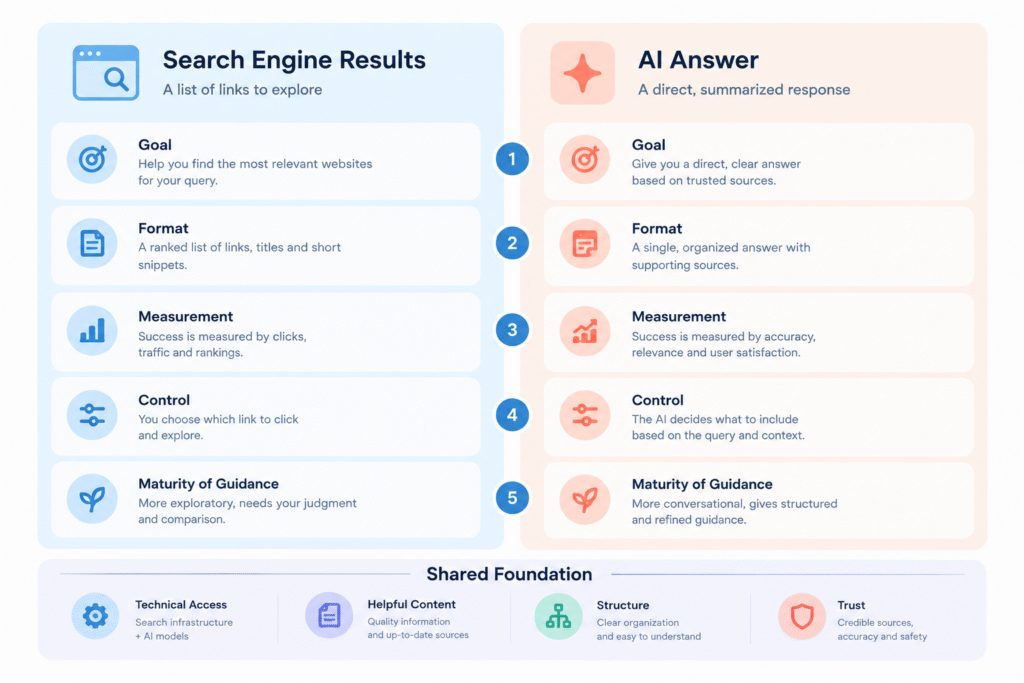
Five differences matter most when you are planning work and budget.
1. The goal: a click versus a citation
SEO is built around earning the click. Success means a page ranks and a person visits it. GEO is built around being included in the answer itself. Success may be a named citation, a mention of your brand, or a recommendation, and it may or may not produce a visit.
That changes how you judge a page. A page that ranks fifth but is cited in AI answers does one job well. A page that ranks first but is never used as a source does another. Neither metric alone tells the full story.
2. The format: a list versus a synthesis
A search results page shows options and lets the user choose. An AI answer makes the choice for them by combining material from multiple pages. Google describes two techniques behind its AI features: retrieval-augmented generation, where the system retrieves pages from its index to ground a response, and query fan-out, where the model issues several related searches to gather more material.
In practice, that means one customer question can trigger many retrieval steps. A thorough page that addresses the main question and its natural follow-ups has more chances of being useful at each step. Google also warns that creating separate pages for every variation primarily to manipulate rankings or AI responses violates its scaled content abuse policy, so the answer is depth on one page, not many thin pages.
3. The measurement: stable rankings versus variable answers
SEO has mature reporting. You can track a keyword’s position, see impressions and clicks in Search Console, and compare periods. GEO measurement is newer and less stable. AI answers can differ between two runs of the same prompt, vary by tool, and change as models and retrieval systems update.
Google offers a Generative AI performance report in Search Console for its own AI features. For other tools there is no equivalent universal report, so most teams run a recurring prompt audit and track trends rather than single results. Treat any tool that claims access to Google’s internal ranking or AI systems with skepticism. Google says no third-party tool has that access.
4. The control you have
In both cases, you do not control the outcome. Google states that indexing and serving are never guaranteed. Even for featured snippets, Google says site owners cannot mark a page to become one, and its systems decide whether a page makes a good featured snippet for a query. The same is true of AI citations. You can improve eligibility and usefulness, but no technique guarantees inclusion.
What you do control is access. OpenAI, for example, publishes separate crawlers for search and for model training, and says site owners can manage them independently in robots.txt. That kind of access decision is a GEO-specific task, and we cover it below.
5. The maturity of the guidance
SEO advice has two decades of official documentation, testing, and shared practice behind it. GEO advice is younger, and a lot of it comes from agencies and software vendors with something to sell. Google’s own guide, published in May 2026, includes a section on “AEO/GEO” misconceptions, and OpenAI and other platforms publish limited detail on how they select sources. The sensible response is to lean on official documentation first and treat everything else as a hypothesis to test.
What GEO and SEO Have in Common
The overlap is larger than most comparison articles admit, and it is the main reason “SEO first” is usually the right advice.
Google’s guide says SEO best practices continue to be relevant because its generative AI features are rooted in its core ranking and quality systems. Its AI features documentation adds that there are no additional requirements to appear in AI Overviews or AI Mode, and no other special optimizations necessary. From Google’s perspective, optimizing for generative AI search is optimizing for the search experience, and thus still SEO.
Both disciplines depend on the same foundations:
- Technical access. A page must be crawlable and indexed, and eligible to show with a snippet, to be shown in Google’s generative AI features.
- Helpful, people-first content. Google says unique, useful content will likely influence your presence in generative AI search more than any other suggestion in its guide.
- Clear structure. Descriptive headings, short paragraphs, and consistent terminology help human readers and systems that extract passages.
- Accurate business details. Google says Merchant Center and Business Profile information can help products and local services appear in AI responses and other results.
- Trust signals. Real authorship, named sources, and genuine reviews support credibility everywhere.
If a page fails on these basics, no GEO tactic will rescue it. That is why foundation work comes first in the decision framework later in this article.
What the Evidence Says About Changing Search Behavior
The case for adding GEO rests on one idea: people click less when an AI answer is present. There is some evidence for it, and it is worth reading precisely.
Pew Research Center studied the browsing behavior of 900 U.S. adults in March 2025, covering 68,879 unique Google searches, 12,593 of which produced an AI summary. Its published analysis found these differences:
| Measure (Pew, March 2025) | With an AI summary | Without an AI summary |
|---|---|---|
| Clicked a traditional result link | 8% of visits | 15% of visits |
| Clicked a link inside the AI summary | 1% of visits | Not applicable |
| Ended the browsing session after the page | 26% of pages | 16% of pages |
Read this carefully. It is a snapshot of U.S. adults on Google during one month in 2025. It measures behavior on pages where a summary appeared, not across all searches, and behavior has likely changed since. It also says nothing about your particular audience or topics.
Even so, the direction is useful. If your customers see AI summaries, then ranking alone may produce fewer visits than it used to, and being named inside the summary becomes worth tracking. Whether that matters for your business is an empirical question you can answer with your own Search Console and analytics data, which we cover in the measurement section.
What GEO Adds Beyond SEO
If the foundations are shared, what is actually new? Four tasks stand out. Each is small compared with a full SEO program, and each can be done without large budgets.
1. Crawler decisions
Different AI crawlers do different jobs, and you can allow or block them separately. OpenAI’s documentation describes the following:
| Crawler | Operator | Purpose |
|---|---|---|
| Googlebot | Search indexing, which Google AI features draw from | |
| OAI-SearchBot | OpenAI | Surfaces websites in ChatGPT search results |
| GPTBot | OpenAI | Training-related crawling, controlled separately from search |
| ChatGPT-User | OpenAI | Fetches pages when a user asks. robots.txt rules may not apply to user-initiated actions. |
OpenAI says a site can allow OAI-SearchBot to appear in ChatGPT search while disallowing GPTBot to signal that content should not be used for training, and that robots.txt changes can take about 24 hours to take effect for search. Review OpenAI’s crawler overview before editing your file. Crawlers from other vendors were not verified for this guide, so check their documentation directly.
For Google, the control works differently. Search Engine Land has reported that Google added a Search Console setting that lets sites opt out of its generative AI features, and that opted-out sites receive no traffic or impressions from them. Confirm the current setting for your property before changing anything.
2. Citation and mention monitoring
SEO has rank trackers. GEO has no equivalent standard. The practical alternative is a prompt audit: a list of 20 to 30 questions your customers might ask, run across the AI tools they use, with results logged each month. You record whether your brand is mentioned, whether your pages are cited, and which competitors appear.
3. Accuracy checks
An AI answer can describe your company wrongly, or fail to mention it at all. SEO rarely has to ask whether a result is accurate. GEO does. If an answer misstates your pricing, services, or location, the fix usually starts with making your own pages clearer and consistent, then strengthening trustworthy third-party coverage.
4. Evidence and credibility on the page
The original GEO research reported that adding statistics, quotations, and source citations tended to help visibility, according to secondary summaries, while keyword stuffing did not. The “up to 40%” figure is a ceiling from a research benchmark, not a forecast, and effectiveness varied by domain. Check the paper before quoting method-level results.
This is not in tension with Google’s advice. Named sources and real data make a page more credible to people too. The mistake is adding them mechanically to influence a model. Google’s guide also says you do not need to write in a special way for AI systems, because they understand synonyms and meaning.
Which One Does Your Business Need?
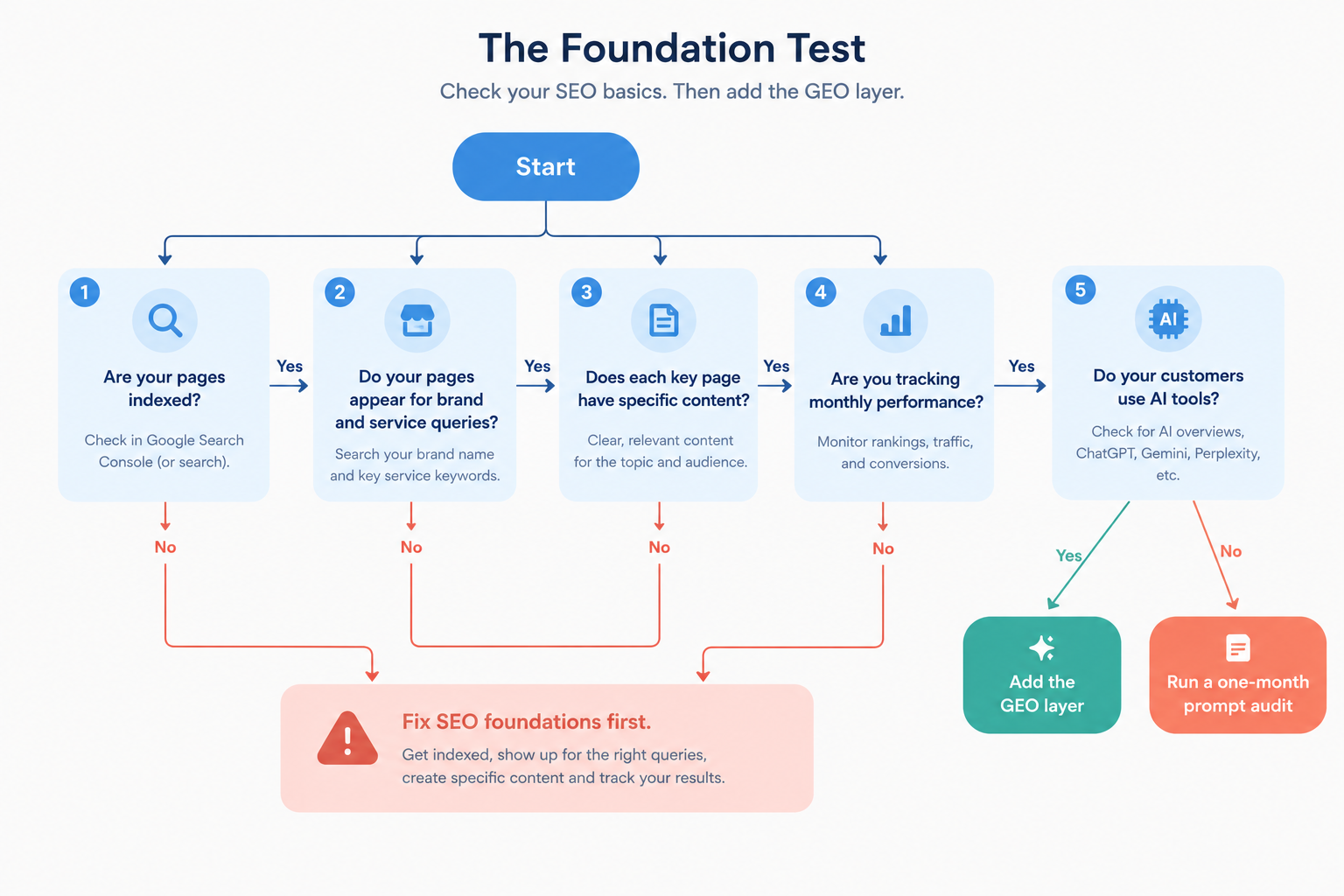
Use the foundation test below. It takes about half an hour and tells you whether to start with SEO, add GEO, or do both in parallel.
The foundation test
Answer these five questions honestly:
- Are your key pages indexed and eligible to show with a snippet? Check Search Console. If not, fix this before anything else.
- Do you appear for your brand name and your main service queries? If not, ordinary SEO is your biggest gap.
- Does each key page answer a real customer question with something specific to your business? Generic pages are what Google calls commodity content.
- Do you review Search Console and conversions at least monthly? Without a baseline, you cannot judge any new work.
- Do your customers use AI assistants when researching what you sell? Ask them on sales calls and in onboarding forms, and check your analytics for AI referrals.
How to read your answers
- “No” to any of questions 1 to 4: Start with SEO. A GEO program built on weak foundations is mostly wasted effort.
- “Yes” to 1 to 4 and “yes” to 5: Add the GEO layer now: crawler review, prompt audit, accuracy checks, and evidence-rich content updates.
- “Yes” to 1 to 4 and “unsure” on 5: Run a one-month prompt audit before committing budget. The result tells you whether AI answers are already shaping your market.
Recommended emphasis by business type
These are judgment-based recommendations, not measured figures. Your own data should override them.
| Business type | SEO priority | GEO priority | First GEO-related step |
|---|---|---|---|
| Local service business | High | Medium | Accurate Google Business Profile, plus one strong page per core service with real pricing context |
| Ecommerce store | High | Medium to high | Clean product data and Merchant Center feeds, plus honest comparison and buying-guide content |
| B2B services or software | High | High | Prompt audit for category and comparison questions, plus original data and expert-led pages |
| Publisher or blog | High | High | Crawler policy decision, plus a clear stance on attribution and licensing |
| Agency or consultancy | High | High | Shared prompt library and reporting that separates Google AI features from other tools |
SEO priority is high for every row for a reason. The shared foundations carry both. The difference is how much extra GEO work is justified once those foundations are in place.
When SEO alone is enough for now
Some businesses can reasonably hold off on dedicated GEO work. If your customers rarely research through AI assistants, if your Search Console data shows steady clicks, and if your sales calls never mention AI tools, the shared foundations already cover most of what matters. A light check each quarter is enough: confirm crawler settings, run a short prompt audit, and make sure nothing in your robots.txt blocks a search crawler by accident.
When GEO deserves more attention now
Other situations call for earlier investment. Your category may involve long research, comparisons, or expert advice, which are the kinds of questions people increasingly put to AI tools. Your clicks may be falling while impressions hold steady. Competitors may be named in AI answers when you are not. Or customers may tell you they found you through an assistant. In any of these cases, a structured prompt audit and a round of evidence-rich page updates are worth prioritizing, while the SEO foundations stay in place.
A Practical 90-Day Plan for Doing Both
This plan assumes a small team and no large budget. Adjust the pace to your capacity.
Days 1 to 30: Foundation and baseline
- Verify indexing and snippet eligibility for your top 20 pages in Search Console.
- Review robots.txt and firewall settings so you do not block search crawlers you want. Decide your policy on training crawlers.
- Write your prompt list of 20 to 30 customer questions and run the first audit. Record results in a simple log.
- Record baseline Search Console clicks and impressions, and your conversion numbers.
- Check your Google Business Profile and any product feeds for accuracy.
Days 31 to 60: Improve the pages that matter
- Rank your top 10 customer questions by business value. Assign each to one strong page.
- Rewrite weak pages to lead with a direct answer, then add specifics, examples, and limits.
- Add named sources, dates, and author details where claims need support.
- Add original visuals, such as a diagram or checklist, with accurate alt text.
- Fix any inaccuracies found in the audit by clarifying your own pages first.
Days 61 to 90: Measure and decide
- Rerun the prompt audit and compare it with the baseline.
- Review the Search Console Generative AI performance report for Google’s AI features.
- Check analytics for traffic from AI platforms, building your referrer list from what actually appears in your data.
- Decide where to invest next: more SEO, more GEO, or more conversion work, based on what the data shows.
How to Evaluate GEO Services and Advice
GEO is a young field, and the gap between solid advice and sales language is wide. Google’s guide tells site owners to review its guidance on evaluating third-party SEO advice before acting on “AEO” or “GEO” services. These questions help:
- Do they promise citations or rankings? Nobody can guarantee inclusion in AI answers. Walk away from guarantees.
- Is the main deliverable an llms.txt file or special markup? Google says Google Search does not use these files, and no verified evidence of a benefit was found for this guide.
- Do they claim access to internal Google metrics? Google says no third-party tool has access to its internal ranking or AI systems.
- Do they plan to publish many near-duplicate pages? Google says producing pages primarily to manipulate rankings or AI responses violates its scaled content abuse policy.
- Do they separate Google’s AI features from other platforms in reporting? Honest reporting acknowledges that behavior differs by tool.
- Can they show their method? Look for named sources, a clear audit process, and baselines before and after.
Common Mistakes When Choosing Between GEO and SEO
Treating it as either-or. The foundations are shared, so abandoning SEO weakens GEO too.
Chasing hacks. Google’s guide says you can ignore llms.txt files, chunking content into tiny pieces, rewriting purely for AI, and seeking inauthentic mentions, at least for Google Search.
Skipping the baseline. Without a starting point, no result can be interpreted.
Blocking every bot. A blanket rule can stop search crawlers you want, such as OAI-SearchBot.
Reporting mentions without checking accuracy. Being named wrongly is not a win.
Publishing AI-generated filler. Google says content created with generative AI tools must still meet its Search Essentials and spam policies.
Assuming one platform speaks for all. Google’s guidance covers Google. Other tools have their own crawlers, retrieval systems, and habits.
How to Measure GEO and SEO Together
Report both on one page so the team does not treat them as rival programs. Google also notes that sites appearing in AI features are included in overall search traffic in Search Console, so your SEO reports already contain some AI-feature activity.
| Question | SEO measure | GEO measure |
|---|---|---|
| Can systems find our pages? | Indexed pages, crawl errors | Crawler access policy, server log checks |
| Are we visible? | Impressions, average position | Prompt audit mentions and citations |
| Are we chosen? | Click-through rate, organic clicks | Citation rate, AI referral sessions |
| Are we accurate? | Snippet and title review | Answer accuracy log |
| Is it paying off? | Conversions from organic traffic | Conversions from AI referrals, assisted brand searches |
A simple citation rate is prompts where your pages were cited divided by prompts tested. This is a suggested internal metric, not an industry standard, and it is only meaningful as a trend because answers vary between runs.
Microsoft has also reportedly been testing an AI Performance report in Bing Webmaster Tools that shows Copilot citations. It was described as a limited beta in January 2026, so verify its current availability in your own account.
Who Should Own GEO and SEO Inside Your Team
One of the quieter risks is organizational. If SEO belongs to one person and “AI search” to another, the two programs can pull in different directions, with duplicate pages, conflicting messaging, and separate reports. A single owner for both, or at least a shared reporting page, avoids that.
- Solo owner or very small team: Treat GEO as a monthly checklist inside your existing SEO routine. The prompt audit and crawler review are small tasks, not a separate program.
- In-house marketing team: Name one lead for search and AI visibility. Give subject experts a clear path to contribute first-hand knowledge, since that is what makes content non-commodity.
- Agency or consultancy: Keep one shared prompt library and one reporting template across clients, and keep the reporting honest about what is measured and what is inferred.
Whatever the setup, involve the people who know the subject. Google’s guide stresses that unique, experience-based content stands out, and that cannot be produced by a process alone. Customer-facing staff, product specialists, and founders usually hold the details that make a page worth citing.
Worked Example (Illustrative)
This is a hypothetical scenario, not a client case study.
A regional heating and cooling company has a 15-page website and gets most of its leads from Google. The owner has read that “SEO is dead” and wants to move budget to GEO.
The team runs the foundation test. Indexing is fine, and the company appears for its brand name. But it does not appear for its main service queries in nearby towns, its service pages are generic, and nobody reviews Search Console. That is a “no” on questions 2, 3, and 4.
The recommendation follows the framework: start with SEO. The team rewrites the service pages around real questions, such as repair costs and replacement timing, adds named sources for any regulatory points, and updates the Google Business Profile. In parallel, it spends one afternoon on a 20-prompt audit to see whether AI tools mention local providers at all.
No outcome is promised. The point is the order of decisions: fix what the shared foundations require, add a low-cost GEO baseline, and let the data decide the next investment.
Frequently Asked Questions
What is the difference between GEO and SEO?
SEO aims to rank pages in search results and earn clicks. GEO aims to make content easy for AI tools to retrieve, cite, and describe accurately in generated answers. They share most foundations, but differ in goals, measurement, and a few extra tasks such as crawler decisions and prompt audits.
Is GEO replacing SEO?
No evidence supports that. Google says optimizing for its generative AI features is still SEO, and AI answers draw on content that search systems retrieve. GEO is better understood as an added layer on top of SEO than a replacement.
Do I need GEO if I already do SEO?
Maybe a little. Strong SEO covers most of what Google’s AI features need. GEO adds crawler decisions, citation monitoring, and accuracy checks. Run a short prompt audit to see whether AI answers already influence your market before adding budget.
Which should a small business prioritize?
SEO first, in almost every case. Make sure key pages are indexed, accurate, and genuinely useful, and keep your Business Profile current. Then add low-cost GEO steps such as a monthly prompt audit and a review of crawler settings.
What is the difference between GEO and AEO?
AEO focuses on being the direct answer to a question, including snippets and voice results. GEO focuses on being cited in AI-generated responses. Practitioners use the terms loosely, and the underlying tactics largely overlap.
How do I measure GEO compared with SEO?
SEO uses rankings, impressions, clicks, and conversions. GEO uses a monthly prompt audit, a simple citation rate, answer accuracy, and AI referral traffic. For Google, the Search Console Generative AI performance report adds direct data.
Can GEO guarantee my brand appears in AI answers?
No. No technique can guarantee inclusion in AI Overviews, ChatGPT, or other tools. You can improve eligibility, usefulness, and credibility, then measure your own results. Be cautious of any provider promising guaranteed citations.
How much should I spend on GEO?
There is no verified benchmark. A sensible start is staff time, not a large budget: a baseline audit, crawler review, and page improvements you would want for SEO anyway. Increase spend only if your own data shows AI answers shaping demand.
Conclusion
GEO and SEO are not rivals. SEO is the foundation that makes your content accessible, useful, and trusted. GEO is an added layer that asks whether AI tools can use that content and whether they describe your business correctly. Which one your business needs first depends on your foundations, and for most businesses the honest answer is SEO, followed by a measured, low-cost GEO layer.
Start with the foundation test, run a baseline prompt audit, and let your own data decide the next step. That approach is cheap, reversible, and consistent with what Google’s guidance says matters most: content that people find unique, compelling, and useful.