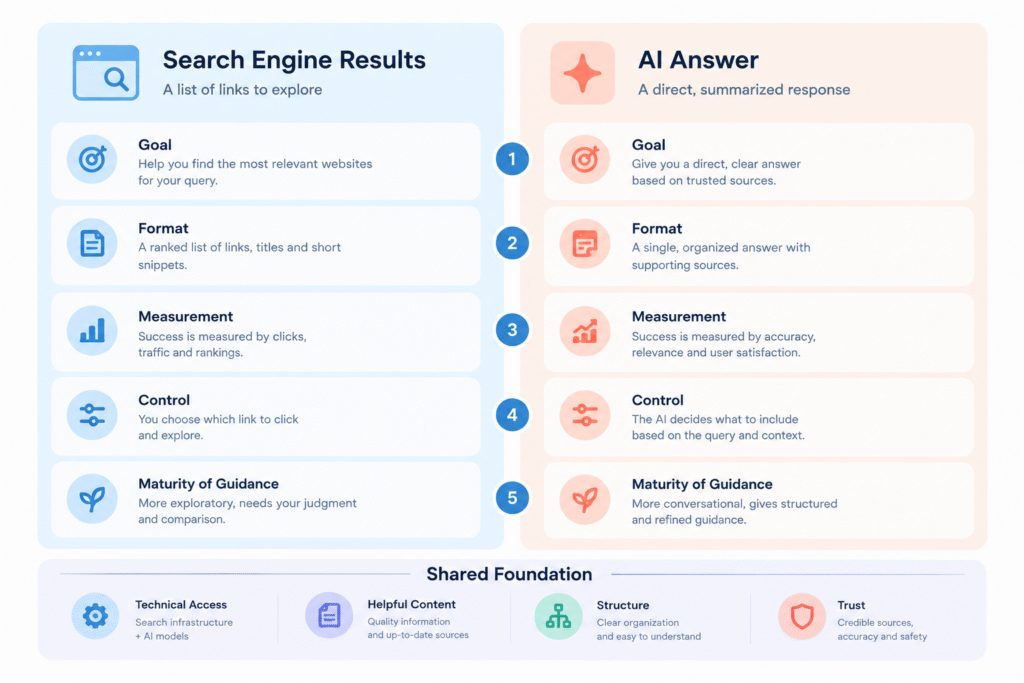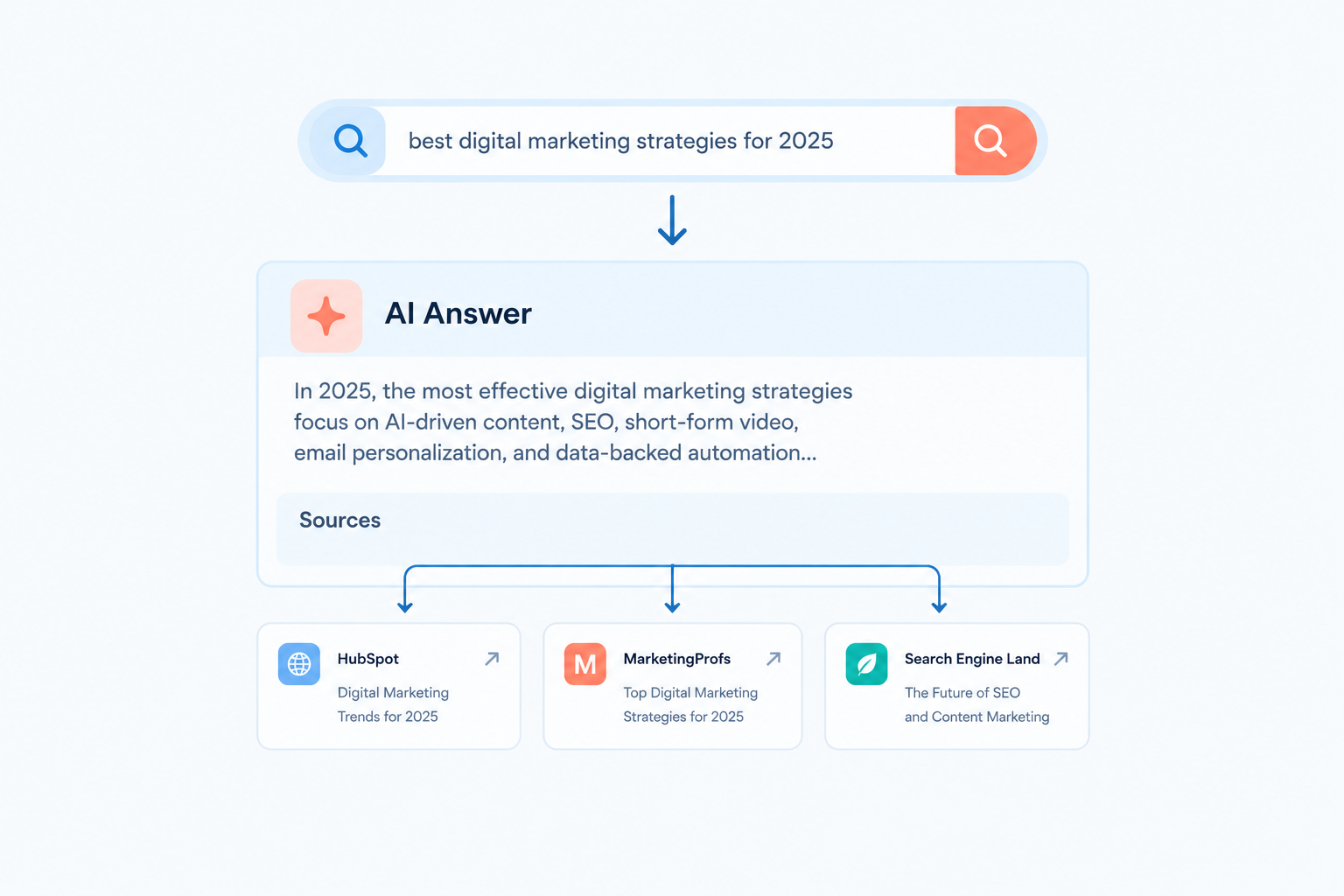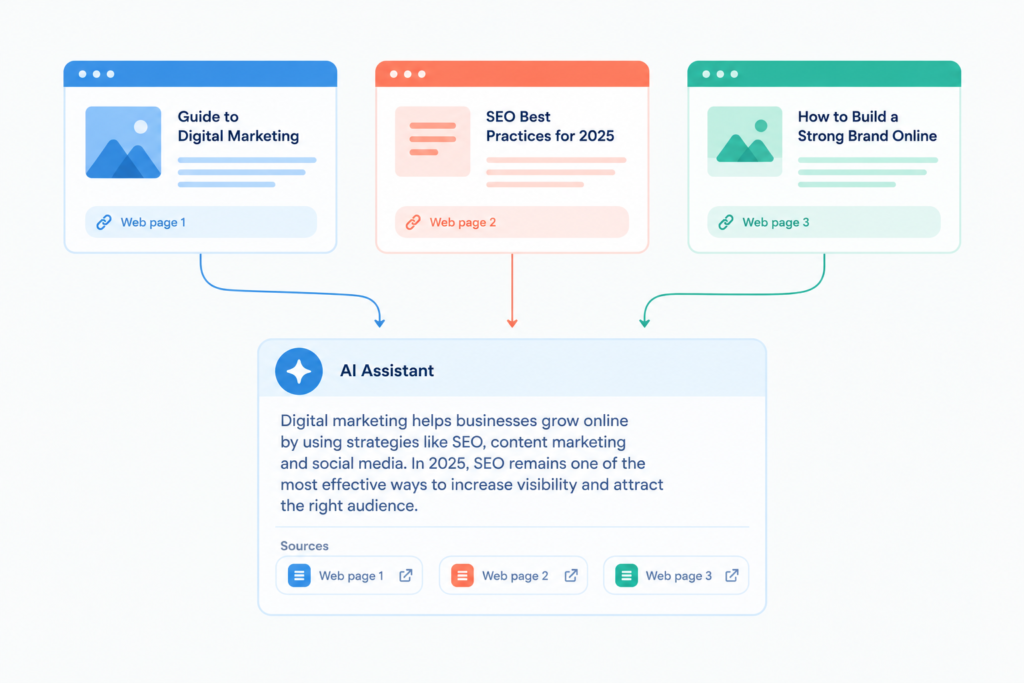
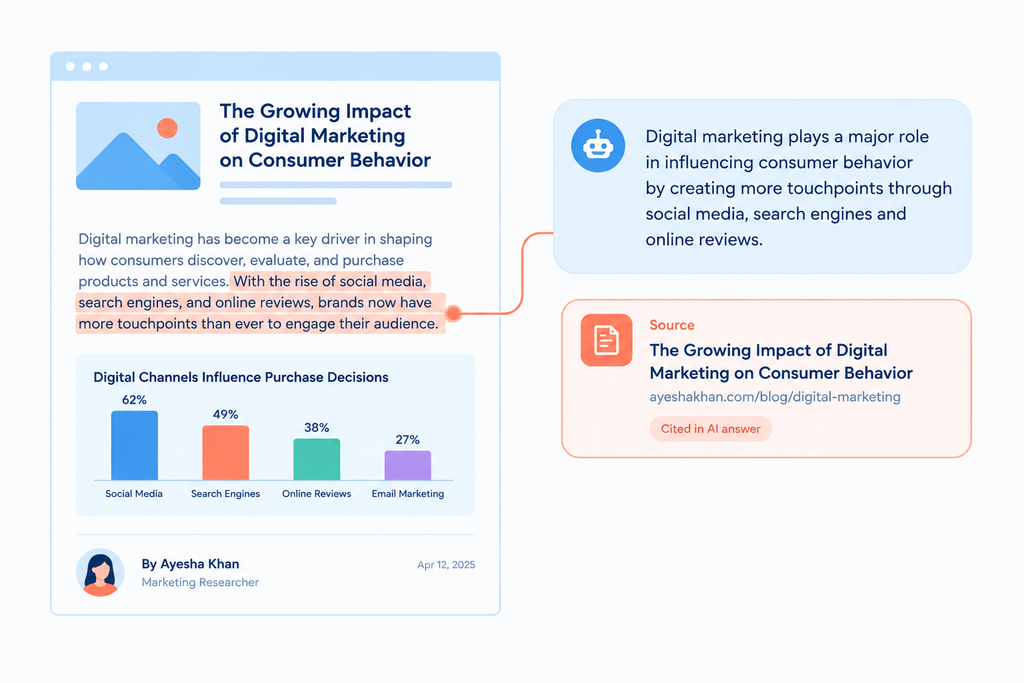
When an AI search tool answers a question, it often shows a handful of sources. Most pages never appear there. The ones that do tend to share a few traits: they are easy to retrieve, they contain a clear and specific answer, and they give the system a reason to trust them.
You cannot control whether a particular tool cites you, and nobody can promise that. But you can control the page. This guide explains how to create content that gets cited by AI search engines, using what the original research found, what Google documents about helpful content, and a step-by-step writing workflow with examples you can adapt.
Content that gets cited by AI search engines is retrievable, specific, and trustworthy. Make the page crawlable, open each section with a direct answer, back claims with original data and named sources, show who wrote it and how, and keep it accurate. Research suggests evidence helps and keyword stuffing does not. Nothing guarantees a citation.
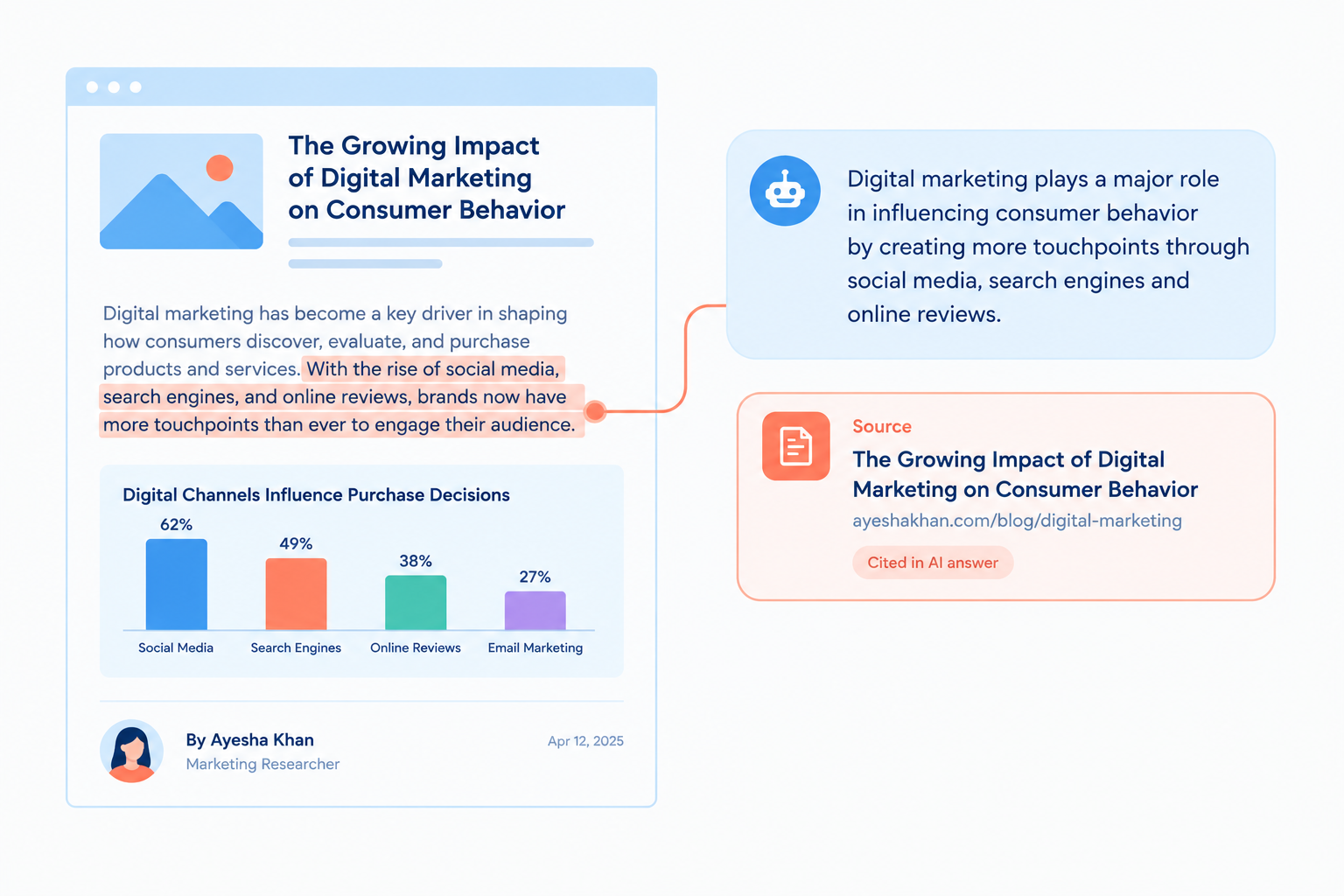
What “Getting Cited” Actually Means
A citation is a link or source reference that an AI tool shows alongside its answer. Google describes its generative AI features as showing prominent, clickable links to web pages that support the response, and OpenAI describes ChatGPT search as surfacing websites in summaries and snippets. A citation is different from a mention of your brand, which can happen without any link.
That distinction shapes how you write. To earn a citation, a specific page has to support a specific claim in the answer. A vague, general page rarely does that well.
The Three Gates: How Content Becomes Citable
No platform publishes its full selection logic, so any model of this process is a simplification. This three-gate model is a practical way to organize what is known. It is a planning aid, not an official standard.
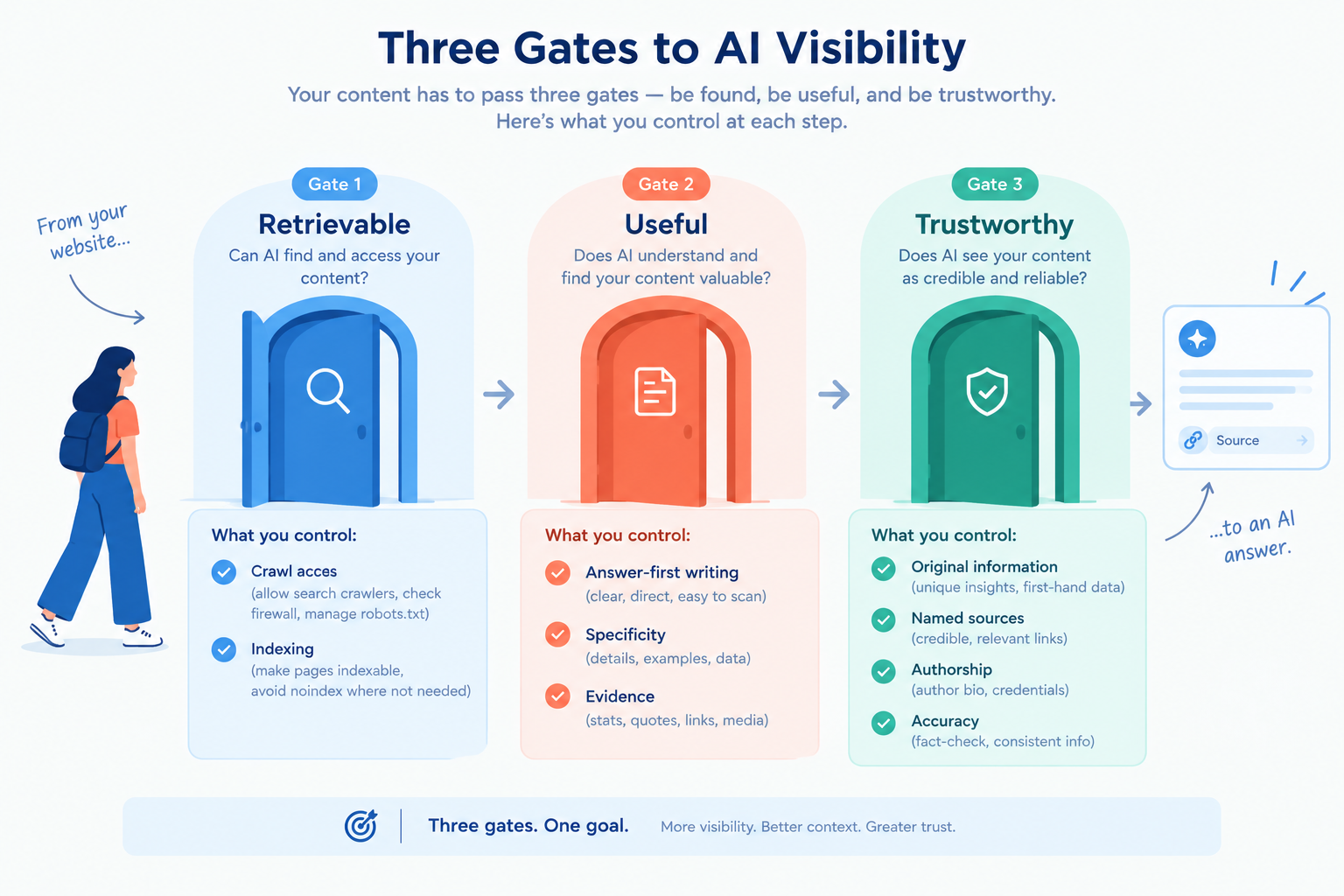
| Gate | Question | What you control | Source of guidance |
|---|---|---|---|
| 1. Retrievable | Can the system find and read the page? | Crawl access, indexing, rendering, internal links | Google and OpenAI documentation |
| 2. Useful | Does a passage clearly support the claim being made? | Answer-first writing, specificity, evidence, structure | The GEO paper and Google guidance |
| 3. Trustworthy | Is there a reason to rely on this page? | Original information, named sources, authorship, accuracy | Google’s helpful content guidance |
A page that fails Gate 1 is invisible no matter how good it is. A page that passes Gate 1 but is generic fails Gate 2. A page that is clear but unreliable fails Gate 3. Most of this guide concerns Gates 2 and 3, since they are about content, but Gate 1 deserves a quick note.
Gate 1 in brief
Google says a page must be indexed and eligible to be shown in Search with a snippet to appear in its generative AI features, and OpenAI says to allow OAI-SearchBot so content can be included in summaries and snippets. Google also says it does not require special files or markup for AI features. For the technical details, see our guide to optimizing your website for ChatGPT, Gemini and AI search.
What the Research Found
The most cited academic work on this subject is the paper that introduced generative engine optimization, accepted to KDD 2024. It is worth understanding in some detail, because it is often quoted loosely.
How the study worked
The authors built GEO-bench, a benchmark of 10,000 queries across 25 domains, and tested nine content modification methods. Each method rewrote one source for a query, and the authors measured how visible that source became in the generated answer. They evaluated on a custom generative engine built on gpt-3.5-turbo over the top five Google results, and also tested a subset on Perplexity.ai. The paper is on arXiv.
What each method did
| Method | Reported change in visibility (position-adjusted word count) |
|---|---|
| Quotation Addition | About +41% |
| Statistics Addition | About +31% |
| Fluency Optimization | About +28% |
| Cite Sources | About +28% |
| Technical Terms | About +18% |
| Easy-to-Understand | About +14% |
| Authoritative tone | About +10% |
| Unique Words | About +6% |
| Keyword Stuffing | About -8% (worse than the baseline) |
These figures come from a reading of the paper’s main results and should be checked against the paper before you quote them. The abstract summarizes the headline as a boost of up to 40%.
What it suggests
- Evidence-style additions did best. Adding relevant quotations, statistics, and source citations performed at or near the top.
- Readable writing helped. Fluency optimization also showed gains.
- Keyword stuffing hurt. It performed worse than leaving the content alone, including in the Perplexity.ai test.
- Lower-ranked pages gained more. In the reported results, sources ranked fifth gained substantially while the top-ranked source lost visibility for some methods. The authors argue this could help smaller creators compete.
- Effectiveness varied by domain, according to the authors.
What it does not prove
The study has real limits, and the authors list several of them:
- Only two engines were tested, and methods may need to change as engines evolve.
- The main engine was a research setup based on gpt-3.5-turbo, not a production system.
- Queries change over time, so the benchmark needs continuous updates.
- The authors did not measure effects on search rankings.
- Some tags in the benchmark were generated by an AI model and may be noisy.
There is also a practical limit. The experiment edited existing sources. It did not test whether inventing a quote or inflating a statistic is wise, and doing so would be dishonest and risky. The sensible reading is that content with real, attributable evidence is more useful to a retrieval system, which is also what it is for a human reader. Treat the “up to 40%” result as a research ceiling, not a forecast for your site.
What Google Says Makes Content Worth Surfacing
Google’s guidance is not specific to citations, but it is the clearest official statement of what its systems are built to reward. Its generative AI guide says that creating content people find unique, compelling, and useful will likely influence your presence in generative AI search more than any other suggestion in the guide.
Non-commodity content
Google contrasts commodity content, which is based on common knowledge that could come from anyone, with non-commodity content that offers a unique expert or experienced view. Its example of commodity content is a generic tips list, and its example of non-commodity content is a first-hand account with specific lessons. A summary of existing material, Google says, restates what is already available elsewhere.
For citation purposes, this matters in a practical way. If your page says what ten other pages say, a retrieval system has no reason to prefer yours. If your page contains something the others lack, such as your own data, a documented process, or a clear expert judgment, it has a reason.
Who, how, and why
Google’s guidance on creating helpful, reliable, people-first content offers three questions:
- Who created this? Make authorship self-evident, with a clear byline and background, and never invent creator profiles.
- How was it created? Explain how the content was produced where readers would care, such as the products tested and the method used, and disclose automation or AI use where readers would expect it.
- Why was it created? Google calls this perhaps the most important question, and says the answer should be that you are creating content primarily to help people.
Questions to ask of your own page
The same guidance lists quality questions that work well as an editing checklist. Does the content provide original information, reporting, research, or analysis? Does it go beyond the obvious rather than copying or rewording other sources? Does it show clear sourcing and evidence of expertise? Is it free of easily verified factual errors? Would you bookmark it or share it?
Google also names warning signs of search-first content, including producing lots of content on many topics in hopes some will rank, mainly summarizing others’ work without adding value, and changing page dates to look fresh without substantive updates. Google says E-E-A-T is not itself a ranking factor, and that of its components, trust is the most important.
A Writing Workflow for Citable Content
The workflow below applies to a single article. It builds the three gates into the process rather than treating them as a final checklist.
Step 1: Choose questions where you have something to add
Not every topic deserves a page. Before writing, apply an information-gain test. A topic is worth a page if you can answer yes to at least two of these:
- Do we have first-hand experience? Have we done the thing, run the project, or served the customers?
- Do we have data? Customer questions, project timings, survey results, or test outcomes that others lack.
- Do we have a clear point of view? A reasoned stance that differs from the generic advice.
- Can we access an expert? Someone qualified who can be named and quoted with permission.
If the answer is no to all four, you are about to write commodity content. Either find an angle, assign a subject expert, or skip the topic and put the effort elsewhere.
Step 2: Gather original material before drafting
Collect the raw material first. Writing from a blank page leads to generic prose. Useful inputs include:
- Notes from sales calls, support tickets, and customer interviews.
- Your own numbers, with the method and date noted.
- Interviews with named experts, recorded or written with permission to quote.
- Primary sources, such as official documentation, standards, and original studies, rather than other blogs’ summaries of them.
- Photographs, screenshots, and diagrams that you create yourself, where accurate and appropriate.
Step 3: Outline around the main question and its follow-ups
Google says its AI features may use query fan-out, issuing multiple related searches to gather material. A page that answers the main question and its natural follow-ups gives a system more to work with. List the main question, then the five or six questions a reader would ask next, and let those become your headings.
Keep this to a single page. Google says producing separate pages for each variation primarily to manipulate rankings or AI responses violates its scaled content abuse policy. It also says there is no ideal page length, so let the topic decide.
Step 4: Write answer-first, specific, and plain
Open each section with a direct answer, then support it. This helps readers scanning on a phone, and gives any system extracting a passage a clean unit. At the sentence level, follow these rules:
- One claim per sentence, with the subject named. Avoid “it” and “this” when the referent is unclear, since a passage may be read without the sentences around it.
- Define terms before using them, and use the same term throughout.
- Prefer specifics to adjectives. Replace “fast” and “affordable” with a number, a range, or a condition.
- Attach units, dates, and conditions to every figure, so the claim is complete on its own.
- State limits and exceptions. A claim with honest boundaries is more reliable than an absolute one.
The difference is easiest to see in practice. These examples are illustrative.
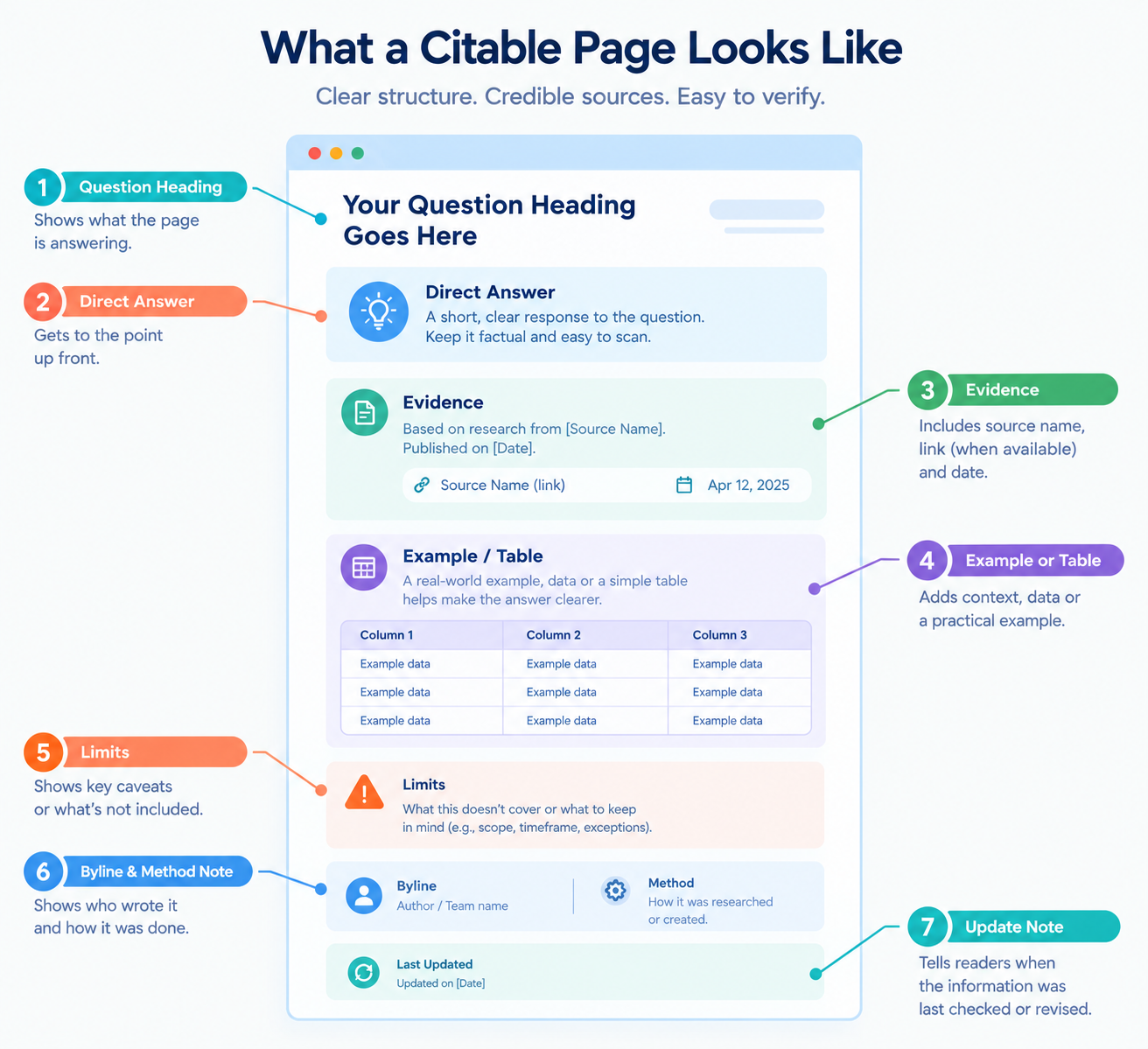
| Weak passage | Citable passage |
|---|---|
| Our approach is fast and affordable, and it works for most businesses. Contact us to learn more. | A typical audit of a 50-page site takes [add your real timeframe] and covers indexing, crawl access, and content gaps. Cost depends on site size and the number of templates reviewed. [Add your real price range and what it includes.] |
| Studies show that this tactic is very effective. | In the GEO research, adding statistics increased a source’s visibility by about 31% on the authors’ main metric, in a test using one research engine. Results varied by domain. |
Google says there is no need to break content into tiny pieces or write in a special way for AI systems. The point of clear passages is better writing, not a trick.
Step 5: Add evidence honestly
The research suggests that quotations, statistics, and citations help. How you add them matters as much as whether you do.
| Evidence type | Do | Do not |
|---|---|---|
| Statistics | Name the source, date, and method. Say whether it is your data or someone else’s. Link to the primary source. | Invent figures, round up for effect, or cite a stat you cannot trace. |
| Quotations | Quote real people who agreed to be quoted, with name and role. Keep the wording accurate. | Fabricate quotes or attribute invented words to real or imaginary experts. |
| Citations | Link to primary sources, such as official documentation or original studies, in the sentence that depends on them. | Cite a source that does not support the claim, or link only to other summaries. |
| Original data | Explain the method, sample, and limits. Publish the figures in text and in a table. | Present a small, informal sample as a definitive study. |
| Examples | Label hypothetical examples as hypothetical. | Present invented case studies or testimonials as real. |
If you cannot supply real evidence, say less. A modest, well-supported claim is better than a bold, unsupported one, for readers and for any system deciding what to rely on.
Step 6: Show who wrote it and how
Add the signals Google’s who-how-why framework describes:
- A real byline linking to a short author page with verifiable background.
- A line on method where it helps readers: how you tested, surveyed, or researched.
- A reviewer note where a specialist checked the content, with their name and role.
- Disclosure of automation or AI assistance where readers would expect it. Google suggests automatically generated content can include information about how it was created.
- A dated update note describing what changed, whenever you revise.
Read our complete guide on How to Get Your Brand Mentioned in ChatGPT and Other AI Search Engines
Step 7: Support the text with visuals and tables
Google says supporting text with high-quality images and videos can create more opportunities to appear beyond a web page link. Tables suit comparisons and specifications, and original diagrams suit processes. Give images descriptive alt text and file names, and make sure every key fact in a visual also appears in the page text.
Step 8: Fact-check and edit
Check every number, name, date, and link. This applies with extra force if you used AI tools in drafting. Google stresses that generative models do not retrieve facts, so outputs can contain hallucinations, and says it is critical to manually fact-check and review AI-generated content before publishing.
- Trace each statistic to its primary source and confirm the figure and date.
- Confirm every quotation with the person quoted.
- Open every link and confirm it supports the sentence it sits in.
- Re-read each section opening as a standalone passage. Does it still make sense?
- Check titles, meta descriptions, and alt text for accuracy, since Google says review should extend to those as well.
Step 9: Publish so systems can reach it
Confirm the page is indexable, not blocked by robots.txt or a firewall, and linked from other relevant pages on your site. Google lists making content easily findable through internal links as a technical point for its AI features. Add structured data only where it accurately matches the visible text, as part of ordinary SEO, since Google says there is no special markup required for generative AI search.
Step 10: Maintain it
Update pages when facts, products, or guidance change, and say what changed. Google lists changing page dates to appear fresh without substantive updates as a warning sign of search-first content. A short log of changes at the bottom of a page is both honest and useful.
Formats That Tend to Earn Citations
No format guarantees a citation, but some suit the way answers are assembled. This table is judgment-based, reasoned from the research and Google’s guidance, not a measured ranking.
| Format | Why it can work | Watch out for |
|---|---|---|
| Original research or survey | Contains data others cannot supply, and gives them something to cite | Weak method or tiny samples presented as definitive |
| Expert Q and A or interviews | Brings a named, qualified voice | Unverifiable credentials or invented quotes |
| Definition and explainer pages | Direct answers to “what is” questions | Copying the same definition everyone else uses |
| Comparison pages | Tables and trade-offs answer “which one” questions | Hiding drawbacks or omitting competitors unfairly |
| How-to guides | Numbered steps are easy to extract and verify | Skipping prerequisites and common errors |
| Pricing and policy pages | State facts plainly where answers need them | Vague wording that avoids real figures |
| Case studies with evidence | Show real results and methods | Unprovable claims, or results presented without context |
| Generic listicles and roundups | Easy to produce | This is the commodity content Google describes. It rarely gives a reason to cite you. |
Using AI Tools to Help Write Citable Content
Google’s guidance on generative AI content says AI can be useful when researching a topic and to add structure to original content, and that content created with it must still meet Search Essentials and spam policies. Using AI tools to generate many pages without adding value for users may violate its scaled content abuse policy.
A responsible approach looks like this:
- Use AI for structure and drafting help, not for facts. Supply your own data, quotes, and sources, and verify every claim.
- Add what a model cannot: first-hand experience, proprietary data, and expert judgment.
- Review by a person who knows the topic, and name that person where appropriate.
- Disclose AI assistance where readers would expect it.
- Do not scale output for its own sake. A high quantity of pages does not make a site higher quality.
If an AI tool could produce your page from a one-line prompt, assume that a retrieval system can find ten pages like it. Original material is what differentiates it.
Pre-Publish Checklist
| Gate | Check |
|---|---|
| Retrievable | Indexable, snippet-eligible, not blocked by robots.txt or firewall, key text present in the rendered page, linked internally |
| Useful | Each section opens with a direct answer; claims are specific; terms are defined; figures have units, dates, and conditions |
| Useful | Tables or diagrams used where they clarify; images have descriptive alt text |
| Trustworthy | At least one element only you can supply: data, first-hand experience, expert input, or a documented process |
| Trustworthy | Statistics traced to primary sources; quotes verified; links support their sentences |
| Trustworthy | Byline, author background, method note, and update note present |
| Trustworthy | AI assistance disclosed where expected; all content fact-checked by a person |
| All | Page added to your prompt audit and Search Console review list |
How to Tell Whether Your Content Is Being Cited
Measure at the page level so you can learn which content works. The details are in our guide to tracking your website visibility in AI search.
- Prompt audit: for each new page, write two or three prompts a reader would ask, run them monthly, and note whether the page is cited.
- Search Console: check the Generative AI performance report for impressions by page in Google’s AI features.
- Analytics: watch AI referral visits and landing pages, remembering that some traffic is misclassified.
- Notes: record when you publish or revise a page, so changes can be linked to actions.
Answers vary between runs, so look for trends over several months rather than reacting to one result.
Common Mistakes
- Inventing evidence. Fabricated quotes and statistics are dishonest and damage trust if discovered.
- Stuffing keywords. In the GEO research, keyword stuffing performed worse than the baseline.
- Writing commodity content. A page that repeats common knowledge gives no reason to be chosen.
- Burying the answer. A long preamble before the point forces readers and systems to dig.
- Using vague claims. “Industry-leading” and “best-in-class” cannot be checked or cited.
- Refreshing dates without changes. Google lists this as a warning sign.
- Mass-producing near-duplicates. Google says producing pages primarily to manipulate rankings or AI responses violates its scaled content abuse policy.
- Chasing format tricks. Google says chunking content into tiny pieces and special files such as llms.txt are unnecessary for Google Search.
- Forgetting access. The best page is useless if crawlers cannot reach it.
- Expecting guarantees. No technique ensures that any tool will cite a page.
Worked Example (Illustrative)
This is a hypothetical scenario, not a client case study.
A commercial cleaning company has a page called “Office Cleaning Costs” that says prices are “competitive and tailored.” When the team asks AI tools how much office cleaning costs, competitors’ pages and a few general guides are cited, and theirs is not.
The team applies the workflow. It runs the information-gain test and finds it has real material: project notes from past quotes, an operations manager with years of experience, and a repeatable way of estimating jobs. It outlines the page around the main question (“How much does office cleaning cost?”) and the follow-ups: what changes the price, how often to schedule, what is included, and what to ask a provider.
The opening of the page now gives a direct answer with a range and the three factors that drive it, using the company’s own anonymized quote data with the method and date stated. The operations manager is named as author, with a short bio, and quoted on common mistakes. A table lists what is and is not included at each service level. An original diagram shows the estimating process. Every external claim links to a primary source, and an update note lists what changed.
The team adds three prompts for the page to its monthly audit. No result is promised. The page is now a better answer for a customer, which is also what a retrieval system is looking for.
Where to Focus by Business Type
These are judgment-based suggestions, not measured results.
| Business type | Highest-value content | Evidence you likely already have |
|---|---|---|
| Local service business | Pricing and process pages, local guides, answers to common customer questions | Quote history, project photos, customer questions |
| Ecommerce store | Buying guides, comparisons, specification pages | Product tests, return reasons, customer questions |
| B2B software or services | Original research, comparisons, use-case and expert-led explainers | Usage data (aggregated), customer interviews, implementation notes |
| Publisher or creator | Original reporting, explainers, data stories | Interviews, archives, audience surveys |
| Agency or consultancy | Method write-ups, benchmark studies, documented lessons | Project retrospectives, anonymized patterns |
Frequently Asked Questions
What kind of content gets cited by AI search engines?
Content that is retrievable, specific, and trustworthy: crawlable pages with direct answers, original data or first-hand experience, named sources, clear authorship, and accurate facts. No platform publishes a full formula, and nothing guarantees a citation, so measure your own results.
Does adding statistics and quotes help AI citations?
The GEO research found that adding statistics and quotations improved visibility in its tests, with caveats about engines and domains. Use real, attributable evidence only. Adding invented or untraceable figures is dishonest and risky, and the research does not support it.
Does keyword stuffing help content get cited?
No. In the GEO research, keyword stuffing performed worse than leaving content unchanged, including in a test on Perplexity.ai. Google also says you do not need to capture every phrasing, since its systems understand synonyms and meaning.
Can AI-written content get cited?
Google says generative AI can help with research and structure, but content must still meet its Search Essentials and spam policies, and must be fact-checked. Mass-producing pages without added value may violate scaled content abuse policy. Original material and human review are what matter.
How long should content be to get cited?
Google says there is no ideal page length. Make the page as long as the topic and audience require, with direct answers at the start of each section. Length for its own sake adds no advantage.
Do I need to break content into short chunks?
No. Google says there is no requirement to chunk content for AI, and its systems can understand multiple topics on one page. Use short paragraphs and clear headings because they help readers, not as a trick for models.
Does authorship matter for AI citations?
Google’s guidance asks who created the content and makes clear authorship part of building trust, noting that trust is the most important element of E-E-A-T. Use real bylines and verifiable backgrounds, and never invent author profiles.
How do I know if my content is being cited?
Run a monthly prompt audit per page, review Search Console’s Generative AI performance report for Google’s AI features, and check analytics for AI referral traffic. Answers vary between runs, so compare trends over several months.
Conclusion
Content gets cited when it is easy to retrieve, clear in the passages that matter, and credible enough to rely on. The research points toward real evidence and readable writing, Google’s guidance points toward original, people-first content, and both agree that shortcuts do not work. Keyword stuffing made things worse, and commodity content gives nobody a reason to choose you.
Start with one page that matters to your business. Run the information-gain test, gather original material, rewrite it answer-first with honest evidence, add a byline and method note, and add it to your prompt audit. That single page will teach you more than a dozen generic ones.