Many searches now return an AI-written answer instead of, or above, a list of links. Google says people are increasingly turning to generative AI experiences to find information, and tools such as ChatGPT and Perplexity are built around that format from the start. For a business, the question is no longer only “Where do we rank?” but also “Are we part of the answer?”
That second question is what generative engine optimization (GEO) tries to answer. This guide explains what GEO is, how AI search tools find and use content, what research and official documentation actually support, and how to build a practical plan without paying for hype. It is written for small business owners, marketers, SEO specialists, and marketing teams who need a clear starting point.
What Is Generative Engine Optimization?
Generative engine optimization (GEO) is the practice of making your content easier for AI search tools, such as Google AI Overviews, ChatGPT, and Perplexity, to find, understand, and cite in generated answers. It builds on SEO fundamentals and adds a focus on credibility, direct answers, and tracking AI visibility.
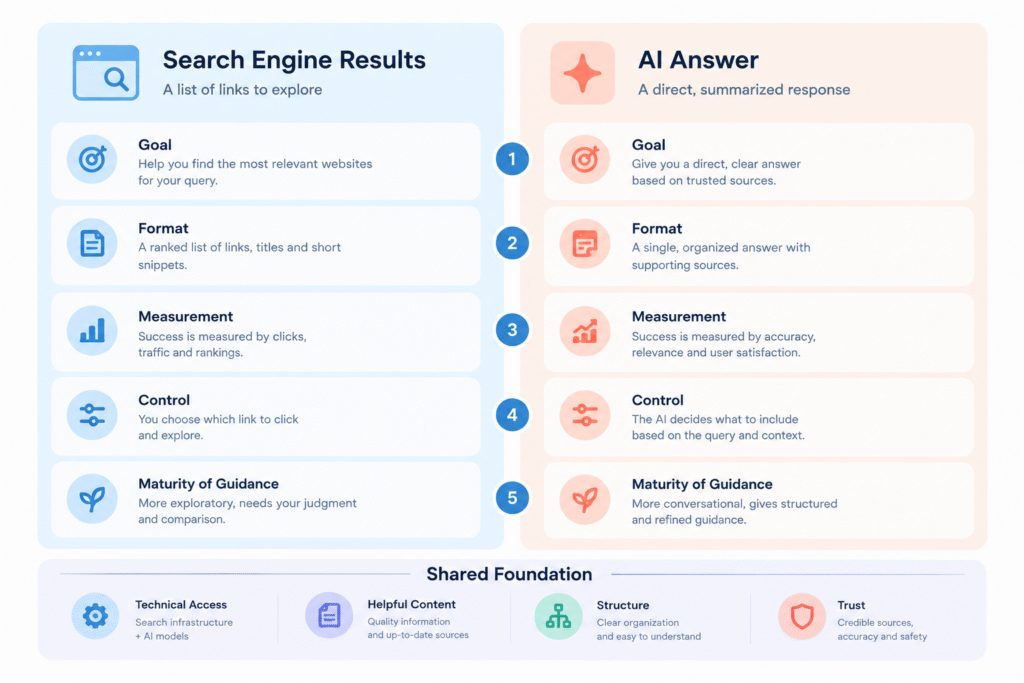
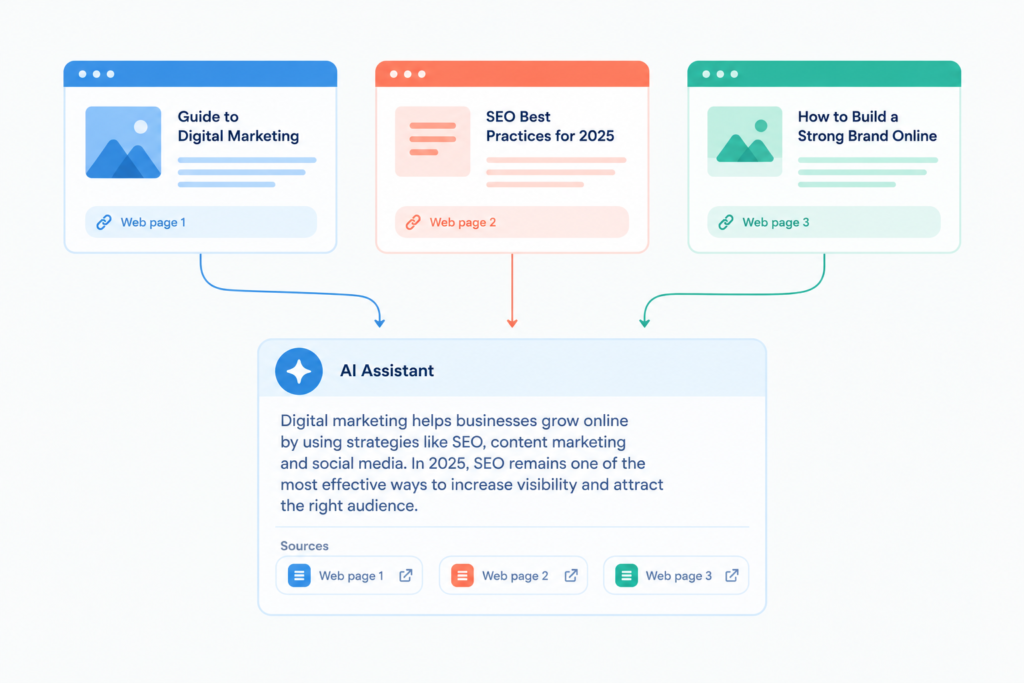
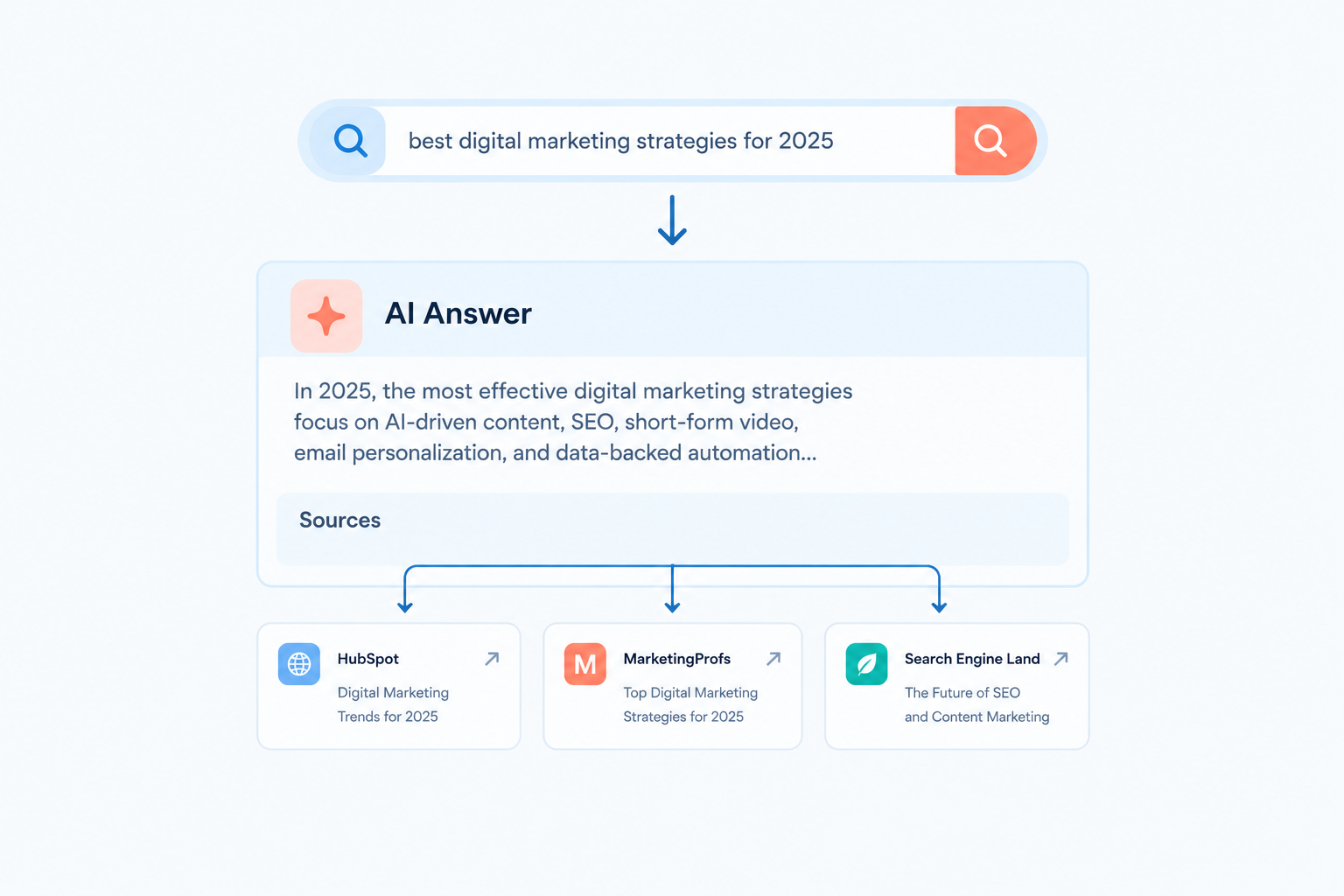
A “generative engine” is any search or answer tool that uses a large language model to gather information from several sources and write a combined response. The user gets one synthesized answer, usually with some links or citations, rather than ten separate results to compare.
The term comes from academic research. A team of researchers introduced GEO as a framework to help content creators improve visibility in generative engine responses, and reported gains of up to 40% in their experiments. The work was accepted to the ACM KDD 2024 conference. Since then, agencies and tool vendors have adopted the label widely, which is why the term now covers everything from solid editorial practice to questionable shortcuts.
Why GEO Matters for Businesses
The practical issue is attention. When an AI answer satisfies the question on the spot, fewer people may click through to any website. The authors of the original GEO paper noted this risk themselves, describing generative engines as a threat to the traffic of the sites they draw from. Whether that plays out for your business depends on your audience and topics, but the direction of travel is clear enough to plan for.
There is also an opportunity. AI answers name sources, products, and brands. If your pages are the ones retrieved and cited, you can reach readers at the moment they are forming an opinion. Google’s own documentation says its AI features offer opportunities for more types of sites to appear, which means smaller publishers are not automatically shut out.
Three business reasons stand out:
- Discovery is spreading across tools. Customers may ask Google, ChatGPT, or another assistant. Your content needs to be usable by all of them.
- Brand perception is shaped in the answer itself. An AI summary can describe your company accurately, inaccurately, or not at all. Monitoring this is now part of reputation work.
- The fundamentals compound. Most GEO actions also improve ordinary search performance and the experience of human visitors, so the effort is rarely wasted.
GEO vs SEO vs AEO: How the Terms Relate
The vocabulary around AI search is messy. Different authors use the same words for different things, so it helps to fix definitions before choosing tactics.
| Term | Main focus | Where it applies | Typical measure |
|---|---|---|---|
| SEO | Ranking and earning clicks from search results | Google, Bing | Rankings, clicks, impressions |
| AEO (answer engine optimization) | Being the direct answer to a question | Featured snippets, voice, AI answers | Snippet and answer presence |
| GEO (generative engine optimization) | Being retrieved and cited in AI-generated answers | AI Overviews, AI Mode, ChatGPT, Perplexity, Gemini | Citations, brand mentions, AI referral traffic |
| LLM SEO or LLMO | Influencing how language models represent a brand | Chat assistants and AI search | Brand mentions and answer accuracy |
In practice, the first three overlap heavily. SEO is the base layer: pages that cannot be crawled, indexed, and understood cannot be retrieved by anything. AEO and GEO are best read as emphasis shifts. They put more weight on concise answers, trustworthy evidence, and being named inside a response rather than only ranked in a list.
How Generative Engines Find and Use Your Content
Generative engines do not write answers purely from memory. Google describes two techniques behind its AI features, and understanding them clarifies what optimization can and cannot do.
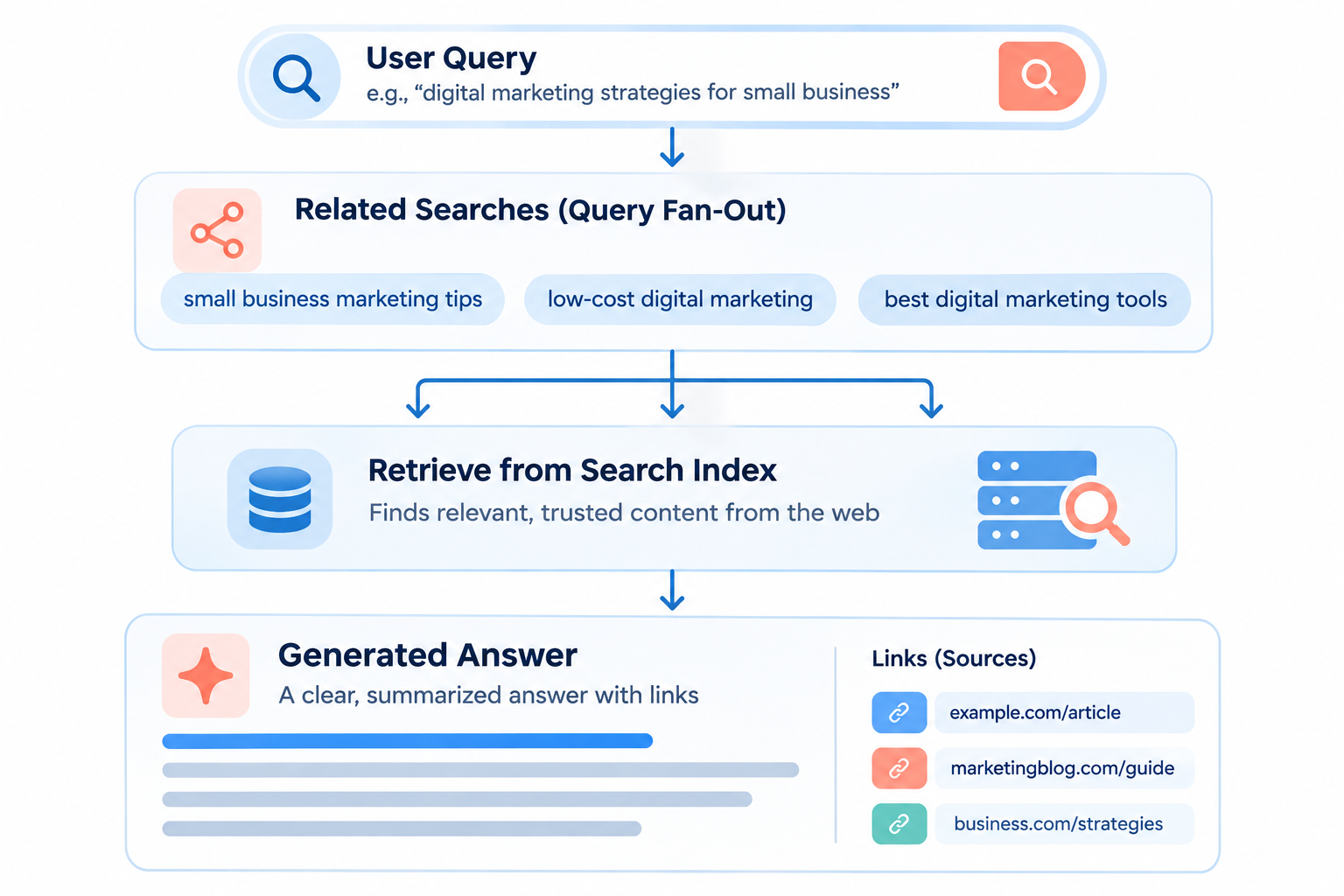
Retrieval-augmented generation (grounding)
The first technique is retrieval-augmented generation, often shortened to RAG. The system uses Google’s core ranking systems to retrieve relevant, up-to-date pages from its index. It then reviews specific information on those pages to write a more reliable response, with prominent links to supporting pages.
The implication is direct: if your page is not retrievable, it cannot ground an answer. Retrieval depends on the same signals as ordinary search, such as relevance, quality, and technical accessibility.
Query fan-out
The second technique is query fan-out. The model creates several related searches at once to pull in more material. Google’s example is a question about fixing a lawn full of weeds, which might trigger searches for herbicides, chemical-free removal, and prevention.
For content planning, this means one question from a user can become many questions behind the scenes. A page that addresses the main question and its natural follow-ups is more likely to be useful at several of those retrieval steps. Google also draws a firm line here: producing separate pages for every variation primarily to manipulate rankings or AI responses violates its scaled content abuse policy. Cover related questions in one thorough page rather than spinning out near-duplicates.
Different tools, different behavior
Google notes that AI Mode and AI Overviews may use different models and techniques, so the responses and links they show will vary. The same is true across vendors. ChatGPT, Perplexity, and Gemini each have their own retrieval pipelines, crawlers, and citation habits, and most do not publish ranking details. Answers can also change between two runs of the same prompt. Any claim that someone has “reverse-engineered” AI citations deserves skepticism.
Is GEO Really Different From SEO?
Google’s position is explicit. From Google Search’s perspective, optimizing for generative AI search is optimizing for the search experience, and therefore still SEO. Its guide, published in May 2026, says SEO best practices remain relevant because the AI features are rooted in core ranking and quality systems. It also says there are no additional requirements to appear in AI Overviews or AI Mode, and no special optimizations beyond those fundamentals.
That statement covers Google. It does not settle how other assistants behave, and it does not remove the need to measure AI visibility, which is a new reporting task. A balanced summary:
- For Google’s AI features, strong SEO is the main lever. Technical eligibility, helpful content, and accurate business details matter most.
- For other AI tools, SEO fundamentals still help, but behavior varies and public documentation is thinner, so test rather than assume.
- For measurement and reputation, tracking how AI tools describe you is genuinely new work that traditional rank tracking does not cover.
What the Research Says (and Its Limits)
The original GEO paper built a benchmark of queries and tested whether rewriting content changed how often a source appeared in generative answers. Its headline result is that visibility can improve by up to 40%. Secondary summaries describe a benchmark of roughly 10,000 queries across several domains.
According to those summaries, the most effective changes were adding relevant quotations, adding statistics, and citing sources, while fluency improvements also helped. Keyword stuffing did not help and, in a test on Perplexity, reduced visibility compared with leaving the content untouched. One summary also reports that lower-ranked pages tended to gain more than top-ranked ones, which suggests that credible, well-supported content may help smaller sites compete.
Read these findings with care:
- “Up to 40%” is a ceiling, not a forecast. It comes from a research benchmark. Your results will depend on your topic, competition, and the engine involved.
- Results varied by domain. The authors report that effectiveness differed across subject areas.
- Engines change. A test run on a particular system at a particular time may not hold later.
- The method details here come from secondary summaries. Check the paper itself before quoting any specific figure.
There is also an apparent tension worth addressing. Google tells site owners not to write specially for AI systems, while the paper found that adding evidence helped. The reconciliation is straightforward: statistics, quotations, and citations make a page more useful and credible to a human reader too. That is different from inserting them mechanically to game a model.
How to Do GEO: A Four-Layer Framework
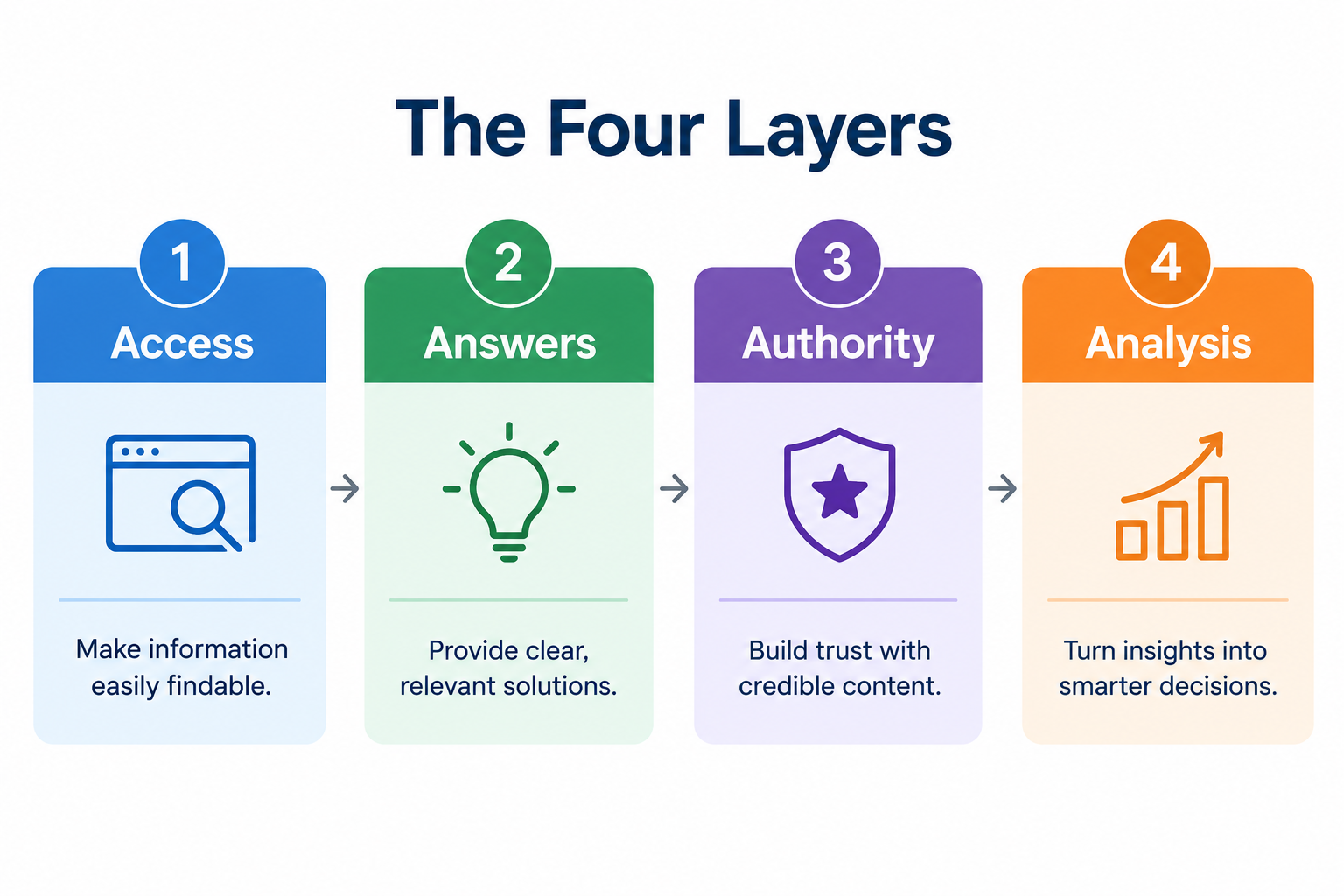
To keep the work practical, organize it into four layers: Access, Answers, Authority, and Analysis. This is a planning framework, not an official standard. Work through the layers in order, because later layers depend on earlier ones.
Layer 1: Access (can systems find and use your pages?)
- Confirm your pages are indexable. To appear in Google’s generative AI features, a page must be indexed and eligible to show with a snippet, which means meeting Google’s technical requirements. Indexing is never guaranteed, so check Search Console rather than assuming.
- Check your Search Console setting. Google’s guide says a site must also be included in generative AI features in Search Console to be eligible for display. Search Engine Land has reported that Google added controls letting sites opt out, and that opted-out sites receive no traffic or impressions from those features. Confirm the current setting for your property.
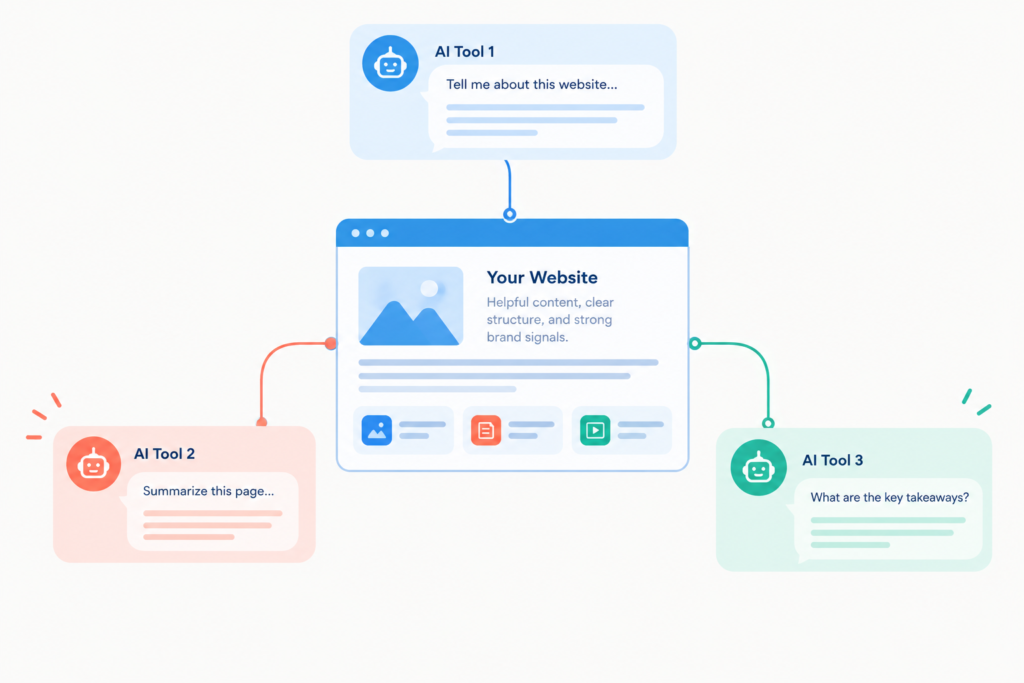
- Keep content crawlable. Google’s AI models use publicly accessible, crawlable content. If you use JavaScript frameworks, follow Google’s JavaScript SEO guidance, and make sure important text is not hidden behind blocked resources.
- Review crawler rules. Different AI crawlers do different jobs, as the table below shows.
| Crawler | Operator | Purpose |
|---|---|---|
| Googlebot | Search indexing, which Google AI features draw from | |
| OAI-SearchBot | OpenAI | Surfaces websites in ChatGPT search results |
| GPTBot | OpenAI | Training-related crawling, controlled separately from search |
| ChatGPT-User | OpenAI | Fetches pages when a user asks. robots.txt rules may not apply to user-initiated actions. |
OpenAI states that each setting is independent, so a site can allow OAI-SearchBot to appear in ChatGPT search while disallowing GPTBot to signal that content should not be used for training. OpenAI also says robots.txt updates can take about 24 hours to take effect for search. Whether to allow training crawlers is a business decision, not a technical one. Read each vendor’s current documentation, such as OpenAI’s crawler overview, before editing robots.txt. Documentation for crawlers from other AI vendors was not verified for this guide, so check those directly.
Layer 2: Answers (is the answer easy to find and use?)
- Match questions to pages. Build a list of the questions your customers actually ask. Good sources are sales calls, support tickets, on-site search, and Search Console queries. Assign each question to one page rather than scattering it across many.
- Lead with the direct answer. Put a clear answer of roughly 40 to 60 words under the relevant heading, then add detail, examples, and caveats below it. People scanning a page and systems extracting a passage both benefit.
- Use descriptive headings and consistent terms. Name things the same way throughout the page. Define a term before using it. Google notes that people generally appreciate pages organized with paragraphs, sections, and headings that give a clear structure.
- Prefer plain language. Short paragraphs and concrete sentences are easier for every reader. Google says you do not need to write in a special way for AI, since its systems understand synonyms and general meaning.
- Add useful images and video. Google says its AI features can bring in relevant images and video, which creates more ways to appear beyond a text link. Use original diagrams and follow Google’s image guidance, including accurate alt text.
A simple structure works for most informational pages:
- State the question as a heading.
- Give the direct answer in two or three sentences.
- Explain why the answer is true, with a named source where possible.
- Show an example or a short process.
- State limits, exceptions, and what the reader should do next.
The table below shows the difference in practice. The example is illustrative and uses invented figures only to demonstrate structure.
| Weak version | Stronger version |
|---|---|
| Our bookkeeping packages are affordable and tailored to your needs. Contact us today for a quote. | Bookkeeping for a small business usually costs more when transaction volume is high or records are messy. Our price depends on three things: monthly transactions, the software you use, and whether we are cleaning up past records. [Add your real price range and a source for any regulatory point.] |
Layer 3: Authority (why should anyone trust this?)
- Publish non-commodity content. Google contrasts commodity content, such as a generic tips list based on common knowledge, with non-commodity content that offers a unique expert or experienced view. Its AI systems look at many sources, so a distinct point of view stands out. Share your process, your data, your mistakes, and what you would do differently. See Google’s guide to optimizing for generative AI features.
- Support claims with named sources. Link to primary sources, state dates, and describe methods. The GEO research suggests that cited, evidence-backed content tends to perform better, and readers trust it more in any case.
- Show who is behind the content. Use real author names, credentials you can prove, and a clear About page. Never invent expertise, awards, or client results.
- Keep business details accurate. Google says Merchant Center and Google Business Profile information can help products and local services appear in AI responses and other results. Keep opening hours, services, and product data current.
- Earn real mentions. Genuine reviews, partnerships, press coverage, and community discussion all contribute to how a brand is described across the web. Google cautions that chasing inauthentic mentions is less helpful than it appears, because its systems also work to block spam.
- Update for real reasons. Refresh a page when facts, products, or guidance change, and say what changed. Changing a date without changing the substance helps no one.
Layer 4: Analysis (is it working?)
- Use Google’s own report. Google’s guide points to the Generative AI performance report in Search Console for seeing how content performs in its AI features. Google also states that sites appearing in AI features are included in overall Search Console traffic.
- Run a monthly prompt audit. Write 20 to 30 prompts that a real customer might use, covering informational and comparison questions. Each month, run them across the AI tools your audience uses and record the results in a simple log.
| Prompt | Tool and date | Brand mentioned or page cited? | Answer accurate? | Notes |
|---|---|---|---|---|
| How much does bookkeeping cost for a small business? | Example only | Yes or no | Yes, partly, or no | Competitors named, wording used |
| Best way to track marketing ROI? | Example only | Yes or no | Yes, partly, or no | Sources cited |
- Track a simple citation rate. Divide the number of prompts where your pages were cited by the number of prompts tested. This is a suggested internal metric, not an industry standard. Because answers vary between runs, compare trends over several months rather than single results.
- Check analytics for AI referrals. Look at your own analytics for traffic from AI platforms. A complete list of referrer names has not been verified here, so build yours from what actually appears in your data.
- Review accuracy, not just presence. A mention that describes your service wrongly is a problem to fix, usually by clarifying your own pages and strengthening trustworthy third-party coverage.
Be cautious about paid tools. Google warns that no third-party tool has access to its internal ranking or AI systems, so treat any claim to the contrary skeptically. Tools can still help with workflow, such as logging prompts, as long as you judge their advice against official guidance.
Content Types That Tend to Suit AI Search
No format is guaranteed to earn citations, but some pages are naturally easy to use as sources because they contain clear, checkable information. These formats are worth prioritizing when your topics allow.
- Definitions and explainers that answer “what is” questions plainly, like this guide.
- Comparisons with honest trade-offs, where a table helps readers weigh options.
- How-to guides with numbered steps, tools needed, and common errors.
- Original data and research, even small surveys or analyses of your own customer questions, which others may cite.
- First-hand reviews and case studies based on real experience, supplied with evidence.
- Pricing and policy pages that state facts clearly rather than hiding them behind a form.
Practical Example (Illustrative)
This is a hypothetical scenario, not a client case study.
A local accounting firm wants to appear when people ask, “How much does bookkeeping cost for a small business?” Today its services page is generic. The firm decides to rebuild it around real customer questions:
- It adds a section that answers the cost question in two sentences, using its real pricing structure.
- It explains what changes the price, such as transaction volume, software used, and cleanup of past records.
- It cites a government or professional source for any regulatory point, with the date checked.
- It names the author and their qualifications on the page.
- It adds an original diagram showing the monthly bookkeeping process, with descriptive alt text.
- It checks that its Google Business Profile lists accurate services and hours.
- It creates a 20-prompt audit list and records a baseline before publishing.
After three months, the firm compares the audit log, Search Console data, and enquiries. None of these steps guarantees inclusion in any AI answer. They do make the page more useful to a customer, which is the real goal and the thing Google’s guidance keeps returning to.
GEO for Different Business Sizes
| Situation | Start here | Avoid |
|---|---|---|
| Small local business | Accurate Google Business Profile, one strong page per core service, honest pricing and FAQ content, reviews from real customers | Buying mass “AI visibility” packages or publishing dozens of thin pages |
| Growing business or in-house marketer | Question-led content calendar, author pages, monthly prompt audit, Search Console review | Rewriting every page at once with no baseline |
| Agency or larger team | Editorial standards for sourcing, a shared prompt library, reporting that separates Google AI features from other tools | Promising rankings or citations to clients |
GEO Myths and Common Mistakes
Google’s guide lists several tactics it says you can ignore for Google Search. Many of them circulate widely in GEO advice, so they are worth examining one by one.
- llms.txt files. Google says Google Search does not use them, so creating one neither helps nor harms visibility there. Other services may read such files, but no verified evidence of a benefit was found for this guide. Treat it as optional.
- Chunking content into tiny pieces. Google says there is no requirement to break content up for AI and that its systems can understand several topics on one page.
- Rewriting purely for AI. Because AI systems understand synonyms and meaning, you do not need to capture every long-tail variation.
- Seeking inauthentic mentions. Paying for or manufacturing mentions across the web is not as helpful as it appears.
- Over-investing in structured data. It is not required for generative AI search and no special markup is needed. It remains useful for rich results, and structured data should always match the visible text on the page.
Beyond those, avoid these mistakes:
- Treating “up to 40%” as an expected result.
- Blocking all AI crawlers by accident through a blanket robots.txt rule or firewall setting.
- Publishing AI-generated filler at scale. Google says content made with generative AI tools must still meet Search Essentials and its spam policies.
- Reporting vanity metrics, such as mentions, without checking whether the answers are accurate.
- Abandoning SEO fundamentals because GEO sounds newer.
What to Watch Next
AI search is moving toward agents that act on behalf of users, such as comparing products or booking a reservation. Google’s guide describes browser agents that may read a site through screenshots, the page structure, and the accessibility tree. It recommends reviewing guidance on agent-friendly site design, which is available from web.dev.
The practical overlap is encouraging. Clear layouts, readable text, accessible markup, and honest product data serve screen-reader users, search crawlers, and AI agents alike. If your business relies on bookings or purchases, these basics are worth auditing now. Because the area is changing quickly, plan to revisit official documentation every quarter.
Frequently Asked Questions
What is generative engine optimization in simple terms?
GEO is the work of making your content easy for AI search tools to retrieve, understand, and cite. It covers technical access, clear answers, credible evidence, and tracking. It extends SEO rather than replacing it.
Is GEO the same as SEO?
Not exactly, but they overlap heavily. Google says optimizing for its AI features is still SEO. For other AI platforms, the same fundamentals help, though each platform has its own crawlers and behavior.
What is the difference between GEO and AEO?
AEO focuses on being the direct answer to a question, including snippets and voice results. GEO focuses on being cited inside AI-generated responses. Practitioners use both terms loosely, and the tactics are largely the same.
Does GEO actually work?
The original research reported visibility gains of up to 40% in a benchmark setting. That does not guarantee results for any site. No technique can promise inclusion in AI answers, so measure your own outcomes.
Do I need an llms.txt file?
Not for Google Search, which says it does not use the file. Other services might, but no verified evidence of a benefit was found. It is optional and low priority compared with content quality and crawl access.
How do I measure GEO results?
Use Search Console’s Generative AI performance report for Google, run a monthly prompt audit across AI tools, and check analytics for AI referral traffic. Track trends over time, since AI answers change between runs.
Can small businesses do GEO?
Yes. Start with indexable, well-written pages, an accurate Google Business Profile, and original answers to customer questions. These steps cost little and help in regular search too.
Should I block AI crawlers?
It depends on your goals. Search crawlers like OAI-SearchBot can help you appear in answers, while training crawlers like GPTBot are separate. Decide per crawler, and review vendor documentation regularly.
Conclusion
Generative engine optimization is best understood as SEO extended into AI answers. Stay accessible to crawlers, answer questions clearly, prove your credibility with real evidence, and measure results honestly. The labels will keep changing, and new platforms will appear. The reader-first work underneath them will not.
Start small: pick your ten most important customer questions, make sure one strong page answers each, and record a baseline in a prompt audit. That is a realistic first month, and it improves your content for people as well as machines.