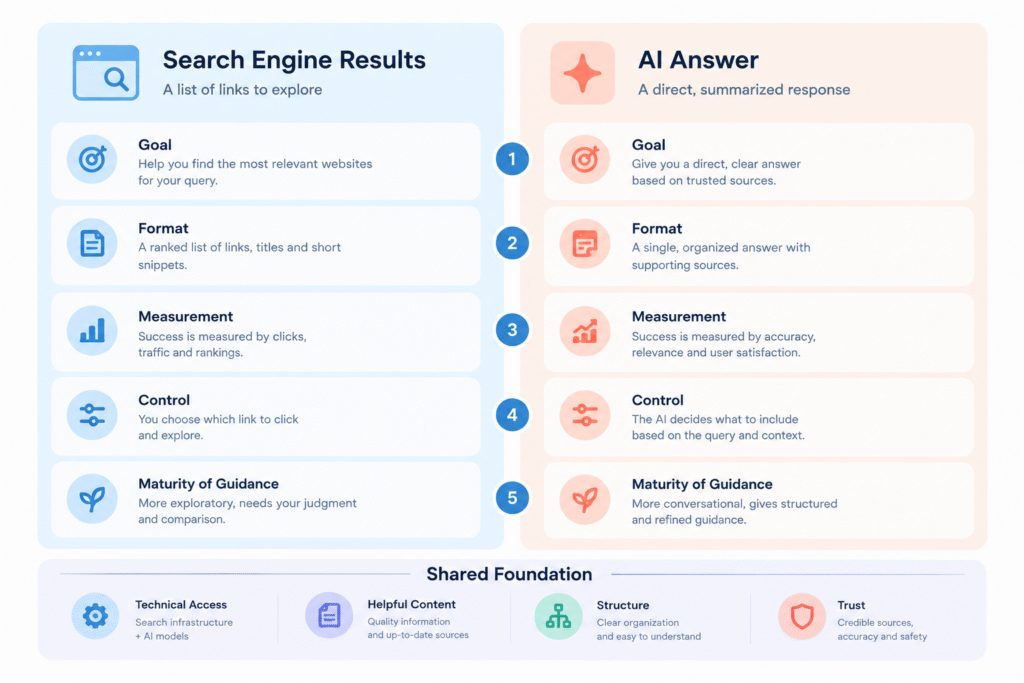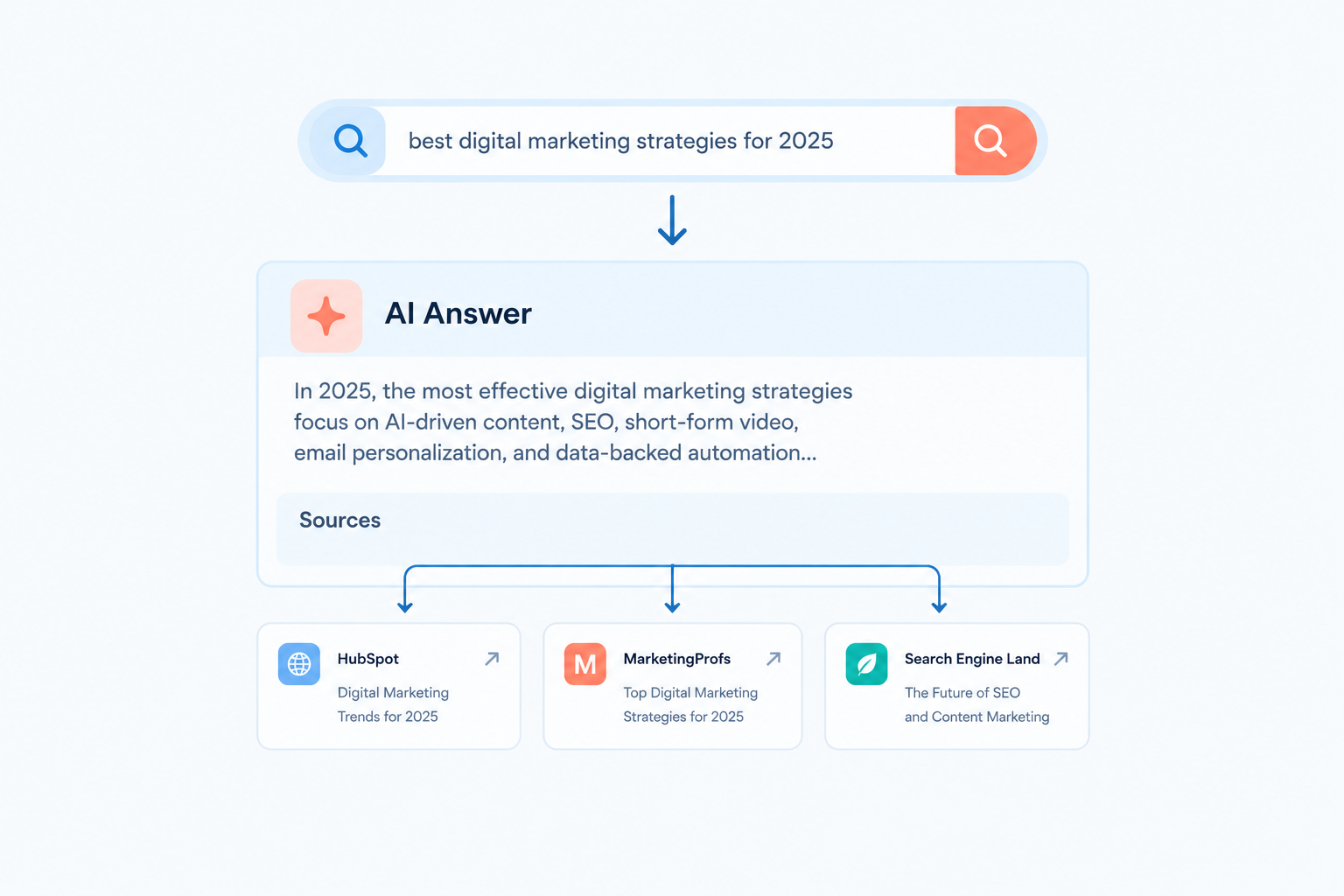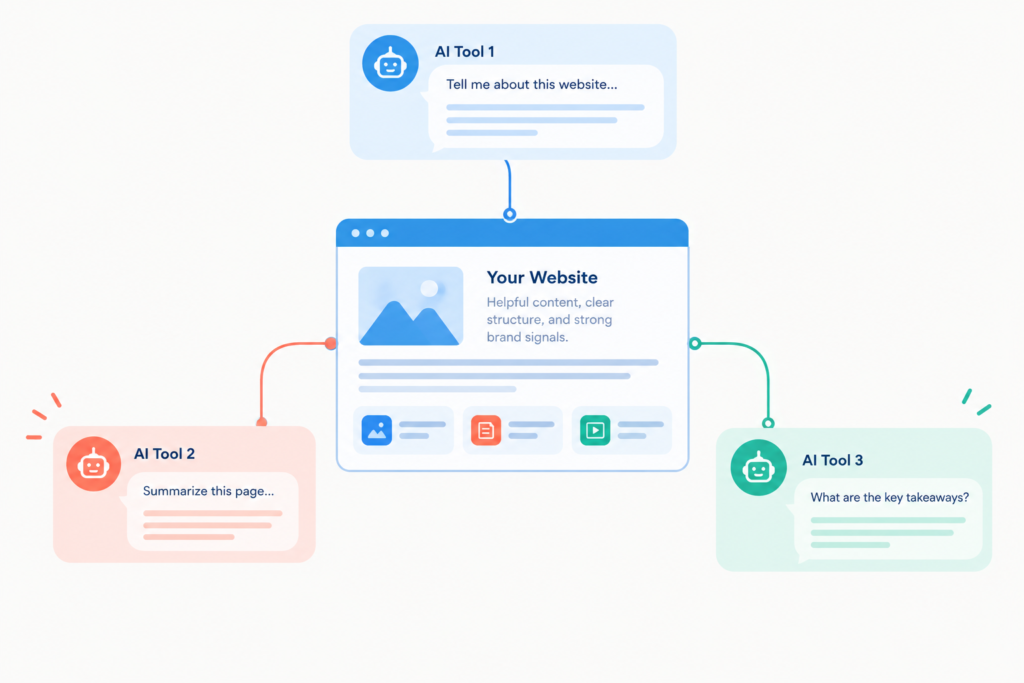
Ask ChatGPT, Claude, Perplexity, or Google’s AI Mode a question, and you get a written answer rather than ten blue links. Behind that answer sit large language models, and often a search step that pulls in pages from the open web. If your content is not among the pages those systems can find and use, your business is absent from the answer.
That is the problem LLM SEO tries to solve. This guide explains what the term means, how it relates to SEO, GEO, and AEO, how AI search engines find and use content, and what you can do about it. It focuses on steps backed by official documentation and flags the many claims that are still unproven.
LLM SEO is the practice of making your content easy for large language models and the AI search tools built on them to find, understand, and cite. It relies on classic SEO foundations and adds attention to crawler access, answer-first writing, consistent facts about your brand, and testing how AI tools actually describe you.
LLM SEO vs GEO vs AEO vs SEO: The Terms Explained
The vocabulary is crowded, and different authors use the same words for different things. This table gives working definitions for this article.
| Term | Plain meaning | Main emphasis |
|---|---|---|
| SEO | Optimizing for search engine rankings and clicks | Crawlability, relevance, helpful content, page experience |
| GEO (generative engine optimization) | Optimizing to be cited in AI-generated answers. Coined in a 2024 research paper. | Visibility in generative engine responses |
| AEO (answer engine optimization) | Optimizing to be the direct answer to a question | Snippets, voice, concise answers |
| LLM SEO or LLMO | Optimizing content for large language model based tools | Usability for AI assistants and their search features |
In practice, GEO, AEO, and LLM SEO describe overlapping work. Google’s guide notes that “AEO” and “GEO” are terms used for work focused on improving visibility in AI search experiences, and says that from its perspective this is still SEO. We treat LLM SEO as one more label for the same family of tasks, and focus on what you can verify and apply. For the broader definition, read our guide to [generative engine optimization (link to the Digital Brand Rise pillar article)].
What Is LLM SEO?
A large language model, or LLM, is an AI system trained on large amounts of text to predict and generate language. Products such as ChatGPT, Claude, Gemini, and Perplexity use LLMs to write answers. LLM SEO is the set of practices that help your content show up inside those answers.
The key is to understand where an LLM-powered answer gets its information. There are two broad sources:
- Knowledge from training. The model has absorbed patterns from text it was trained on. You cannot edit that retroactively, and nobody outside the vendor can see exactly what went in. The practical lever here is long-term: being widely and accurately described across the web.
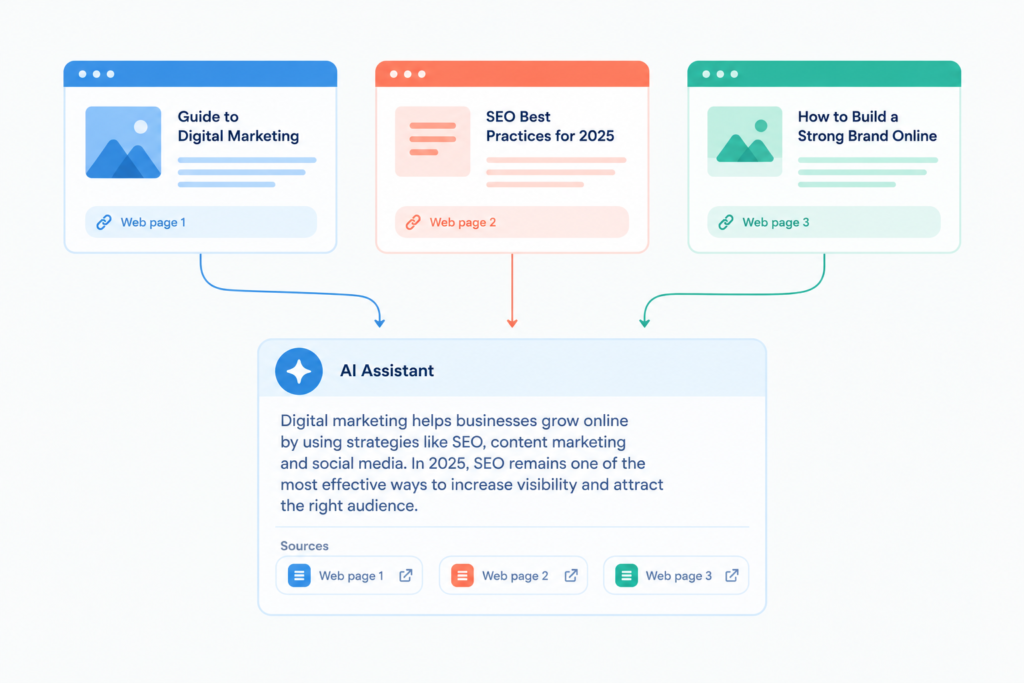
- Content retrieved at answer time. Several assistants can search the web or fetch pages while answering. Google describes this as retrieval-augmented generation, where the system retrieves relevant pages from its index to ground a response and shows links to supporting pages. This is the part you can influence most directly, because your pages either can or cannot be retrieved and used.
Most LLM SEO advice that holds up targets the second source. If you hear a promise to “get your brand into the model,” ask what evidence supports it.
Read more on: How GEO & SEO Differ
Why LLM SEO Matters for Your Business
The business case is attention. People are increasingly asking AI tools questions that they once typed into a search box, and Google says people are gravitating to generative AI experiences to find information.
There is also behavioral evidence. Pew Research Center analyzed browsing data from 900 U.S. adults in March 2025 and, in its published analysis, found that users clicked a traditional result link in 8% of visits to pages with an AI summary, compared with 15% of visits to pages without one. Only 1% of visits involved a click on a link inside the summary. This is a single-month, U.S., Google-only snapshot and behavior has likely changed since, but it shows why being named inside an answer is worth tracking.
There is an opportunity as well. Google’s AI features documentation says these features offer opportunities for more types of sites to appear, which means a smaller business with genuinely useful content is not automatically at a disadvantage.
Three practical reasons to care:
- Customers are asking AI tools about your category. If your pages cannot be used, competitors fill the answer.
- AI answers describe brands. Accuracy matters. A tool that states the wrong price or service area costs you leads.
- The work compounds. Most LLM SEO tasks also improve ordinary search results and the experience for human visitors.
How AI Search Engines Find and Choose Sources
Each platform has its own retrieval system, and most publish little detail about how they rank sources. What is documented, particularly by Google, gives a useful model.
Retrieval and grounding
Google says its generative AI features use retrieval-augmented generation, drawing on its core Search ranking systems to retrieve relevant, up-to-date pages. The system then reviews the specific information on those pages to generate a response with prominent, clickable links.
Query fan-out
Google also describes query fan-out, in which the model generates a set of related queries to fetch more results. Its example: for “how to fix a lawn that’s full of weeds,” the related queries might cover herbicides, chemical-free removal, and prevention. The implication is that one user question can pull in material relevant to several sub-questions, so a page that covers the topic’s natural follow-ups has more chances of being useful.
Google is also clear that creating separate pages for every query variation primarily to manipulate rankings or AI responses violates its scaled content abuse policy. Depth on one page beats many thin ones.
Platforms behave differently
Google notes that AI Mode and AI Overviews may use different models and techniques, so the responses and links they show vary. Other assistants differ again, and answers can change between two runs of the same prompt. Treat any claim of “reverse-engineered” LLM ranking factors with caution.
The AI Crawlers You Should Know
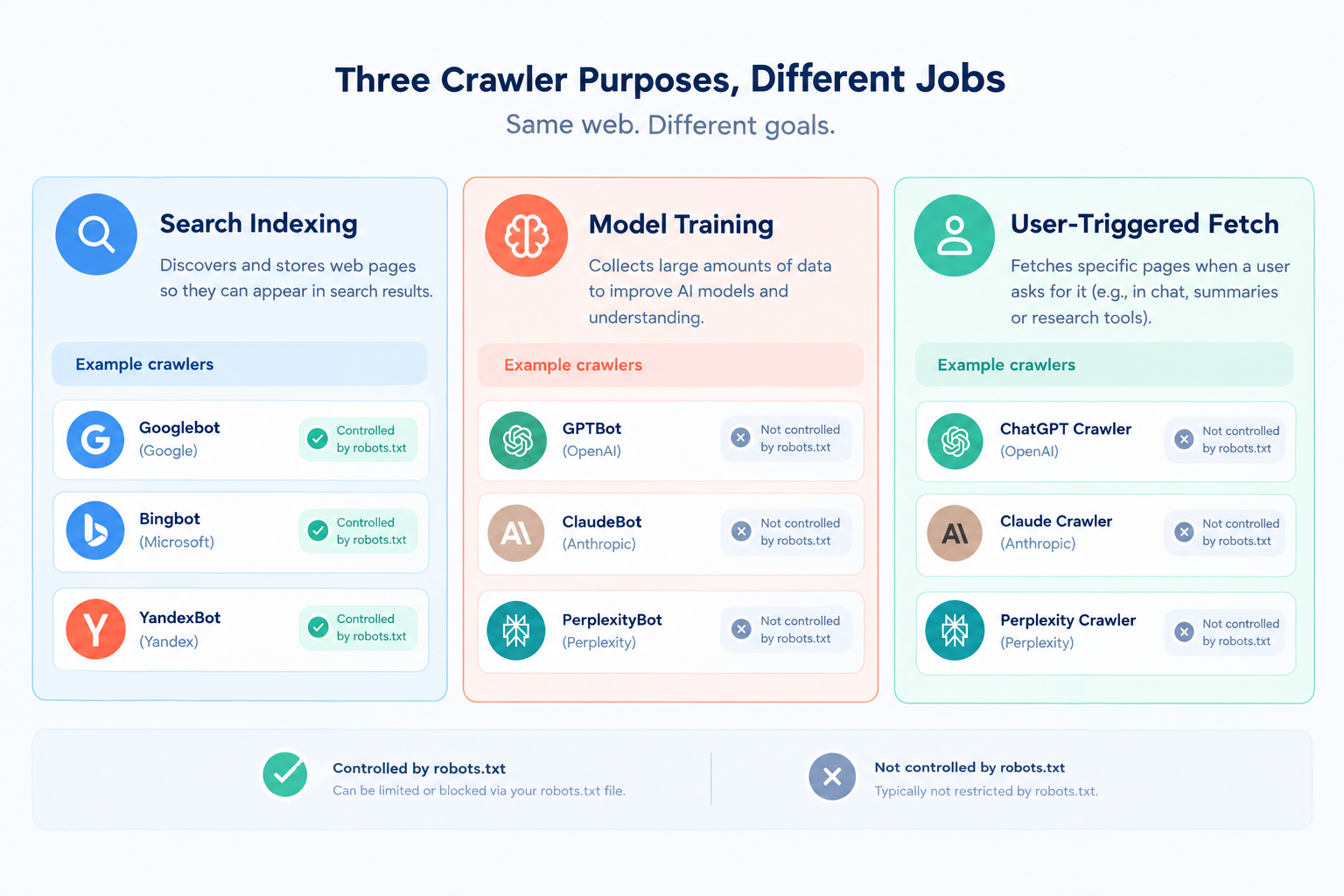
Access is the first LLM SEO task. If a crawler cannot reach your page, it cannot use it. Vendors typically separate crawlers by purpose: some index pages for search, some collect material for model training, and some fetch pages when a user asks. The table summarizes what each vendor documents.
| Crawler | Operator | Documented purpose | Respects robots.txt? |
|---|---|---|---|
| Googlebot | Search indexing, which Google AI features draw from | Yes | |
| OAI-SearchBot | OpenAI | Surfaces websites in ChatGPT search results | Yes |
| GPTBot | OpenAI | Training-related crawling | Yes |
| ChatGPT-User | OpenAI | Fetches pages when a user asks | Rules may not apply to user-initiated actions |
| Claude-SearchBot | Anthropic | Navigates the web to improve search result quality | Anthropic documents robots.txt controls |
| ClaudeBot | Anthropic | Collects content that could contribute to training | Anthropic documents robots.txt controls |
| Claude-User | Anthropic | Accesses sites when users ask questions | Anthropic documents robots.txt controls |
| PerplexityBot | Perplexity | Surfaces and links websites in Perplexity search results | Perplexity recommends allowing it in robots.txt |
| Perplexity-User | Perplexity | Supports user actions within Perplexity | Generally ignores robots.txt rules, per Perplexity |
The detail is in each vendor’s documentation, so check the current pages before editing your file: OpenAI’s crawler overview, Anthropic’s crawler help article, and Perplexity’s crawler documentation. Crawler names and behavior change, so recheck regularly.
Search crawlers versus training crawlers
The important distinction is between crawlers that support search and those used for training. OpenAI says each setting is independent, so a site can allow OAI-SearchBot while disallowing GPTBot. Perplexity says PerplexityBot is not used to crawl content for AI foundation models. Anthropic describes ClaudeBot as related to training and Claude-SearchBot as related to search quality, and warns that blocking Claude-SearchBot “may reduce your site’s visibility and accuracy in user search results.”
Whether to allow training crawlers is a business decision with legal, licensing, and reputational angles. It is separate from whether you want to appear in AI search results. Many sites will want to allow the search crawlers and decide on training crawlers deliberately. Illustrating the OpenAI example from its documentation, a file that allows search and disallows training looks like this:
User-agent: OAI-SearchBot
Allow: /

User-agent: GPTBot
Disallow: /
This is an illustration, not a recommendation for your site. OpenAI notes it can take about 24 hours for robots.txt changes to take effect for search. Also remember that a firewall or bot-protection setting can block these crawlers even when robots.txt allows them, so review both.
What about Google?
Google’s guide says that to be eligible in its generative AI features, a page must be indexed and eligible to be shown in Google Search with a snippet. Google also says a site must be included in generative AI features in Search Console to be eligible for display. Search Engine Land has reported that Google added a setting letting sites opt out, and that opted-out sites receive no traffic or impressions from those features. Confirm your property’s setting in Search Console.
How to Optimize Content for AI Search Engines: A Seven-Step Process
[IMAGE 3: Seven-step workflow graphic goes here]
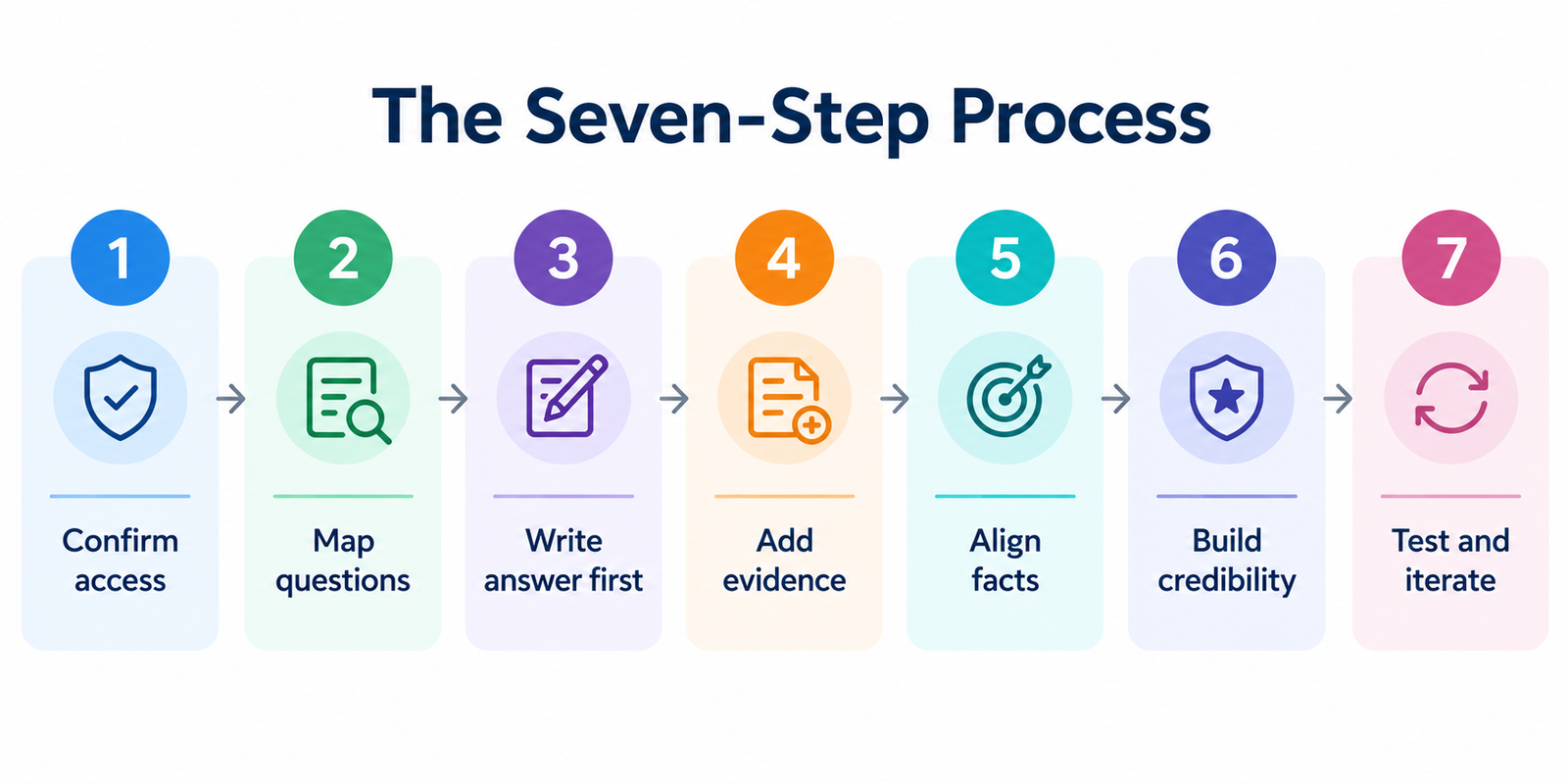
The steps below are ordered so that each depends on the one before. They apply to most informational and commercial pages. This is a working process, not an official standard.
Step 1: Confirm access and indexing
Check that your key pages are crawlable, indexed, and eligible to show with a snippet. Use Search Console for Google, and review robots.txt and any firewall rules for the crawlers in the table above. If you use heavy JavaScript, follow Google’s JavaScript SEO guidance and confirm that important text is visible in the rendered page.
Indexing is never guaranteed. Google states that meeting the requirements does not mean it will crawl, index, or serve a page. Verify rather than assume.
Step 2: Map the questions your customers ask
LLM SEO starts with questions, not keywords. Gather them from sales calls, support tickets, on-site search, reviews, and Search Console queries. Group them by topic, then assign each important question to one page.
Google says its AI systems understand synonyms and meaning, so you do not need to capture every phrasing. Focus on the real question and its likely follow-ups, not on exact-match variations.
Step 3: Write answer-first sections
Open each section with a direct answer, then support it. This helps people scanning on a phone and helps any system extracting a passage. A reliable pattern:
- State the question as a heading.
- Give a direct answer in two or three sentences.
- Explain why it is true, citing a named source where possible.
- Show an example, a short process, or a comparison.
- State limits, exceptions, and the reader’s next step.
The difference in practice is easy to see. The example below is illustrative.
| Weak version | Answer-first version |
|---|---|
| Our CRM migration service is tailored to your needs. Reach out to learn more about how we can help your team move data smoothly. | Migrating a CRM usually takes longer when data is messy, fields do not map cleanly, or integrations are custom. The timeline depends on record volume, number of integrations, and how much cleanup is needed. [Add your real timeline ranges and a named source for any compliance point.] |
Google says it does not require you to chunk content into tiny pieces or write in a special way for AI, and that there is no ideal page length. The point of answer-first writing is clarity for readers, not a trick for models.
Step 4: Add original evidence and named sources
Google’s guide says unique, non-commodity content is likely to influence your presence in generative AI search more than any other suggestion in its guide. It contrasts a generic tips list based on common knowledge with content offering a distinct expert or experienced view.
Add things that only you can supply:
- Your own data, even small: survey results, anonymized customer questions, or process timings you measured.
- First-hand experience: what you tried, what failed, what you would do differently.
- Named external sources for factual claims, with dates.
- Original diagrams, checklists, and examples with accurate alt text.
The original GEO research, according to secondary summaries, found that adding statistics, quotations, and source citations tended to help visibility, while keyword stuffing did not. Treat those summaries as a hint and check the paper for specifics. The reported “up to 40%” gain is a benchmark ceiling, not a forecast for your site.
Step 5: Keep facts and entities consistent
LLMs summarize information from multiple places. If your company name, services, prices, location, or product names differ from page to page and from profile to profile, the summary may reflect the inconsistency. Use a short consistency audit:
| Item | Check |
|---|---|
| Business name | Same spelling and form on the site, profiles, and directories |
| Services and products | Same names and descriptions on service pages, product feeds, and profiles |
| Location and hours | Matches your Google Business Profile and the site footer |
| Pricing | Stated clearly, with the same figures wherever shown |
| Authors | Real names, short bios, and verifiable credentials on every article |
| Dates | Updated for real reasons, with the change described |
Google also says that Merchant Center and Google Business Profile information can help products and local services appear in AI responses and other results. Keep those accurate.
Step 6: Build real credibility beyond your site
AI answers can reflect what is said about a brand across the web, including in blogs, videos, and forum discussions. Google’s guide says its generative AI features can show what is being said about products and services in such places. That makes genuine reviews, partnerships, press coverage, and community participation relevant.
Google also cautions that seeking inauthentic mentions is less helpful than it appears, because its ranking systems focus on high-quality content and other systems block spam. Earn mentions by being useful, not by manufacturing them.
Step 7: Test, measure, and iterate
You cannot optimize what you do not measure. Run a recurring prompt audit.
- Write 20 to 30 prompts a real customer might use. Include definition, comparison, and “best option for” questions.
- Run them across the AI tools your audience uses, and log the date and tool.
- Record whether your brand is mentioned, whether your pages are cited, which competitors appear, and whether the answer is accurate.
- Repeat monthly and compare trends, not single results. Answers can differ between runs.
- Fix inaccuracies by clarifying your own pages first, then strengthening trustworthy third-party coverage.
Use Search Console’s Generative AI performance report for Google’s AI features, and check your own analytics for traffic from AI platforms. Build your referrer list from what appears in your data rather than from a generic list. Google warns that no third-party tool has access to its internal ranking or AI systems, so judge any tool’s claims against official guidance.
LLM SEO Checklist for Each Page
| Area | Checks |
|---|---|
| Access | Indexed, snippet-eligible, not blocked by robots.txt or firewall, important text visible when rendered |
| Answers | Direct answer near the top of each section, question-style headings where natural, consistent terminology |
| Evidence | Named sources with dates, original data or first-hand detail, clear author |
| Entities | Brand, product, service, and location facts match across the site and profiles |
| Media | Original diagrams or images with descriptive alt text |
| Structure | Short paragraphs, descriptive headings, tables or lists where they clarify |
| Measurement | Page is included in your prompt audit and Search Console review |
Content Formats That Suit LLM SEO
No format guarantees citations, but some pages are naturally easy to use as sources because they contain clear, checkable information. When your topics allow, prioritize these:
- Definitions and explainers that answer “what is” questions plainly and define terms before using them.
- Comparisons with honest trade-offs, where a table lets readers weigh options.
- How-to guides with numbered steps, tools needed, and common errors.
- Original research, even modest: a small survey, an analysis of your own customer questions, or a documented test.
- Pricing, policy, and specification pages that state facts plainly rather than hiding them behind a form.
- Images and video that explain something. Google says its AI features can bring in relevant images and video, which creates more ways to appear than a text link alone.
Whatever the format, Google says there is no ideal page length. Make each page as long as the topic and audience need.
The Limits of LLM SEO
It helps to be plain about what this work cannot do, so that you set realistic expectations with your team and any provider you hire.
- You cannot see inside the models. Vendors do not publish complete source-selection logic, so any “ranking factor” list is inference.
- You cannot edit training data. What an LLM absorbed in training is outside your control. Retrieval at answer time is where your actions have the clearest effect.
- Results are noisy. The same prompt can produce different answers on different runs, so one screenshot proves nothing.
- Platforms differ and change. A tactic that seems to work in one tool may do nothing in another, or stop working after an update.
- Measurement is immature. Google offers a Generative AI performance report in Search Console. For other tools, you rely largely on your own audits and analytics.
None of this is a reason to wait. The core actions are low risk because they also improve ordinary search and the experience of human readers.
Keeping Your LLM SEO Work Current
AI search changes quickly, so build a light maintenance routine rather than a one-time project.
- Monthly: rerun your prompt audit, log the results, and note any inaccurate descriptions to fix.
- Quarterly: recheck crawler documentation from each vendor, review robots.txt and firewall rules, and confirm your Search Console settings.
- When facts change: update the page, the product feed, and your profiles together, and say what changed.
- After major platform announcements: read the official documentation before changing tactics, and avoid reacting to unverified claims.
What About llms.txt?
llms.txt is a file proposed to help language models access a site’s key information more easily. According to coverage of the proposal, it came from Jeremy Howard and remains a proposal, with its success depending on whether web developers adopt it. It is not an adopted web standard.
The practical question is whether it helps visibility. Google’s guide says you do not need llms.txt files or other special markup to appear in Google Search, including its generative AI capabilities, because Google Search does not use them. It also says creating them for other systems will neither harm nor help your Google visibility. For other platforms, no verified evidence of a benefit was found for this guide.
The sensible position: it is optional, low priority, and cheap to try if you want to. Spend your effort on access, answers, evidence, and measurement first.
LLM SEO Myths and Common Mistakes
Google’s guide lists several tactics it says you can ignore for Google Search. Some circulate widely in LLM SEO advice:
- Special files and markup. No new machine-readable files, AI text files, or markup are needed for Google Search.
- Chunking content. There is no requirement to split content into tiny pieces.
- Rewriting only for AI. Systems understand synonyms and meaning, so you do not need every long-tail variation.
- Inauthentic mentions. Not as helpful as they appear.
- Over-focusing on structured data. Not required for generative AI search, though useful for rich results, and it should match the visible text.
Other mistakes to avoid:
- Blocking every bot. A blanket rule can stop search crawlers you want to allow.
- Confusing search and training crawlers. They serve different purposes and are controlled separately.
- Promising or buying “guaranteed citations.” No technique guarantees inclusion in AI answers.
- Publishing AI-generated filler. Google says content made with generative AI tools must still meet Search Essentials and its spam policies.
- Ignoring accuracy. A mention that gets your pricing wrong is not a win.
- Skipping the baseline. Without a starting prompt audit, you cannot interpret later results.
LLM SEO Priorities by Business Type
These are judgment-based suggestions, not measured results. Your own data should override them.
| Business type | Start with | Watch for |
|---|---|---|
| Local service business | Accurate Business Profile, one strong page per service, clear pricing context | AI answers listing outdated hours or services |
| Ecommerce store | Clean product data, Merchant Center feeds, honest buying guides | Comparison answers that omit your products |
| B2B software or services | Comparison and “best for” pages, original data, expert-written explainers | Competitors named for category questions |
| Publisher or blog | Crawler policy decisions, clear authorship, original reporting | Attribution and licensing concerns |
| Agency or consultancy | Shared prompt library, consistent reporting, evidence-led content | Overpromising to clients |
Worked Example (Illustrative)
This is a hypothetical scenario, not a client case study.
A small accounting software company has a features page, a pricing page, and a handful of blog posts. When the team asks several AI tools “best accounting software for freelancers,” the company is rarely named, and one tool describes its pricing incorrectly.
The team works through the seven steps. It finds that its pricing page is rendered by a script that hides the plan details from crawlers (Step 1), so it moves the key details into the page text. It lists the ten questions freelancers ask most (Step 2) and builds a comparison page that opens with a direct answer about who each option suits, including honest trade-offs (Step 3).
It adds a small survey of its own users with the method and date stated (Step 4), aligns plan names across the site and profiles (Step 5), and asks genuine customers to leave reviews (Step 6). It runs a 25-prompt audit before changes and again after 90 days (Step 7).
No outcome is promised. The value of the process is that each action is something you can justify, verify, and measure, and each also helps ordinary search and human readers.
Frequently Asked Questions
What is LLM SEO in simple terms?
LLM SEO is making your content easy for large language model based tools, such as ChatGPT, Claude, Perplexity, and Google’s AI features, to find, understand, and cite. It relies on SEO basics plus crawler access, answer-first writing, consistent brand facts, and testing how AI tools describe you.
Is LLM SEO different from SEO?
It overlaps heavily. Google says optimizing for its generative AI features is still SEO. LLM SEO adds a few tasks, including crawler decisions, entity consistency, and prompt audits, but it rests on the same foundations of access, helpful content, and trust.
What is the difference between LLM SEO and GEO?
GEO is the term from a 2024 research paper for improving visibility in generative engine responses. LLM SEO is a more informal label for similar work. Practitioners use both loosely, and the practical tactics are largely the same.
How do LLMs choose which websites to cite?
No platform publishes a full formula. Google says its AI features use retrieval and query fan-out on top of its core ranking systems. For other tools, behavior is less documented, so test with prompt audits rather than relying on claimed ranking factors.
Should I allow AI crawlers in robots.txt?
Search crawlers such as OAI-SearchBot, Claude-SearchBot, and PerplexityBot support appearing in AI search results, per vendor documentation. Training crawlers such as GPTBot and ClaudeBot are separate. Decide per crawler, and check each vendor’s current documentation first.
Does llms.txt help LLM SEO?
Google says Google Search does not use llms.txt, and it neither helps nor harms visibility there. For other platforms, no verified evidence of a benefit was found. It is a proposal, not an adopted standard, so treat it as optional.
How do I measure LLM SEO results?
Run a monthly prompt audit across the AI tools your audience uses, track a simple citation rate, check answer accuracy, review Search Console’s Generative AI performance report, and look at AI referral traffic in your analytics. Compare trends over time.
Can LLM SEO guarantee my brand appears in AI answers?
No. Nothing can guarantee inclusion in AI Overviews, ChatGPT, Claude, or other tools. You can improve access, usefulness, and credibility, then measure your own results. Treat guarantees from any provider as a warning sign.
Conclusion
LLM SEO is best understood as practical SEO for a world where AI assistants answer questions. Make sure the right crawlers can reach your pages, write answers people and systems can use, back them with real evidence, keep your facts consistent, and test how AI tools describe you. The labels may change, but those habits will not.
Start this week with two small tasks: review your robots.txt and firewall for the crawlers in this guide, and write a 20-prompt list for your most important customer questions. Those two steps give you access and a baseline, which is what every later decision depends on.