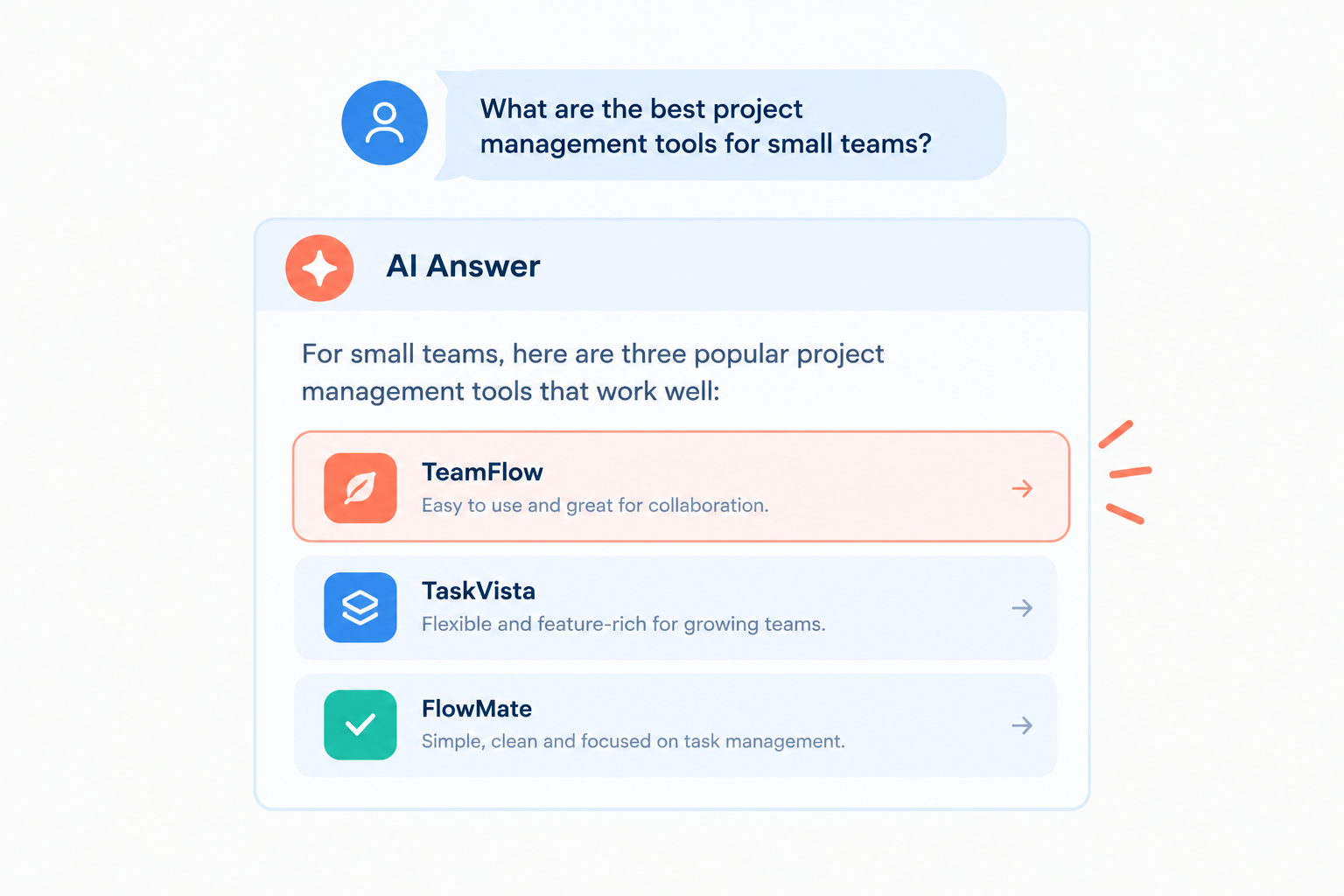
Ask ChatGPT for “the best project management tool for a small agency” or “a reliable accountant near me,” and it will name a handful of brands. Ask the same question next week, and the list may change. For the businesses named, that is valuable exposure at the moment of decision. For everyone else, it is invisible.
So how do you get your brand mentioned in ChatGPT and in other AI search engines? The honest answer is less glamorous than most guides suggest. AI tools tend to name brands that are clearly described, consistently described, and credibly discussed in places they can find. That means your own website plus what other people say about you across the web.
This guide explains the difference between a mention, a citation, and a recommendation, what the available studies do and do not prove, and a step-by-step process for earning more mentions without gimmicks. No tactic can guarantee that any AI tool will name your brand.
To get your brand mentioned in ChatGPT and other AI search engines, make sure your own site clearly states what you do, keep your facts consistent everywhere, and earn genuine third-party presence through reviews, expert coverage, partnerships, and community participation. Then audit what AI tools actually say about you, fix inaccuracies, and track the trend. Nothing guarantees a mention.
Read the Pillar content about: Generative Engine Optimization
Mentions, Citations, and Recommendations: What You Are Actually Trying to Earn
The language around “AI visibility” blurs several different outcomes. Separating them makes your goals and measurement clearer.
| Outcome | What it means | Example | How you can see it |
|---|---|---|---|
| Mention | The AI names your brand in its answer | “Brand X is one option for small agencies” | Prompt audit |
| Citation | The AI links to or lists one of your pages as a source | A numbered source link to your guide | Prompt audit, and Search Console for Google features |
| Recommendation | The AI actively suggests your brand as a good choice | “For small agencies, Brand X is a strong fit because…” | Prompt audit |
| Referral visit | A person clicks through to your site | A session with utm_source=chatgpt.com | Analytics |
These can occur independently. A tool can mention you without linking to you, link to your page without recommending you, or describe you inaccurately. Each calls for a different response, which is why the audit later in this guide records them separately.
How AI Tools Come to Name a Brand
No platform publishes a full formula for which brands it names. What can be said with confidence is limited, and it is worth being explicit about where the evidence stops.
What is documented
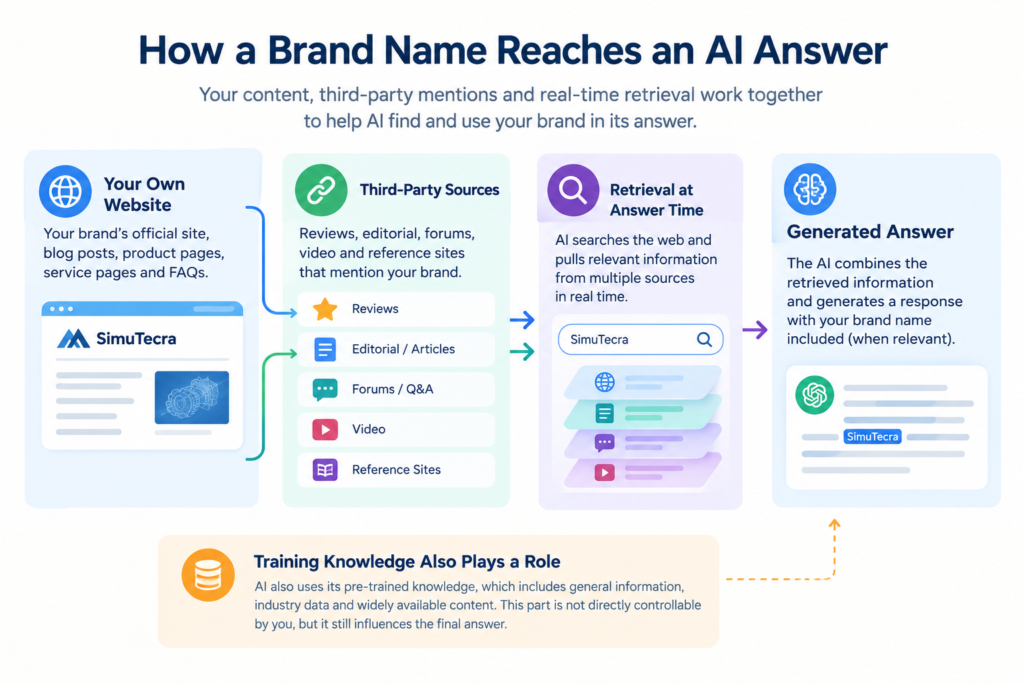
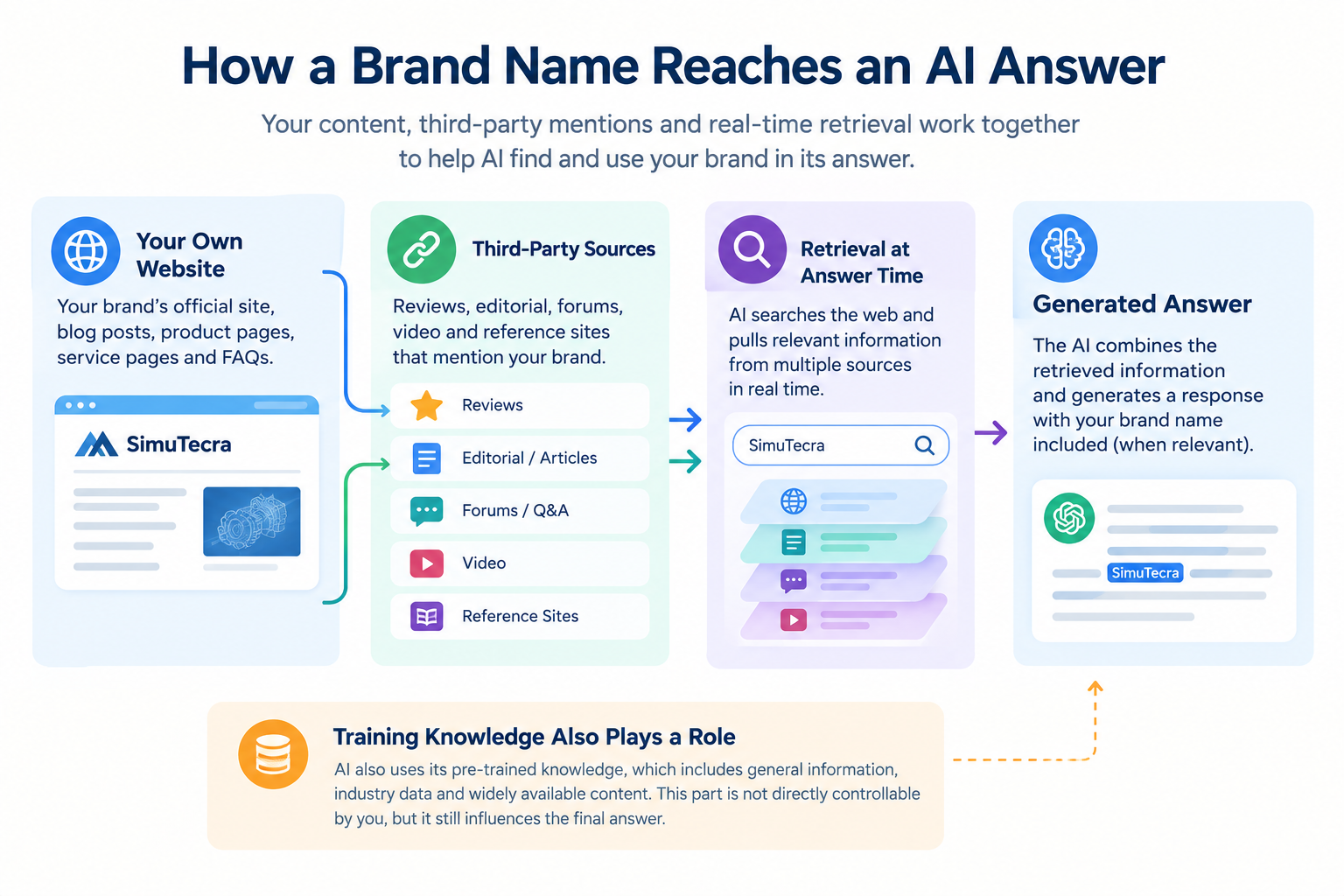
Google says its generative AI features use retrieval-augmented generation, drawing on its core Search ranking systems to retrieve relevant pages and ground responses. It also says these features “can show what’s being said about products and services across the web, including in blogs, videos, and forum discussions.” In other words, a brand’s presence in an answer can reflect what others say about it, not only what it says about itself.
OpenAI’s publisher FAQ says any public website can appear in ChatGPT search, and that sites should allow OAI-SearchBot for content to be included in summaries and snippets. It does not publish a ranking formula or a method for earning a recommendation.
What studies suggest (with caveats)
Two vendor studies offer useful, but limited, evidence.
Peec AI’s citation study. Search Engine Land reported on an analysis of 30 million cited sources across ChatGPT, Google AI Mode, Gemini, Perplexity, and AI Overviews. Reddit was the most-cited domain, followed by YouTube and LinkedIn, with Wikipedia and Forbes also in the top five. Yelp and G2 appeared often for recommendation queries. By platform, ChatGPT favored Wikipedia, Reddit, and editorial sites; Google leaned toward platforms such as Facebook and Yelp; and Perplexity emphasized Reddit, LinkedIn, and G2 for B2B queries. The article did not state the study period, and Peec AI is a vendor of AI search analytics.
Ahrefs’ AI Overview brand study. Ahrefs analyzed 75,000 brands and checked millions of AI Overview responses for brand mentions. It reported that branded web mentions had the strongest correlation with brand visibility in AI Overviews (0.664), ahead of branded anchors (0.527), branded search volume (0.392), Domain Rating (0.326), referring domains (0.295), and backlinks (0.218). The study was published in May 2025, covers Google’s AI Overviews only, and the authors themselves stress that correlation is not causation. Its sample was limited to higher-authority domains with substantial branded search demand, which may limit how far it generalizes.
Taken together, these studies point in one direction: brands that are widely discussed, on the platforms AI tools draw from, tend to be named more. They do not prove that any particular action will cause a mention. Treat them as a reason to look at your off-site presence, not as a recipe.
What is still unknown
- How any platform weighs a mention in a review site versus a news article versus a forum post.
- How quickly new mentions are reflected in answers, which no source reviewed here quantifies.
- How much of a given answer comes from training knowledge versus live retrieval. The split can differ by tool and by query.
Be skeptical of any guide that gives exact percentages for these without a clear source and method.
Step 1: Find Out What AI Tools Say About You Today
You cannot improve what you have not measured. Start with a baseline audit built around five kinds of prompts. Use the tools your customers use, and log the date and tool for every run.
| Prompt type | Example pattern | What it reveals |
|---|---|---|
| Category | “Best [category] for [audience]” | Whether you are in the consideration set |
| Problem | “How do I [solve the problem you solve]?” | Whether tools connect your brand to the problem |
| Comparison | “[Competitor] vs [Brand]” and “[Brand] vs [Competitor]” | How you are framed against rivals |
| Brand | “What is [Brand]?” and “Is [Brand] any good?” | Accuracy and sentiment of descriptions |
| Alternative | “Alternatives to [Competitor]” | Whether you appear as an alternative |
Run 20 to 30 prompts across these types. For each, record:
- Whether your brand is mentioned, cited, or recommended.
- Whether the description is accurate (services, pricing, location, positioning).
- Which competitors appear, and in what order.
- Which sources the tool cites or lists, where it shows them.
Answers vary between runs, so repeat important prompts a few times and compare trends over months, not single results. A simple mention rate is prompts where your brand was named divided by prompts tested. This is a suggested internal metric, not an industry standard.
Step 2: Run a Source-Gap Analysis
This step turns the audit into a plan. When a tool shows its sources, those sources tell you where your category is being discussed and where you are absent.
- List every source domain or page that appears in answers for your category prompts.
- Group them by type: review platforms, editorial sites, forums, video, professional networks, reference sites, competitor sites.
- For each source, check whether your brand appears there, and how it is described.
- Rank the gaps by how often the source recurs and how realistic it is to earn a legitimate presence.
If review sites dominate your category prompts and you have almost no reviews, you know where to start. If forum threads dominate and nobody has discussed your brand, the answer is genuine participation, not advertising. The studies above suggest which source types appear often overall, but your own category audit is more reliable than a general ranking.
Step 3: Make Your Own Site the Best Source About You
Third-party mentions matter, but your site is the one source you control. AI tools need a clear, consistent, accessible account of what you do. For crawler access and technical readiness, see our guide to [optimizing your website for ChatGPT, Gemini and AI search.The brand-specific points are below.
State plainly what you do and who you serve
Write one clear description of your business and use it consistently: what you offer, for whom, where, and what makes you different. Put it on your homepage, About page, and key service pages in text, not only in images. If a person or a model cannot summarize your business after reading your site, it will struggle to place you in the right category.
Publish pages that answer the questions that lead to a mention
- Comparison and alternative pages with honest trade-offs, including who your product is not for.
- Pricing and policy pages that state facts plainly.
- Use-case pages that tie your offering to specific problems.
- Original data and research that others have a reason to cite.
Google’s guide says unique, non-commodity content is likely to influence your presence in generative AI search more than any other suggestion in its guide. Generic content that says what everyone says gives a model no reason to choose you.
Keep facts consistent everywhere
| Item | Where to align it |
|---|---|
| Business name and short description | Website, social profiles, directories, review profiles, press boilerplate |
| Services and product names | Service pages, product feeds, listings |
| Location, hours, contact details | Website footer, Google Business Profile, directories |
| Pricing and plans | Pricing page, comparison pages, review profiles |
| Leadership and authors | About page, bylines, professional profiles |
Google says Merchant Center and Business Profile information can help products and local services appear in AI responses and other results, so keep those accurate and current.
Step 4: Earn Genuine Third-Party Presence
[IMAGE 3: Third-party presence map goes here]
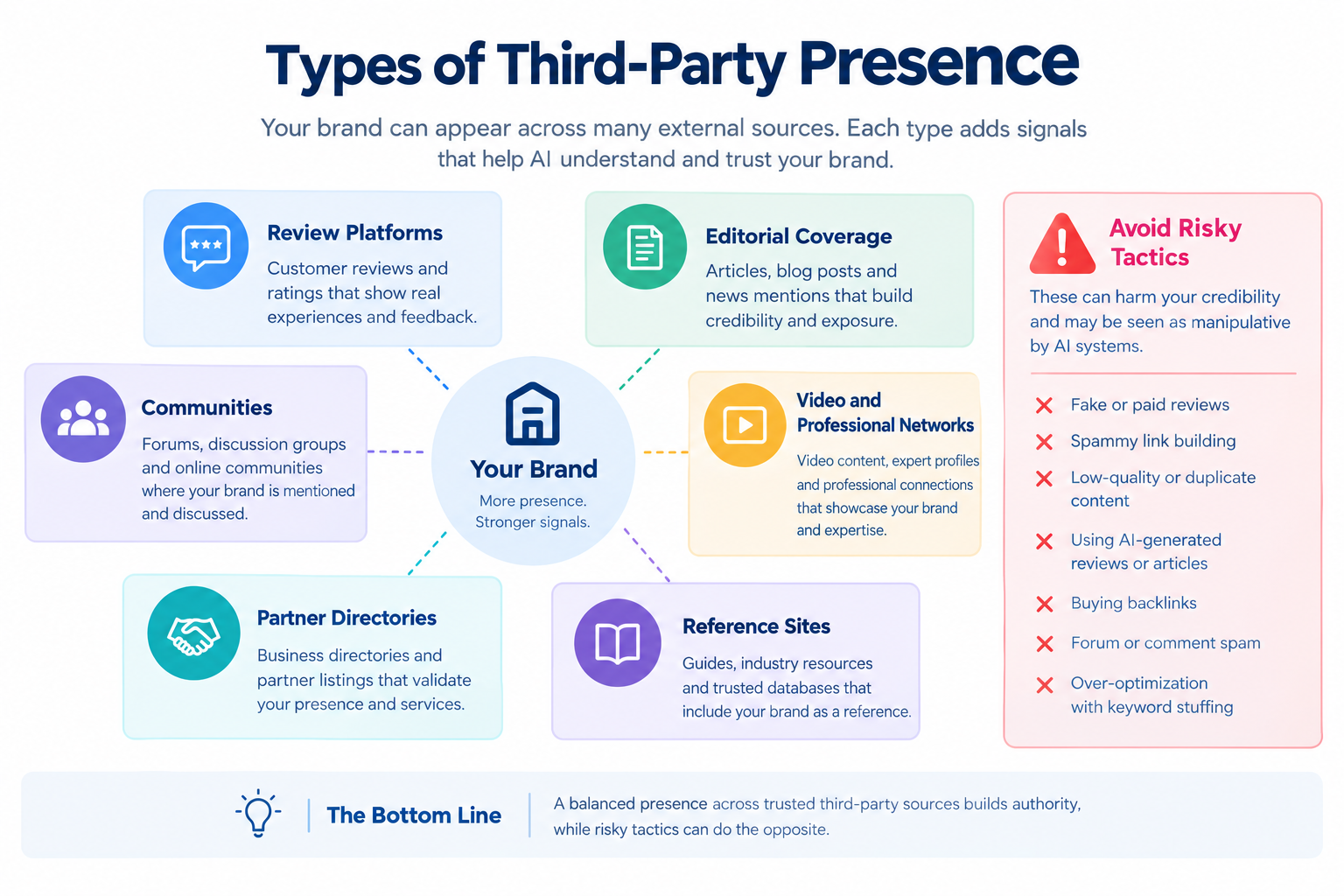
This is where most of the long-term work sits, and where most bad advice lives. The principle is simple: earn mentions by being worth mentioning. Google’s guide cautions that seeking inauthentic mentions across the web is not as helpful as it might seem, because its core ranking systems focus on high-quality content and other systems block spam.
Reviews and rating platforms
In the Peec AI analysis, review platforms such as Yelp and G2 appeared often for recommendation queries. If your category has review platforms, claim your profile, keep it accurate, and ask real customers for honest reviews at a natural moment, such as after a successful project. Respond to reviews professionally.
Never buy, fabricate, or incentivize fake reviews. It is deceptive, platforms act against it, and it can damage trust. Follow each platform’s rules on soliciting reviews.
Expert coverage and editorial mentions
Editorial sites such as Forbes appeared among frequently cited domains in the Peec study. You do not need to chase the biggest names. Relevant trade publications, industry newsletters, podcasts, and local media can all establish you as a credible voice. Ways to earn coverage honestly:
- Publish original data or a small research study that reporters and bloggers can cite.
- Offer genuine expertise to journalists and editors for relevant stories.
- Contribute useful guest articles to publications in your field, with real author credentials.
- Speak at or sponsor industry events where proceedings are published online.
Community discussion: Reddit, forums, and professional networks
Reddit was the most-cited domain in the Peec AI study, with YouTube and LinkedIn following. That does not mean you should flood those platforms. Communities punish promotional behavior, and manufactured posts can backfire. A sustainable approach:
- Participate as a person with expertise. Answer questions helpfully, and mention your product only where it is genuinely relevant.
- Disclose your affiliation whenever you discuss your own brand.
- Follow each community’s rules, including limits on self-promotion.
- Encourage real customers to share their experiences, without scripting or paying for it.
On LinkedIn and YouTube, publish useful material under real names. Founder and expert posts, explainer videos, and demonstrations create content that others can reference. Google notes that its generative AI features can show what is being said in blogs, videos, and forum discussions.
Partnerships, directories, and associations
Credible listings in industry associations, partner directories, marketplaces, and integration pages can reinforce what you do and who you work with. Keep your profile text consistent with your own site.
Wikipedia: handle with care
Wikipedia appears among the most-cited sources in the Peec study, and ChatGPT favored it according to that report. That makes some marketers tempted to edit it directly. Do not do this casually. Wikipedia’s conflict of interest guideline says conflict-of-interest editing is strongly discouraged, that editors with a relationship to a topic should disclose it, and that they are strongly discouraged from editing affected articles directly. The Wikimedia terms require paid editors to disclose who is paying them.
If your organization is notable and an article exists, the guideline says you can propose changes on the article’s talk page using the edit request process. If you do not meet Wikipedia’s inclusion standards, no amount of editing will change that, and attempts can lead to reversals and reputational harm. Focus on earning independent coverage first.
Step 5: Strengthen Category Association
A brand gets named when a tool connects it to a category, a problem, or an audience. If every source describes you differently, the association is weak. If sources consistently say “Brand X is a [category] for [audience],” the association is clear.
- Pick the category language customers actually use, based on sales calls and search queries, and use it consistently in your boilerplate, bios, and profiles.
- Be specific about audience and use case. “Invoicing software for freelance designers” is easier to place than “business solutions.”
- Brief partners and spokespeople so that coverage and profiles describe you the same way.
- Avoid exaggerated claims. Overstated claims invite correction or contradiction in other sources.
Step 6: Fix Inaccurate or Missing Mentions
When the audit shows a wrong description or a competitor named in your place, work through these in order:
- Record the answer with the prompt, tool, and date. Rerun it a few times.
- Check your own pages for outdated, conflicting, or hidden information, and correct it in plain text.
- Align profiles and listings so they match.
- Find the source of the error. If a third-party page contains the wrong detail, request a correction where realistic.
- Strengthen accurate coverage so that correct information is more widely available than the incorrect version.
- Re-audit after several weeks and treat improvements as trends to confirm.
No platform promises to change a specific answer on request, so keep expectations modest.
Step 7: Track Mentions and Referrals
| Measure | How to get it | Limits |
|---|---|---|
| Mention, citation, and recommendation rate | Monthly prompt audit | Answers vary between runs |
| Answer accuracy | Audit log | Manual review needed |
| Competitor share of mentions | Audit log | Depends on your prompt list |
| AI referral visits | Analytics, including utm_source=chatgpt.com per OpenAI’s FAQ | Misses mentions without clicks |
| Google AI feature performance | Search Console Generative AI performance report | Google only |
| Branded search interest | Search Console and trends data | Influenced by many factors |
Be cautious about tools that claim to use internal metrics from Google or other platforms. Google says no third-party tool has access to its internal ranking or AI systems. AI visibility tools can still help you run and log prompts at scale, as long as you judge their claims against official documentation and your own checks.
A simple monthly scorecard
Keep reporting light enough that you will actually maintain it. One row per month is enough:
| Month | Prompts tested | Mentioned | Cited | Recommended | Accurate | Top competitor named | AI referral visits |
|---|---|---|---|---|---|---|---|
| Baseline | Count | Count | Count | Count | Count | Name | Number |
| Month 1 | |||||||
| Month 2 | |||||||
| Month 3 |
Read the scorecard as a trend. A change of a prompt or two in either direction is within normal run-to-run variation, so wait for a sustained pattern before declaring that something worked.
A 90-Day Plan to Earn More Brand Mentions
Days 1 to 30: Baseline and foundation
- Write your 20 to 30 prompt list across the five types and run the first audit.
- Run the source-gap analysis and rank the gaps.
- Align your brand description, facts, and profiles across your site and listings.
- Confirm search crawlers are not blocked, using the website optimization guide.
Days 31 to 60: Earn presence
- Claim and complete profiles on the review and directory platforms in your category.
- Start a simple, honest review request routine for real customers.
- Publish one original piece of data or research, and share it with relevant editors and communities.
- Begin disclosed, helpful participation in two or three relevant communities.
Days 61 to 90: Reinforce and review
- Publish comparison, use-case, and pricing pages that answer your audit’s gap questions.
- Pursue two or three guest contributions or expert quotes in relevant publications.
- Rerun the prompt audit and compare it with the baseline.
- Decide next quarter’s priorities from the data, and drop channels that show no sign of value.
If You Only Have Two Hours a Week
Most small teams cannot run a full program. A modest routine still builds momentum if you pick the right tasks.
- Hour one, week one: build the prompt list and run the baseline audit.
- Every week: reply to new reviews, and ask one recent happy customer for an honest review.
- Every two weeks: add one useful answer in a community where you already have a credible reason to be present, with your affiliation disclosed.
- Every month: rerun the audit, update the scorecard, and correct any inaccurate page or listing.
- Every quarter: publish one piece that others have a reason to cite, such as original data or a thorough comparison.
Consistency beats intensity here. A steady stream of genuine, well-described presence is more believable to people, and more likely to be useful to any retrieval system, than a short burst of promotion.
What If an AI Tool Describes You Negatively?
Not every mention is a good one. An answer might repeat an old complaint, quote a harsh review, or compare you unfavorably. Before reacting, work out whether the statement is wrong or simply unflattering.
- If it is wrong, follow the correction steps above: fix your own pages and profiles, then request corrections from the source where realistic.
- If it is true but dated, publish clear, dated updates, such as a changelog, a response on the review platform, or an explanation on your site.
- If it is true and current, treat it as product or service feedback. The most durable fix is improving what customers experience, because that changes what they say next.
Avoid attempts to suppress criticism through fake positive reviews or pressure on reviewers. They tend to make the situation worse, and they erode the trust that makes any mention valuable.
What Not to Do
Tactics that try to force mentions tend to be risky, short-lived, or both. Avoid these:
- Fake or incentivized reviews. They are deceptive and platforms act against them.
- Astroturfing communities. Sock puppet accounts and scripted threads break platform rules and can permanently damage your reputation.
- Buying mentions or links in bulk. Google says inauthentic mentions are not as helpful as they seem, and its systems work to block spam.
- Editing Wikipedia about yourself without disclosure. This violates its conflict of interest and paid editing rules.
- Hidden text or instructions aimed at AI tools. Tactics that try to trick models rather than inform readers are deceptive and high-risk.
- Mass-producing near-duplicate pages. Google says producing pages primarily to manipulate rankings or AI responses violates its scaled content abuse policy.
- Promising guaranteed mentions. No provider can guarantee them, so treat such claims as a warning sign.
Google’s guide also lists items that you can ignore for Google Search, such as llms.txt files, chunking content, and rewriting content just for AI systems. For a fuller discussion, see our guide to LLM SEO.
Where to Focus by Business Type
These are judgment-based suggestions, not measured results. Your own audit should override them.
| Business type | Likely high-value sources | First step |
|---|---|---|
| Local service business | Google Business Profile, local review sites, local media | Audit “best [service] near me” prompts and fix profile accuracy |
| Ecommerce store | Review platforms, product feeds, buying-guide coverage | Complete product data and encourage honest reviews |
| B2B software or services | Software review platforms, LinkedIn, trade publications, forums | Audit comparison and alternative prompts |
| Publisher or creator | YouTube, newsletters, citations by other publishers | Decide your crawler and licensing stance |
| Agency or consultancy | Case-study coverage, speaking, LinkedIn, directories | Build proof and consistent positioning |
Worked Example (Illustrative)
This is a hypothetical scenario, not a client case study.
A small outdoor gear brand sells lightweight camping equipment online. When the team asks ChatGPT and Perplexity for “best lightweight tents for solo hikers,” competitors are named and the brand is not. One tool also describes the brand’s tents with the wrong weight.
The audit’s source-gap analysis shows that answers lean on review roundups, outdoor forums, and a few video reviews. The brand has no presence in any of them. The team updates its own product pages with accurate weights as plain text, aligns product names across its site and retail listings, and publishes a comparison page that is honest about when its tents are not the best choice.
It then sends review units to a few relevant independent reviewers without conditions on the review, asks real customers for honest feedback after purchase, and joins two outdoor forums as a clearly identified brand representative who answers gear questions. It reruns a 25-prompt audit after 90 days.
No result is promised. Each action is legitimate, can be justified to customers and reviewers, and helps ordinary search as well.
Frequently Asked Questions
How do I get my brand mentioned in ChatGPT?
Make your site clearly describe what you do, keep facts consistent everywhere, and earn genuine third-party presence through reviews, expert coverage, and community participation. Then audit what ChatGPT says and track the trend. No tactic guarantees a mention, and OpenAI publishes no formula.
Why doesn’t ChatGPT mention my brand?
Several reasons are possible. Your brand may be unclear or inconsistently described, thinly discussed across the web, or blocked from search crawlers. Answers also vary between runs. Run a prompt audit and a source-gap analysis to see where competitors appear and you do not.
Can I pay to be mentioned in ChatGPT or other AI search results?
No verified way to buy organic mentions was found for this guide. Be wary of services that sell guaranteed mentions or fake reviews. Legitimate paid options, if any exist, would be disclosed by the platform itself, so check official documentation.
Do backlinks matter for AI brand mentions?
Ahrefs found backlinks correlated more weakly with AI Overview brand visibility (0.218) than branded web mentions (0.664) in its study. That is correlation, not causation, and it covers Google’s AI Overviews only. Links still matter for ordinary search.
Does Reddit help my brand appear in AI answers?
Reddit was the most-cited domain in a Peec AI study, but that does not mean posting promotional content works. Participate honestly, disclose affiliations, follow community rules, and let genuine discussion develop. Manufactured posts can backfire.
Should I create or edit a Wikipedia page for my brand?
Be careful. Wikipedia strongly discourages conflict-of-interest editing and requires paid editors to disclose who is paying them. If your organization is notable, propose changes on the talk page. Focus first on earning independent coverage.
How long does it take to get mentioned?
No source reviewed here gives a verified timeline. Results depend on the platform, your category, and how much credible coverage exists. Measure monthly, compare trends over several months, and avoid judging a single run.
How do I track whether my brand is being mentioned?
Run a monthly prompt audit across the AI tools your customers use, logging mentions, citations, recommendations, and accuracy. Add analytics for AI referral traffic, including utm_source=chatgpt.com, and Search Console’s Generative AI performance report for Google features.
Conclusion
Getting your brand mentioned in ChatGPT and other AI search engines comes down to being easy to understand, consistent, and credibly discussed. The studies available point toward third-party presence, but they are vendor analyses with limits, and none proves that a given action causes a mention. That is a reason for honest, patient work rather than shortcuts. Read our guide on GEO vs. SEO
Start this week with a 20-prompt baseline audit and a source-gap analysis. Those two exercises show you what AI tools say today and where to earn presence, which makes every later decision cheaper and better informed.