
Almost every content team now uses AI somewhere in its process. The question is no longer whether to use it. It is whether the pages that come out are better for readers or just faster to produce. The difference shows up quickly: one team ships pages that sound like every other page, and another ships pages that carry its own data, experience, and judgment.
This guide is about AI content optimization, meaning the editorial process that turns AI-assisted drafts into pages that are helpful, original, accurate, and accountable. It covers what Google actually says, what the data shows, a workflow with clear human ownership, editing and fact-check protocols, disclosure, a team policy, and how to audit what you have already published.
AI-assisted content can be fine for search if it is genuinely helpful, accurate, and original. Google says the issue is value, not the tool, and that producing many pages with AI without adding value may violate its spam policy on scaled content abuse. Use AI for research and structure, add your own evidence and experience, fact-check everything, show who is responsible, and explain how the content was made.
What Google Actually Says About AI-Assisted Content
Most confusion comes from paraphrases of Google’s position. These are the points from Google’s own documentation, each of which can be checked on the page.
| Topic | What Google says | Source page |
|---|---|---|
| Acceptable use | Generative AI can help with researching a topic and adding structure to original content. | Guidance on using generative AI content |
| The line to avoid | Using AI tools to generate many pages without adding value for users may violate the spam policy on scaled content abuse. | Guidance on using generative AI content |
| Definition of the abuse | Scaled content abuse involves many pages generated mainly to manipulate rankings, typically with large amounts of unoriginal content that provides little to no value, “no matter how it’s created.” | Spam policies |
| Fact-checking | Models predict likely word sequences and can be inaccurate, so it is critical to manually fact-check and review AI-generated content before publishing. | Guidance on using generative AI content |
| Metadata | Review title elements, meta descriptions, structured data, and image alt text too, since they can appear in Search. | Guidance on using generative AI content |
| Disclosure | Consider telling readers how the content was created, including how automation was used and why. | Guidance on using generative AI content and helpful content guidance |
| Authorship | Make clear who created the content. Avoid deceptive authorship such as AI-generated headshots, made-up names, or false credentials. | Helpful, reliable, people-first content |
| Purpose | Using automation, including AI, mainly to manipulate rankings violates spam policies. The primary purpose should be to help people. | Helpful, reliable, people-first content |
Two points stand out. First, the policy is about the outcome (many pages, little value, aimed at rankings) and not the production method. Second, the practical duties are ordinary editorial ones: check facts, show who is responsible, and be honest about how the work was done.
What the rater guidelines add
Search Engine Land reported that Google’s January 2025 update to its Search Quality Rater Guidelines added a definition of generative AI and told raters to give the Lowest rating to pages where nearly all main content is automated or AI-generated or reposted with little to no effort. It also reported that raters look for paraphrasing of common knowledge, summaries that add nothing, and leftover AI phrasing, and that padding which buries useful material can earn a Low rating. Google’s own documentation points to sections 4.6.5 and 4.6.6 of the guidelines on scaled content abuse and content with little effort, originality, or added value.
One caution: Google’s documentation says these guidelines do not directly influence ranking. They show what kind of quality Google’s evaluation process looks for, so they are useful as a standard to edit against, not as a ranking formula. We read the secondary report, not the guidelines, so verify the wording in the source.
What the Data Shows, and What It Does Not
Ahrefs published a study in 2026 using its own AI content detector on large samples of pages. It is vendor data and detectors are imperfect, but it gives a useful picture.
| Finding (as reported) | Detail |
|---|---|
| Top 3 results | 5.3% of pages were 100% AI-generated and 9.0% were 80% or more AI. Pages under 50% AI made up 82.2% of the top 3. |
| Top 10 results | Between 8.4% (position 1) and 11.7% (position 10) of pages were 80% or more AI. |
| Average AI level | About 27.1% at position 1, rising to about 30.9% at position 10. |
| Indexation | Low-AI pages were indexed at about 49%, versus about 40% for very high-AI pages. |
| Impressions | Low and moderate AI pages received two to three times the impressions of high and very high AI pages in the sample. |
How to read this: AI-heavy pages do appear in top results, and most top pages are not mostly AI. The gaps in indexation and impressions are consistent with lower average quality or authority in AI-heavy pages. The author himself notes that these are correlations, that the detector is not perfect, that Google’s method (if any) is unknown, that the ranking analysis only covers pages already indexed, and that newer or lower-authority sites may use more AI. The study sizes should be checked against the Ahrefs page before quoting.
So the data neither shows that AI content is penalized nor that it is safe. It shows that quality, not the tool, is the variable to manage.
Myths to Drop
| Myth | What the evidence supports |
|---|---|
| Google penalizes any AI-written page | Google says the issue is value and manipulation. Its guidance allows AI for research and structure. |
| AI content is fine if it passes a detector | Detectors are probabilistic, and Google does not describe passing a detector as the goal. Ahrefs notes detection is not perfect. Focus on value and accuracy. |
| A human glancing at the draft is enough | Google says it is critical to manually fact-check and review. Light skimming misses subtle errors. |
| Disclosing AI use will hurt rankings | Google suggests telling readers how content was created. No source read for this guide shows a ranking penalty for disclosure. |
| More pages mean more traffic | Scaled pages with little value are the stated spam concern, and Ahrefs reports lower indexation and impressions for AI-heavy pages on average. |
| Rewording AI text makes it original | Google describes synonymizing and rewording content as a form of scaled abuse when users gain little. Originality comes from new information, not new phrasing. |
A Human-Led, AI-Assisted Model
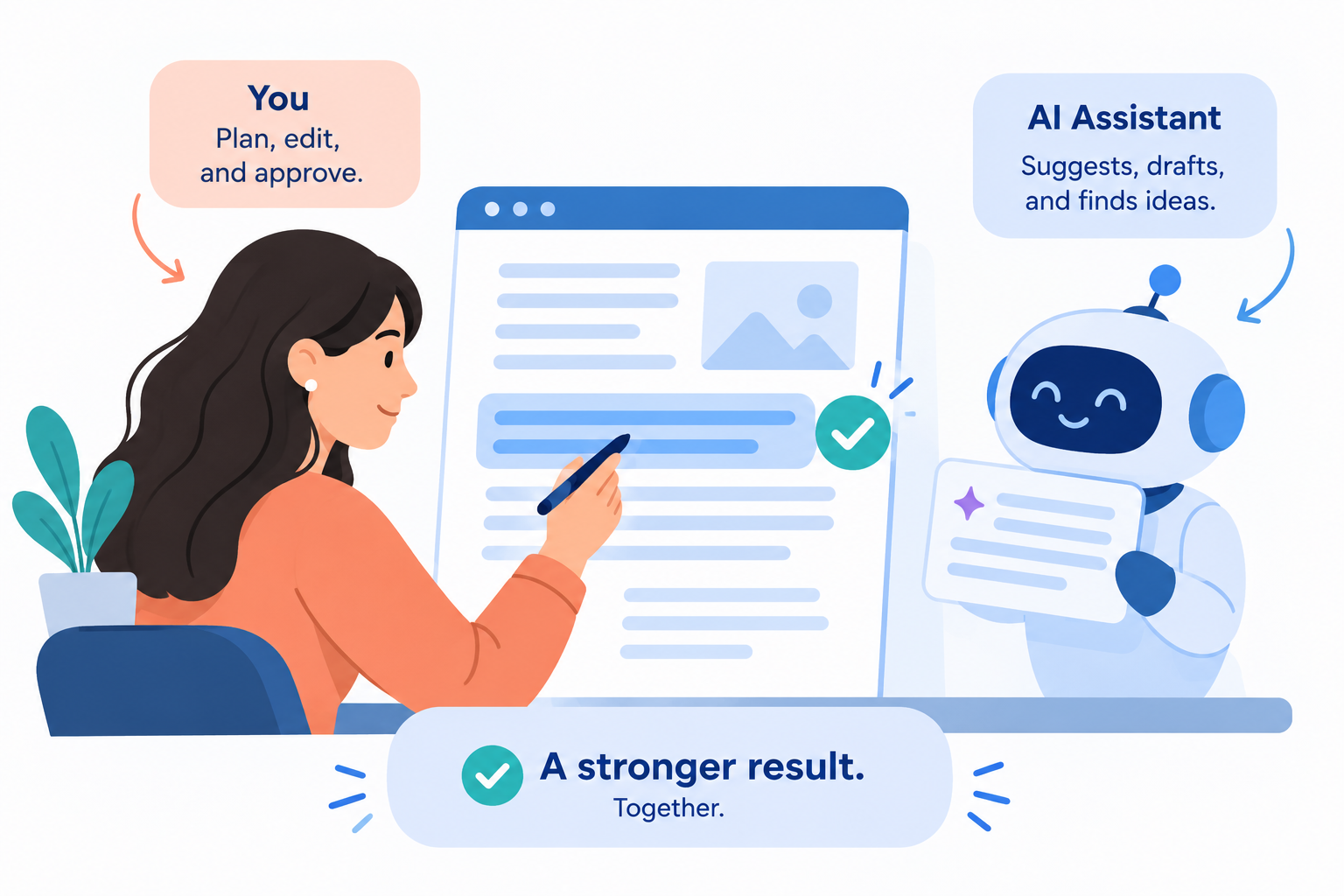
A reliable way to use AI is to decide in advance what the tool does and what a person owns. The table below is a judgment-based division of labor, not a standard.
| Stage | AI can help with | A person must own | Main risk |
|---|---|---|---|
| Strategy | Brainstorming angles, grouping topics | Deciding whether the page should exist and who it is for | Publishing pages with no purpose |
| Research | Summarizing documents you supply, listing questions to answer | Choosing sources, verifying claims, gathering original material | Fabricated or outdated facts |
| Outline | Suggesting structure and missing subtopics | The thesis and the unique contribution | A generic outline that mirrors every competitor |
| Draft | Producing a first draft from your notes and data | The evidence, examples, opinions, and experience | Bland, commodity prose |
| Edit | Tightening, checking consistency, suggesting alternatives | Voice, accuracy, claims, tone, and cuts | Over-polished text that says little |
| Check | Flagging claims to verify, finding typos | Fact-checking against primary sources, legal and compliance review | Errors that look confident |
| Publish | Drafting metadata options | Byline, disclosure, metadata review, final approval | Unreviewed titles and alt text |
| Maintain | Spotting outdated passages | Deciding what to update, retire, or merge | Stale pages |
If AI is writing the evidence, you have crossed a line. If AI is helping you organize and express the evidence you gathered, you are using it as a tool.
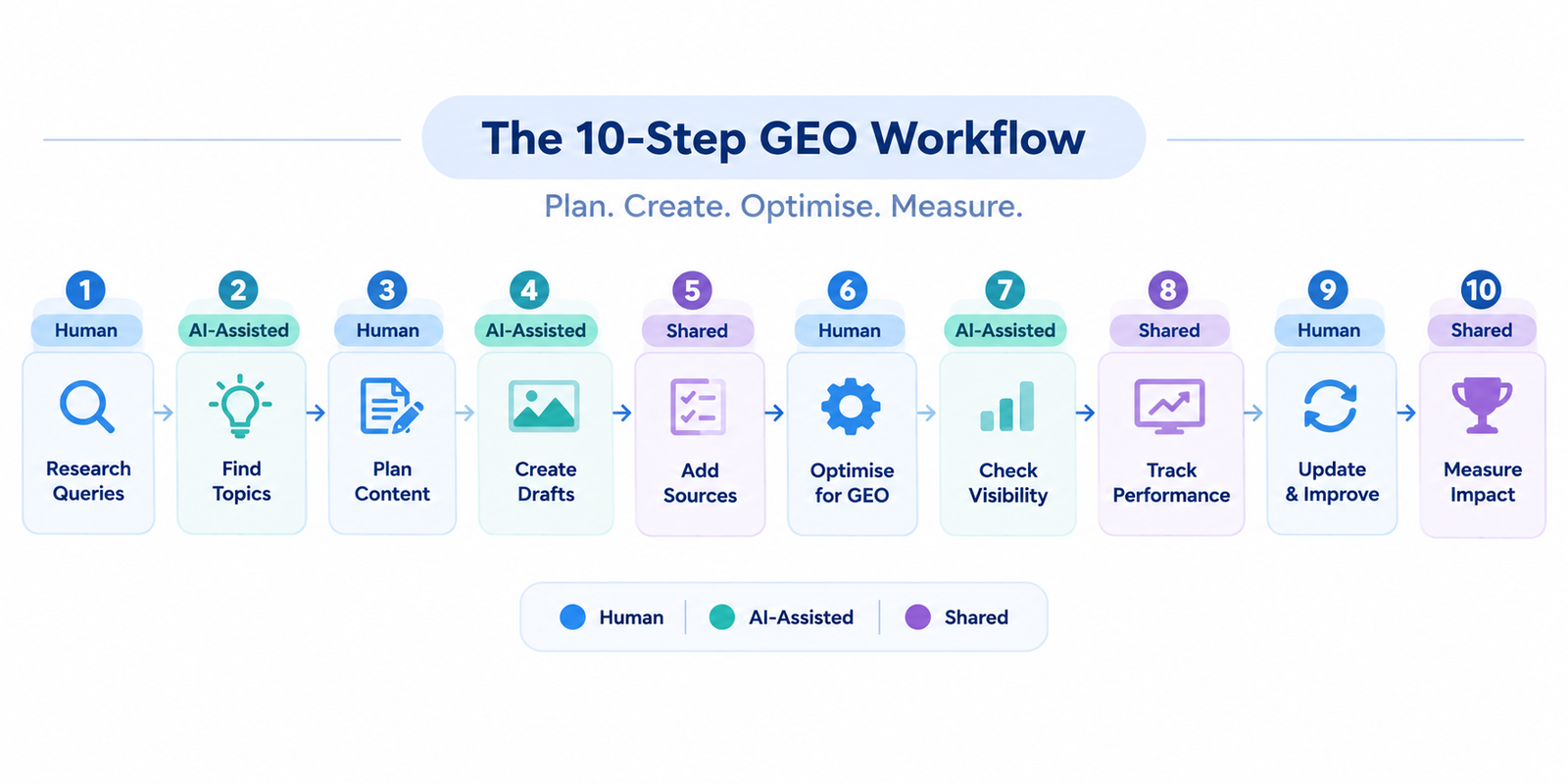
The 10-Step Workflow
Step 1: Decide whether the page deserves to exist
Google’s helpful content questions ask whether a page offers original information, reporting, research, or analysis, and whether it offers more value than other pages in the results. Apply them before you prompt anything. Write one sentence completing: “This page will help [specific reader] do or decide [specific thing], and it will include [something other pages lack].” If you cannot finish the sentence, do not create the page.
Step 2: Gather original inputs
Collect what a model cannot invent: customer questions, support tickets, your own numbers with dates, project notes, photographs, interview transcripts, internal process documents, and quotes from people who agreed to be named. These are the raw material of originality. If you have none, the topic may not be right for your site yet.
Step 3: Write a constraint-based brief
Give the AI a brief that limits what it can do. A useful brief states the reader, the purpose, the thesis, the sections, the source material to use, and rules such as “do not add statistics that are not in the supplied material,” “do not invent quotes,” and “flag any claim you are unsure about.” Treat the brief as a document you keep, since it also shows how the content was made.
A template you can adapt:
Reader: [who they are and what they know]
Goal: [what they should be able to do after reading]
Thesis: [our position in one sentence]
Use only: [pasted notes, data, transcripts]
Do not: invent facts, quotes, statistics, names, or sources
Flag: any statement that needs a primary source
Output: outline first, then wait for approval
Step 4: Build the outline around questions
Ask the tool for the questions your reader will have, then compare with your inputs. Cut sections that only restate common knowledge. Add sections where you hold unique material. This is where AI is most useful and least risky, because you are judging the outline yourself.
Step 5: Draft from your material
Either write the draft yourself and use AI for suggestions, or have the tool draft from the notes you supplied. In both cases, you supply the claims. Keep the draft in sections and review each one before moving on, so errors do not compound.
Step 6: Add information gain
Reread each section and ask what a reader gets here that they could not get from the top five results. Add it if the answer is “nothing”: a worked example from your business, a number from your own data, a limitation you have seen, a decision rule, a mistake you made. Our guide to creating content that gets cited by AI search engines covers the evidence side in more depth.
Step 7: Fact-check line by line
Use the protocol in the next section. Do not skip this step because the draft reads well. Fluent text is not accurate text.
Step 8: Edit for voice and remove filler
Cut the opening that restates the question, the closing that restates the article, and every sentence that could appear on any site. Replace vague claims with specifics. Keep the voice consistent with how your people actually speak. Use the editing checklist below.
Step 9: Add accountability and publish
Add a byline that links to a real author page, a reviewer line where an expert checked the content, a dated update note, and a short statement of how the content was made. Review the title, meta description, structured data, and image alt text yourself, as Google advises.
Step 10: Maintain and measure
Schedule a review, update facts when they change, and track whether the page performs. Avoid changing dates without real updates, which Google lists as a warning sign in its helpful content guidance.
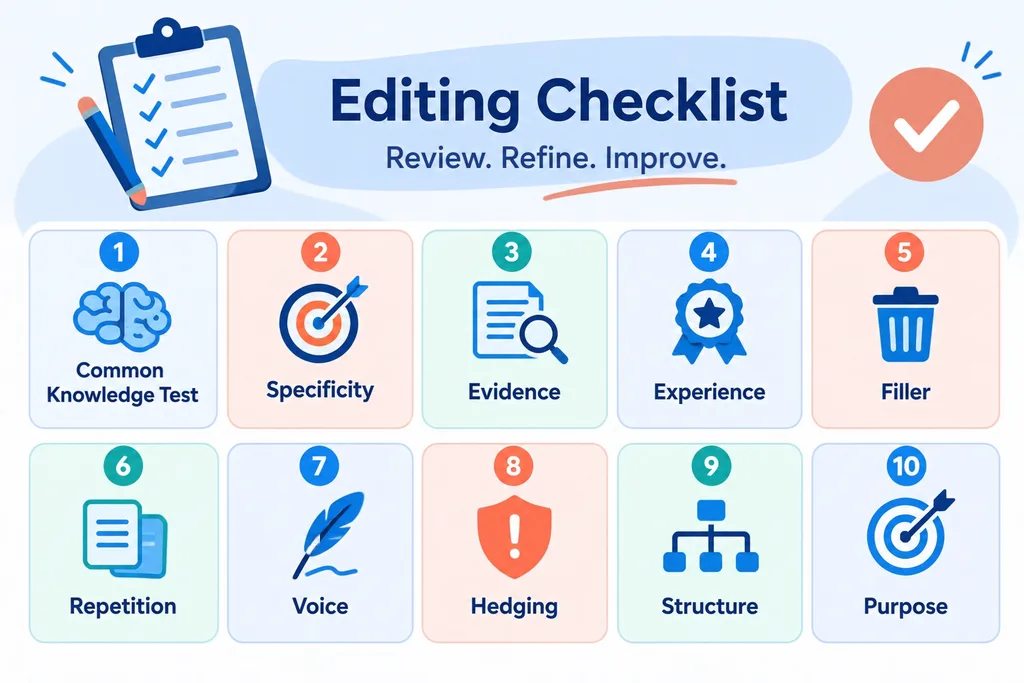
The Editing Checklist: Making AI-Assisted Text Original
These checks target the patterns Google’s guidance and the rater guidelines describe: common knowledge, paraphrase of well-known sources, filler, and generic phrasing.
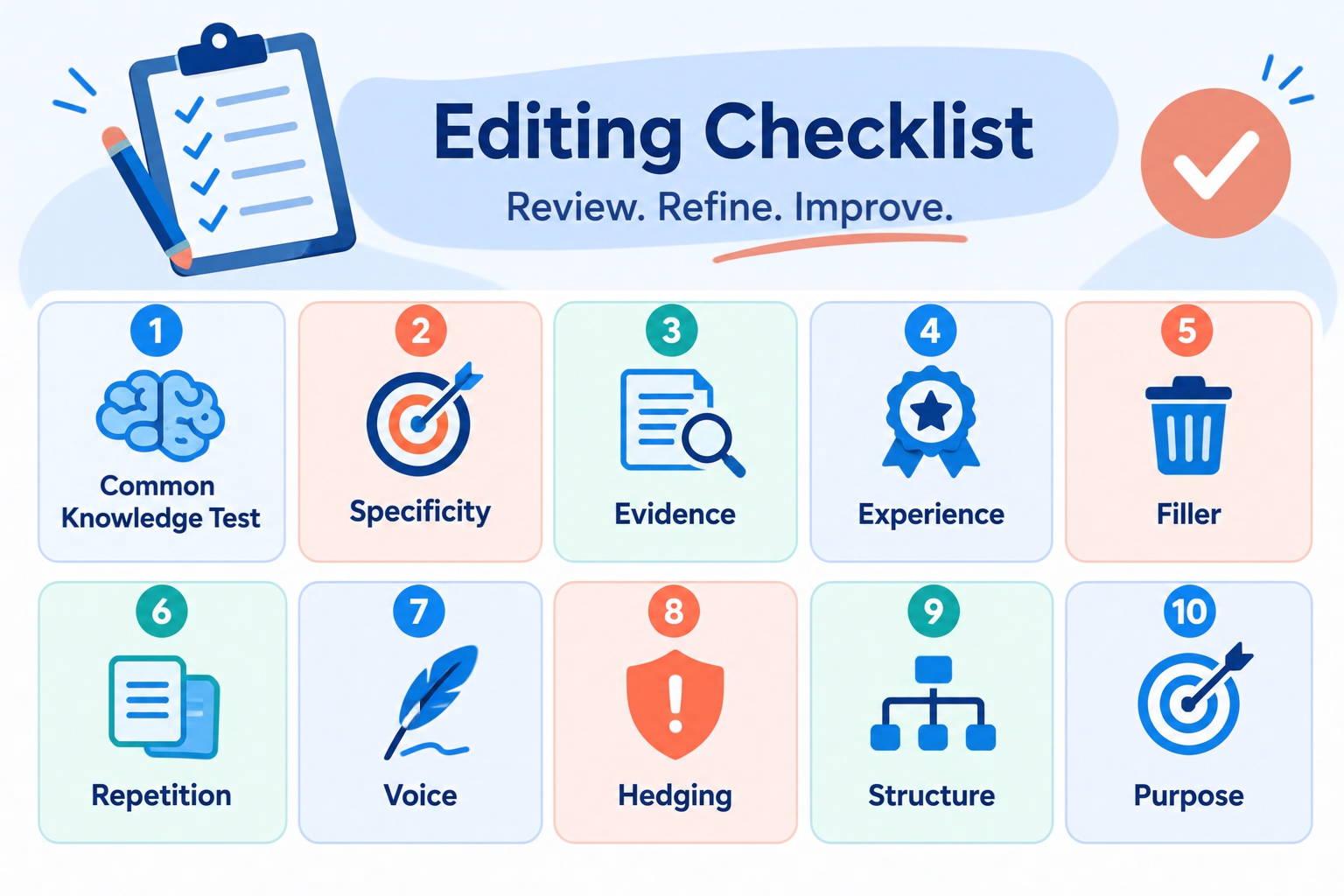
| Check | Question to ask | Fix |
|---|---|---|
| Common knowledge test | Would a reader learn this from any top result? | Add your own data, example, or judgment, or cut the passage. |
| Specificity | Does each claim name who, how many, when, or under what condition? | Replace “many” and “often” with facts or remove them. |
| Evidence | Is each factual claim supported by a primary source or your own data? | Add the source and date, or remove the claim. |
| Experience | Is there something only someone who did this would know? | Add a real example, a failure, or a constraint. |
| Filler | Does a paragraph exist only to add length? | Delete. Google warns that filler can make a page look rich but lack value. |
| Repetition | Do sections restate each other? | Merge or cut. |
| Voice | Does it sound like your organization? | Rewrite stock phrases in your normal wording. Remove leftover AI phrasing. |
| Hedging and certainty | Are uncertain points marked uncertain and certain points stated plainly? | Fix both over-hedging and false confidence. |
| Structure | Does each section open with the point? | Move the answer to the first sentence. |
| Purpose | Would you be comfortable showing this to the customer it is meant for? | If not, revise or retire. |
A before-and-after example (illustrative)
The passages below are invented to show the editing pattern. They are not from any real site.
| Generic AI-style passage | Improved passage (with placeholders for your real data) |
|---|---|
| Regular maintenance is important for keeping your heating system running efficiently and can help prevent costly repairs down the line. | In our service records for [period], the most common cause of winter breakdowns was [specific fault, from your own records]. A [specific task] at [timing] takes about [time] and, in our experience, avoids most of these calls. [Replace with your real finding or remove.] |
| There are many factors to consider when choosing a provider, such as price, quality, and reputation. | Three questions separate good providers from poor ones: [question 1], [question 2], and [question 3]. We list what a good answer looks like below, based on [your source of experience]. |
The second column is better because it carries information only the author could supply, not because the wording is fancier.
The Fact-Check Protocol
Google’s documentation says models predict likely word sequences and can produce inaccurate output, and that manual fact-checking is critical. Make it a defined step with an owner.
| Claim type | How to verify | Standard before publishing |
|---|---|---|
| Statistics and study findings | Open the original source and confirm the figure, date, sample, and method | Link to the primary source. If you cannot open it, remove the figure. |
| Quotes | Confirm the exact words with a published source or the person | Never publish a quote you could not verify. |
| Company, product, and pricing facts | Check the official page or contact the company | Date the information. |
| Legal, medical, financial claims | Review by a qualified person | Do not publish advice you cannot back, and add appropriate caution. |
| Technical steps and code | Run or test them | Do not publish untested instructions. |
| Names, titles, dates | Check against a reliable record | Correct or remove. |
| Links | Click every link | Fix or remove broken or wrong links. |
| Metadata and alt text | Read them against the page | Make sure they describe the real content. |
- Highlight every checkable claim in the draft.
- Trace each one to a primary source and note it beside the claim.
- Remove or rewrite any claim you cannot confirm.
- Have a second person check a sample of the first person’s work.
- Log the check with date and initials, so you can show the review happened.
Authorship, Disclosure, and Trust
Google’s helpful content guidance frames this as three questions: who created the content, how it was created, and why. Answering them honestly is part of AI content optimization.
Who
Use real bylines that link to real author pages. Google specifically names AI-generated headshots, made-up names, and false credentials as signs of deceptive authorship. If a person did not write or review the page, do not imply that they did.
How
Google suggests explaining how automation or AI was used where readers would reasonably want to know. A short note is usually enough. Examples of wording you can adapt:
- “This article was drafted with the help of an AI tool from our own notes and reviewed, fact-checked, and edited by [name], [role].”
- “We used AI to help organize our research. All figures were checked against the sources linked above.”
- “AI tools were not used to write this article.” (Only if true.)
Decide on a consistent policy across the site. The exact placement is a judgment call, and Google’s documentation does not prescribe a format.
Why
The purpose should be to help the people who use the page. If the honest answer is “to rank for a keyword,” revisit Step 1.
Images and product data
For AI-generated images, Google’s guidance mentions adding metadata where appropriate. For ecommerce, the same page says AI-generated images in Merchant Center must include the IPTC DigitalSourceType metadata “TrainedAlgorithmicMedia,” and AI-generated product titles and descriptions must be specified separately and labeled. Confirm current requirements on Google’s page, since they change.
Scale: When More Is Too Much
The scaled content abuse policy is the clearest risk for teams that publish at volume. Google’s examples include generating many pages with AI without adding value, scraping and transforming content, stitching together content from other pages, creating multiple sites to hide scale, and producing many keyword pages that make little sense. Google’s page also says that if you host such content, you should exclude it from Search. Read the guide on AI Overviews Are Changing SEO and Organic Traffic
Use these questions before publishing a batch:
- Does each page serve a distinct need, or are they variations of one page?
- Does each page contain information that is specific to its topic and not merely swapped keywords?
- Has a person reviewed and edited each page, not just a sample?
- Would the pages still exist if search engines did not?
- Can you explain, in one sentence per page, what a reader gains?
If the answer to any of these is no, slow down. Publishing fewer, better pages is safer than scaling a template, and no volume of pages is guaranteed to rank.
Audit the AI-Assisted Content You Already Have
Many teams now have a backlog of AI-assisted pages. A triage process helps you decide what to do.
- Inventory. List pages that used AI, and record publish date, author, traffic, conversions, and last update.
- Score each page against the editing checklist and fact-check protocol, for example pass, needs work, or retire.
- Check performance. Compare impressions, clicks, and conversions in Search Console and analytics.
- Decide. Choose one action for each page.
- Record the decision and the date.
| Situation | Likely action |
|---|---|
| Valuable topic, generic text | Rewrite with original inputs, fact-check, add byline and review |
| Accurate but thin, overlaps another page | Merge into the stronger page and redirect |
| Inaccurate or outdated | Fix urgently or remove |
| No clear reader or purpose | Retire (remove, and use the appropriate status code or redirect) |
| Strong performance, good quality | Keep, add disclosure and update schedule |
| Low value but required for other reasons | Keep but do not promote, and improve when resources allow |
Google’s spam policy says that content which violates the scaled content policy should be excluded from Search if you host it. Use judgment, and where a page is clearly low value, removing it is better than leaving it. Do not delete pages that serve users just to reduce page count.
Writing a Team AI Content Policy
A short written policy prevents most problems. This template covers the points that matter. Adapt it to your organization and have the appropriate people review it.
| Policy section | What to specify |
|---|---|
| Allowed uses | Research support, outlines, drafting from supplied material, editing suggestions, metadata options |
| Prohibited uses | Inventing facts, quotes, statistics, reviews, or author identities. Publishing unreviewed output. Using AI to mass-produce pages without added value. |
| Inputs | What material may be shared with AI tools, including confidentiality and client data rules |
| Review | Who edits, who fact-checks, who approves, and what must be logged |
| Disclosure | When and how the use of AI is disclosed to readers |
| Authorship | Who may be named as author or reviewer, and what that implies |
| Metadata and images | Rules for titles, descriptions, alt text, and AI-generated images |
| Legal and compliance | Topics that need expert review, and rules for regulated claims |
| Measurement | How quality and performance are tracked |
| Review of the policy | Who updates it and how often |
Measuring Whether It Works
Measure outcomes you can verify, and avoid vanity checks such as an AI detector score.
| Metric | Where to get it | What it tells you |
|---|---|---|
| Indexing status of new pages | Search Console | Whether pages are being included |
| Impressions and clicks over time | Search Console | Whether pages earn visibility and visits |
| Engagement and conversions | Analytics | Whether readers find the page useful |
| Fact-check error rate | Your review log | How many errors the draft contained before review |
| Edit time per page | Your workflow tool | Whether the process is efficient |
| Corrections after publication | Reader feedback and support tickets | Whether checks are catching errors |
| AI citations and mentions | Prompt audits and platform reports | Whether the page is being used in AI answers |
For AI visibility measurement, see our guides to tracking your website visibility in AI search and [the KPIs marketers should track. Compare AI-assisted pages with similar human-written pages of the same age and topic to avoid blaming or crediting the tool for what is really a quality or authority difference.
Common Mistakes
- Treating the draft as the product. The draft is raw material, and the edit is where value is added.
- Letting AI supply the facts. Supply the facts and have the tool help with wording and structure.
- Skipping the fact-check. Fluent text is often wrong in small ways.
- Chasing detector scores. Detectors are imperfect, and passing one does not make a page helpful.
- Rewording instead of adding. Paraphrase is not originality.
- Faking authorship. Invented authors and headshots are named as deceptive in Google’s guidance.
- Scaling before proving quality. Test a small batch, review it properly, and measure it.
- Ignoring metadata. Titles, descriptions, and alt text need review too.
- Hiding the process. Where readers would want to know, explain how the content was made.
A 30-Day Implementation Plan
Week 1: Rules and roles
Write the AI content policy, assign editors and fact-checkers, and create the brief template and the review log.
Week 2: Pilot
Choose three pages with clear business value. Gather original inputs, build briefs, and run the full workflow, including fact-check, byline, and disclosure.
Week 3: Audit
Inventory existing AI-assisted pages, score a sample against the checklist, and choose actions for the weakest high-value pages.
Week 4: Measure and refine
Compare the pilot pages with similar pages, review the error log and edit time, and adjust the workflow. Decide what to scale, with the scale questions above as a gate.
Worked Example (Illustrative)
This is a hypothetical scenario, not a case study. A small accounting firm uses AI to draft 30 blog posts about tax topics in a month. A review finds that most posts restate common guidance, two contain outdated thresholds, and none has an author or review note. The firm decides to pause new volume.
It scores the 30 posts against the checklist, keeps eight with clear value, merges nine overlapping posts into three stronger guides, corrects the two outdated pages first, and retires the rest. For the kept pages, a named accountant adds examples from client questions (with permission and without identifying details), checks every figure against official sources, and signs off. Each page gets a byline, a review line, and a short note on how AI was used. The firm then publishes two new pages a month, each built from client questions and reviewed by a person. It tracks indexing, impressions, enquiries, and corrections. Nothing in this plan promises rankings or citations, and the firm treats the results as evidence to learn from.
What Is Still Uncertain
- How Google’s systems treat AI-assisted content internally. The documentation describes principles, not detection methods.
- How reliable AI detectors are for any individual page. Ahrefs itself says they are imperfect.
- Whether disclosure affects performance in any way. No source we read measured this.
- How the guidelines and policies will change. The pages we read were updated in August to October 2026.
- How other AI search platforms judge originality. Most do not publish their criteria.
Stay close to the stable principles: help readers, be accurate, and be accountable.
Frequently Asked Questions
Does Google penalize AI-generated content?
Google’s guidance says the concern is value and manipulation, not the production method. It says AI can help with research and structure, and that generating many pages without adding value may violate its scaled content abuse policy. Quality still matters.
Can AI-assisted content rank?
Yes. Ahrefs’ 2026 study found AI-heavy pages in top results, though most top pages were not mostly AI, and AI-heavy pages had lower indexation and impressions on average. The study is correlational and no ranking is guaranteed.
Do I need to disclose that I used AI?
Google suggests explaining how content was created, including automation or AI, where readers would reasonably want to know. It does not prescribe a format. Be honest and consistent.
How do I make AI-assisted content original?
Supply information the model cannot invent, such as your data, experience, examples, and expert judgment. Rewording alone is not originality. Use the common knowledge test: if every top result says it, add something or cut it.
Do AI detectors tell me if my content is safe?
No. Detectors are probabilistic and imperfect, and Google does not describe passing one as the goal. Judge a page by whether it is accurate, original, helpful, and reviewed by a person.
How should I fact-check AI-generated content?
Highlight every checkable claim, trace it to a primary source, remove anything you cannot confirm, verify quotes and links, and log the check. Google says manual fact-checking is critical.
Is it safe to publish AI content at scale?
Scale is the main risk. Google’s spam policy targets many pages produced mainly to manipulate rankings with little value, however they are made. Test small batches with real review before scaling, and ask whether each page serves a distinct need.
Should I name an AI tool as the author?
Name real people who are responsible for the content, and describe AI use in a process note. Google names deceptive authorship, such as fake names or AI headshots, as a sign of low quality.
Conclusion
AI makes it easy to produce content and hard to produce content that is worth reading. Google’s documents are consistent on the point: the tool is not the issue, value and honesty are. Use AI for research and structure, bring your own evidence and experience, check every fact, show who is responsible, and explain how the work was done.
Start with a written policy and a pilot of three pages. Review them properly, measure them, and refine the process before you scale. A smaller set of original, accurate pages will serve your readers, and your search visibility, better than a large set of pages that say what everyone else says.
Next step: Read our complete guide to generative engine optimization
References
- Google Search Central: Guidance on using generative AI content
- Google Search Central: Spam policies for Google web search
- Google Search Central: Creating helpful, reliable, people-first content
- Search Engine Land: Google quality raters and AI-generated content
- Ahrefs: Google Doesn’t Punish AI Content; It Punishes Bad Content