Search used to be a matching game. You typed words, the engine found pages containing those words, and optimizing meant placing the right words in the right places. That is no longer a good description of what happens. Today’s systems try to work out what a query means, what the person is trying to do, and which pages and facts best address it.
This guide explains semantic SEO: what Google says about how it understands language, what entities and intent are, what site owners can and cannot influence, and how to turn all of it into a practical workflow. It also separates documented facts from popular claims, because this topic attracts a lot of confident but unsupported advice.
Semantic SEO is the practice of optimizing for meaning instead of exact keywords. It means covering a topic thoroughly, making clear which entities (people, places, organizations, products, concepts) you discuss, and matching the intent behind the query. Google documents systems that interpret concepts and meaning, but it does not publish a “semantic score,” and no technique guarantees rankings.
From Keywords to Meaning
The shift happened gradually. Google’s own ranking systems guide lists several systems built to interpret language, and it notes that Hummingbird, a major improvement to its overall ranking systems made in August 2013, has continued to evolve. The practical consequence is the same: a page can be relevant to a query without containing the exact words, and a page that repeats the exact words can still be irrelevant.
The vocabulary
| Term | Plain meaning | Example |
|---|---|---|
| Keyword | The words a person types or says | “best running shoes for flat feet” |
| Topic | A subject area made up of related questions and subtopics | Choosing running shoes |
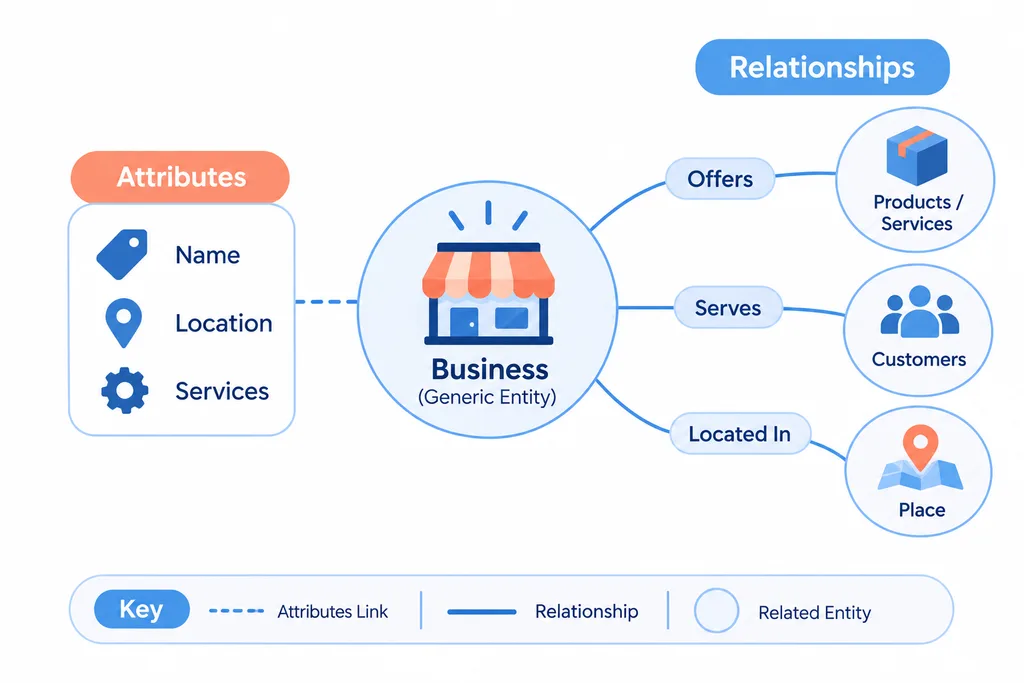
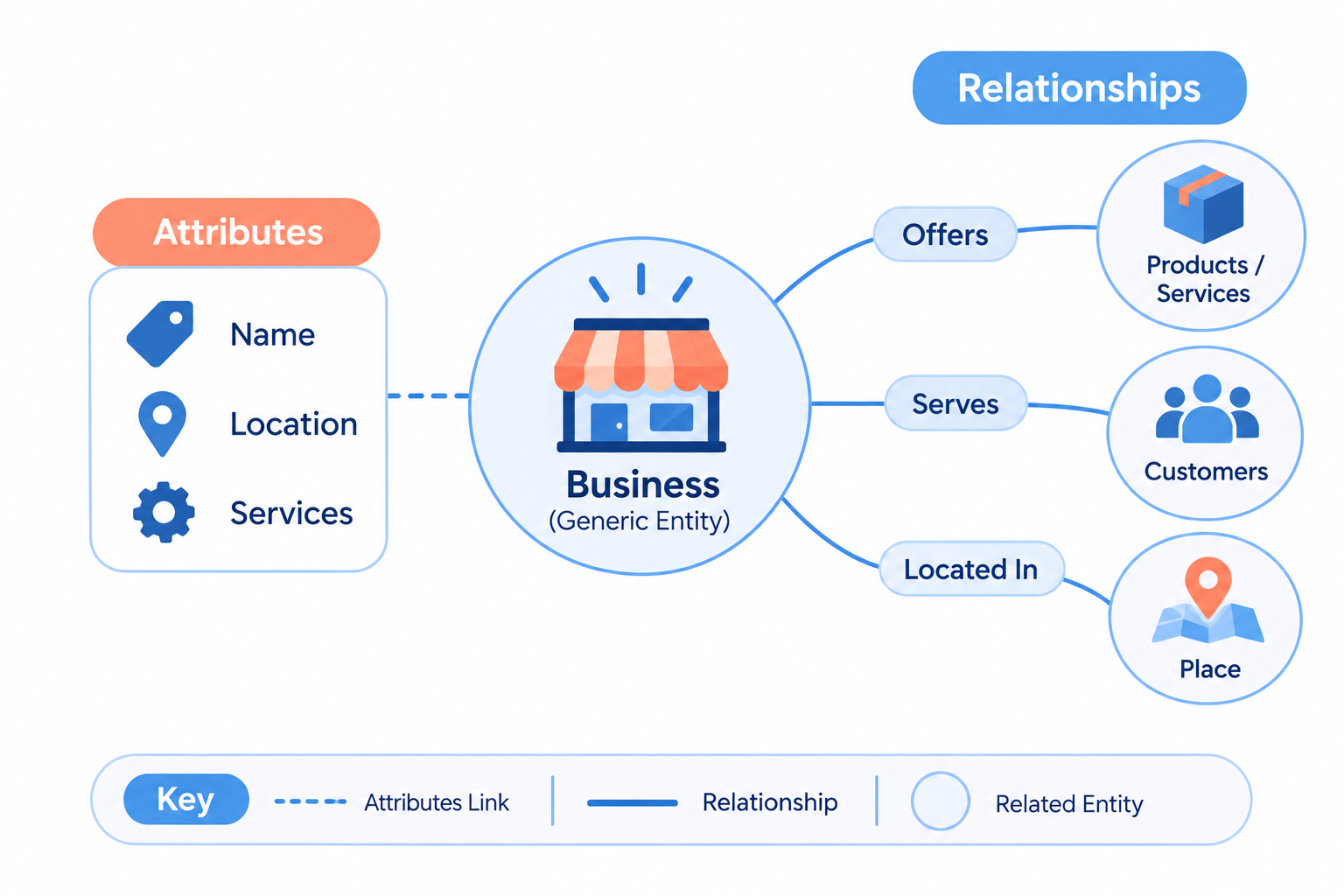
| Entity | A distinct, identifiable thing such as a person, place, organization, product, or concept | A specific shoe brand, a city, “plantar fasciitis” |
| Attribute | A fact about an entity | A shoe’s weight, drop, price, or cushioning type |
| Relationship | How entities connect | A shoe model belongs to a brand and suits a type of runner |
| Intent | What the person wants to achieve | Compare options before buying |
| Context | Details that change the best answer | Location, device, earlier searches, season |
Semantic SEO is the habit of working at the level of topics, entities, and intent instead of one keyword per page.
What Google Says About Understanding Queries
Google’s ranking systems guide describes several systems that deal with language and meaning. The page showed a last updated date of December 10, 2025 when read. The descriptions below are Google’s, paraphrased closely.
| System | What Google says it does | Status noted on the page |
|---|---|---|
| BERT | An AI system that helps understand how combinations of words express different meanings and intent | Active |
| RankBrain | An AI system that helps understand how words are related to concepts | Active |
| Neural matching | An AI system used to understand representations of concepts in queries and pages | Active |
| Passage ranking | An AI system used to identify individual sections or passages of a page | Active |
| MUM | An AI system capable of understanding and generating language | Google says it is not currently used for general ranking in Search |
| Freshness systems | Show fresher content for queries where it would be expected | Active |
| Deduplication and site diversity | Avoid unhelpful duplication and show no more than two listings from the same site in top results in general | Active |
Several points follow from this. Google says its systems relate words to concepts, so you do not have to match phrasing exactly. It says it can evaluate individual passages, so a clear section can help even on a broad page. It says MUM is not used for general ranking, a useful reminder that popular articles sometimes overstate which system does what. And the page also tells you that older named systems such as Panda and Penguin were folded into core ranking systems, so the field of named algorithms is smaller and more stable than the news cycle suggests.
What the page does not give you is a recipe. Google describes what systems aim to do, not how to trigger them. Treat these descriptions as design principles: be clear about meaning, be thorough on a topic, and write passages that stand on their own.
Entities: How Search Engines Represent Things
The Knowledge Graph in Google’s words
Google’s help page describes its Knowledge Graph as a database of billions of facts about people, places, and things, used to surface publicly known factual information when helpful. It says the data comes from public sources, licensed data for items such as sports scores and weather, and information from content owners, including suggested changes to claimed knowledge panels. The page does not explain how entities are linked to one another, so be cautious about detailed claims on that point.
Knowledge panels: what you can and cannot do
Google says knowledge panels are generated automatically when enough information exists on the open web, and that whether a panel displays is not something it would influence. Official representatives can claim and verify a panel and suggest changes, and others can use the feedback link. Google’s help pages do not describe a way to request or pay for a panel. Any service that promises to “create your knowledge panel” is promising something Google says it controls automatically.
For local businesses, Google points to Business Profiles, which resemble knowledge panels for businesses that serve customers at a location or within a service area.
How a machine reads your page: a useful demonstration
Google Cloud’s Natural Language API gives a window into the idea of entity analysis. Its documentation says an extracted entity has a name, a type (such as person, location, organization, event, work of art, or consumer good), metadata that can include a Wikipedia URL and a Knowledge Graph identifier when available, a salience score, and mentions in the text. Salience is described as the importance or centrality of the entity to the whole document, on a scale from 0 to 1.
This is a separate commercial tool, and Google does not say that Search uses it to rank pages. Treat it as a way to see your text through an entity-aware lens: if the entity you want a page to be about does not come out as the most salient one, a human reader may also find the page unfocused. Use it as a diagnostic, not a target.
What you can influence
- How clearly your pages identify entities. Use full names on first mention, consistent naming after, and context that disambiguates (for example, the location, category, or role).
- How much accurate, verifiable information exists about you. Consistent facts on your site and across reputable third-party pages make it easier for any system to confirm who you are.
- Organization and business data you provide. This includes structured data, Business Profile details, and claimed panels.
What you cannot control
- Whether Google creates a knowledge panel for you.
- Which facts the Knowledge Graph holds, beyond suggesting changes through official channels.
- How any system weights an entity internally.
Intent: What the Person Wants
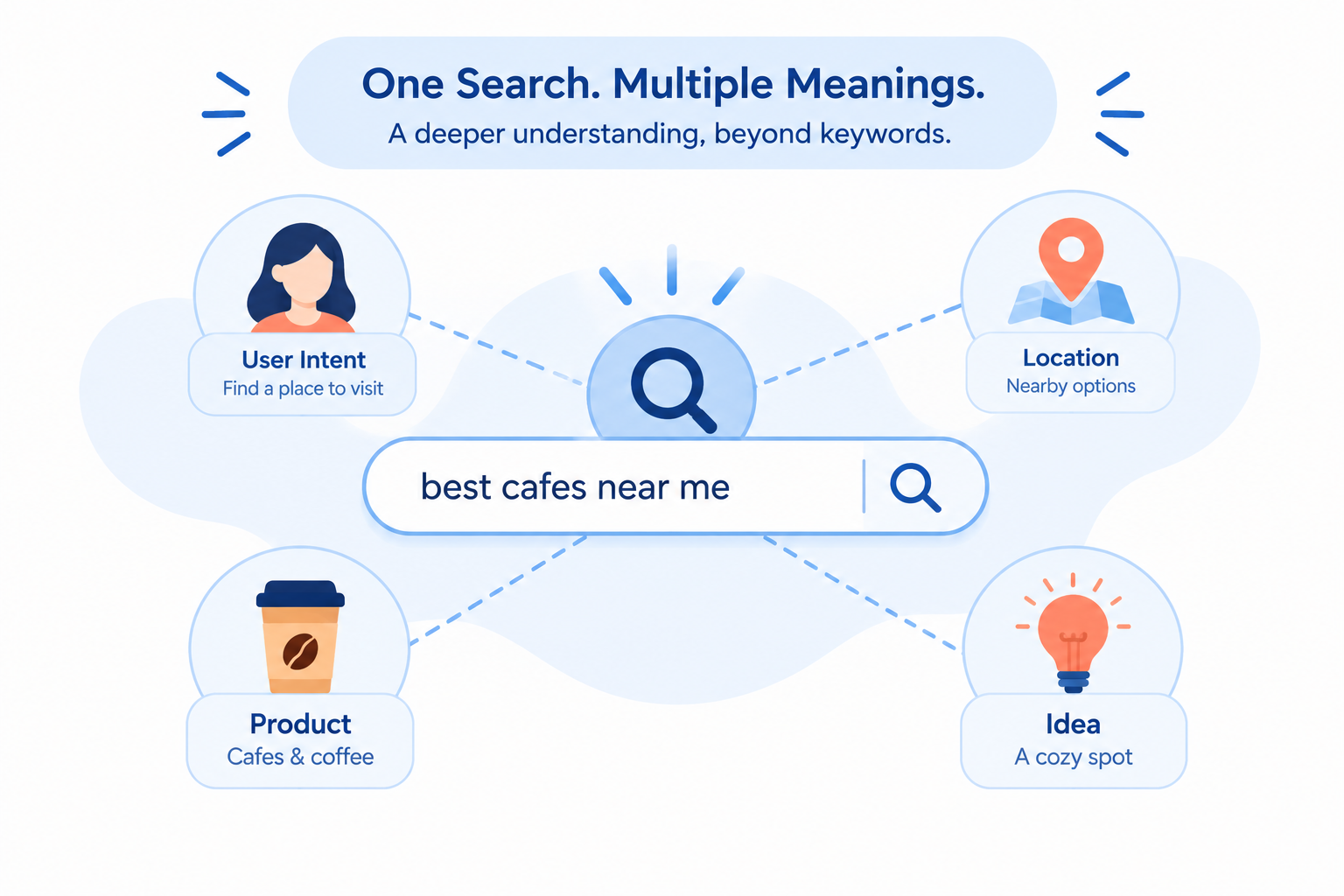
Understanding intent means working out what outcome the person wants, which is often more than the literal words. A search for “python” may mean the language or the snake. A search for “pizza” may mean a recipe, a menu, or delivery. Google’s systems use context and language understanding to decide, and your job is to make your page’s purpose obvious.
A practical set of intent types
The categories below are an industry convention, not a Google taxonomy. They are useful for planning, and real queries often mix them.
| Intent | The person wants to | Page that fits | Example query |
|---|---|---|---|
| Informational | Learn or understand | Guide, explainer, definition, tutorial | what is semantic SEO |
| Commercial investigation | Compare options before deciding | Comparison, review, buying guide | best CRM for small teams |
| Transactional | Do or buy something | Product, pricing, sign-up, booking page | book a boiler service |
| Navigational | Reach a known site or page | Brand, login, or contact page | brand name login |
| Local | Find something nearby | Location page, profile, directions | dentist near me |
| Troubleshooting | Fix a problem | Step-by-step help, diagnostic guide | printer offline fix |
How to read intent from the results
The most reliable evidence is what Google already shows for the query. Search it in a clean browser and note what types of pages dominate (guides, product pages, videos, forums, local results), which features appear, and how results are structured. If every result is a product page and you publish an essay, the mismatch is your problem to solve, not Google’s. Results vary by user and location, so treat each check as a sample, and note the date.
Mixed and changing intent
Some queries serve several intents, and some change over time or by season. When results are mixed, one page can sometimes serve more than one need with clear sections, or you can create separate pages with clearly different purposes. Avoid creating near-duplicate pages for slightly different phrasings, since this invites cannibalization and wasted effort.
Intent in AI search
Google’s documentation says that AI Overviews and AI Mode use query fan-out, running related searches across subtopics and data sources. This means a single question can trigger several searches for related sub-questions, which is a practical reason to cover the full set of questions around a topic. Our guide to how AI Overviews are changing SEO and organic traffic in 2026 covers the traffic side.
Topics and the “Topical Authority” Debate
“Topical authority” is widely used in SEO to describe a site that covers a subject deeply and is trusted on it. The idea is intuitive. The concept of a named, measurable “authority score,” however, is not something Google documents.
In November 2023, Search Engine Journal reported that Google’s John Mueller replied to a Reddit thread questioning the concept. As reported, he agreed with a comment that called topical authority a repackaged form of relevancy, and he said SEOs should not worry about it. This was an informal comment, not official documentation, and the SEJ author’s own view was that no actual authority score exists at Google. We read the secondary report, not the original thread.
A sensible reading is this. Covering a topic thoroughly, accurately, and with clear structure is good practice because it helps readers and gives search systems more evidence of relevance. Treating “topical authority” as a metric you can raise by publishing a fixed number of articles is unsupported. Google’s helpful content guidance instead asks whether a page offers original information, covers a topic in a substantial and comprehensive way, and offers insight beyond the obvious.
What to do instead
- Cover the questions your audience actually asks, including follow-ups.
- Make each page’s purpose clear and distinct.
- Link related pages with descriptive anchor text so readers and crawlers can follow the topic.
- Show real expertise and first-hand knowledge in the content itself.
- Measure results page by page, instead of chasing a score.
A Semantic SEO Workflow
This 10-step workflow turns the concepts into work you can do. It does not require special tools, although tools can speed up parts of it.
Step 1: Define the core entities
List the things your business and content are about: your organization, products and services, locations, people, and the main concepts in your field. Write a one-line definition and a preferred name for each. This list becomes your reference for consistent naming.
Step 2: Collect the questions
Gather real questions from customers, sales calls, support tickets, site search, Search Console queries, and the results pages themselves. Group them by topic. Each group is a candidate for a page or a section.
Step 3: Map topics and intent
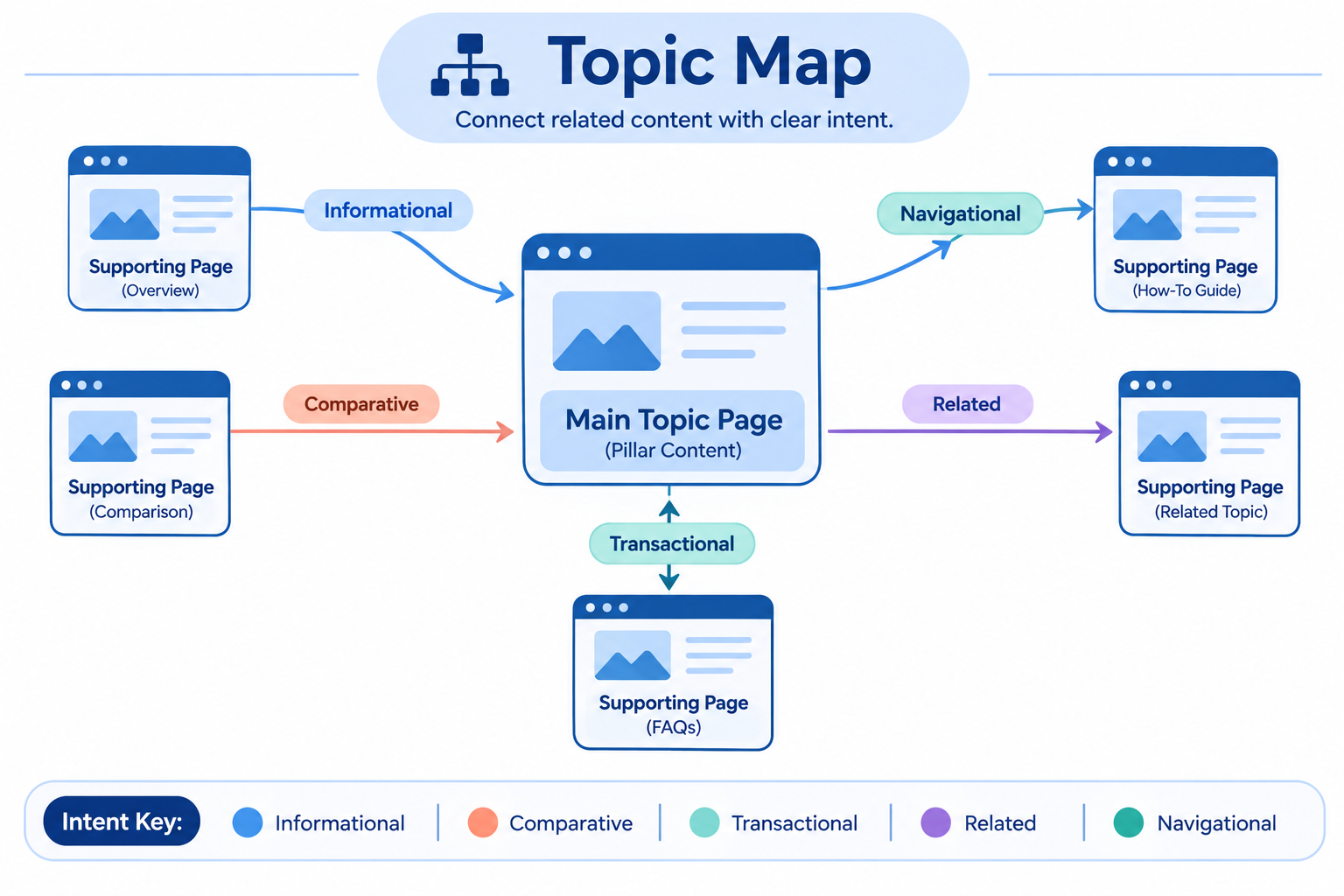
For each group, identify the main intent and the pages that already satisfy it in the results. Then build a topic map: a simple diagram or table showing a main topic, its subtopics, and the page that will serve each. Keep one main page per distinct intent.
| Topic | Main intent | Planned page | Supports | Status |
|---|---|---|---|---|
| [Main topic] | Informational | [Pillar guide] | [Subtopic pages] | [Draft, live, update] |
| [Subtopic A] | Informational | [Supporting article] | [Pillar] | [Status] |
| [Subtopic B] | Commercial investigation | [Comparison page] | [Pillar and service page] | [Status] |
| [Service] | Transactional | [Service page] | [Pillar] | [Status] |
Step 4: Check for cannibalization
Compare the map against existing pages. If two pages target the same intent, merge them, differentiate them, or redirect one. In Search Console, look for multiple pages of yours appearing for the same queries, then judge whether they serve different needs.
Step 5: Write with clear entities and attributes
Name things plainly and keep the naming consistent. Introduce each important entity with enough context to identify it. State relevant attributes (what it is, where, who for, how much, how it works) in the text, not only in images or scripts. Google advises keeping important content in text form.
| Unclear | Clearer |
|---|---|
| “Our platform helps teams do more.” | “[Product name] is a project management tool for [type of team]. It handles task tracking, time logging, and client reporting.” |
| “We have been serving the area for years.” | “[Business name] has provided [service] in [city and region] since [year].” |
| “It supports all major integrations.” | “It integrates with [named tools], and does not currently support [named gaps].” |
The clearer versions name entities, state attributes, and admit limits. Replace the bracketed placeholders with your real facts.
Step 6: Write passages that stand alone
Because Google describes passage-level understanding, give each section a clear heading and a direct opening statement that answers the heading’s question. Our guide on creating content that gets cited by AI search engines covers this writing style in detail.
Step 7: Build internal links around the topic
Link from the main page to each supporting page and back, using descriptive anchor text that says what the destination is about. Link between sibling pages where a reader would naturally go next. Google lists internal links among its recommendations for making content easy to find. Avoid generic anchors such as “click here.”
Step 8: Add structured data where it fits
Structured data gives machine-readable details that must match the visible page. See the next section.
Step 9: Align off-site information
Keep your name, address, descriptions, and key facts consistent across your site, Business Profile, social profiles, and reputable directories. Correct inaccuracies where you can.
Step 10: Review and maintain
Review pages on a schedule, update facts that change, merge or retire pages that no longer serve a distinct need, and update the topic map. Avoid changing dates without real changes, which Google lists as a warning sign in its helpful content guidance.
Structured Data: A Supporting Tool, Not a Shortcut
Structured data helps you state facts about the things on your page in a machine-readable way. Google’s Organization documentation says the markup helps Google understand an organization’s administrative details and tell it apart from others, and that some properties can influence visuals such as the knowledge panel.
| Property (from Google’s Organization page) | What it is for |
|---|---|
| name | The organization name, consistent with your site name |
| url | The organization website, which helps identify it uniquely |
| sameAs | URLs of other pages with information about the organization, such as social or review profiles |
| logo | A representative logo that is crawlable and indexable and meets Google’s size and format rules |
| address, contactPoint, telephone, email, description, legalName, foundingDate | Additional recommended details |
- No properties are required. Google recommends using the most specific applicable subtype, such as a LocalBusiness subtype for physical locations.
- Where to place it. Google says to add it to the home page or one page that describes the organization, such as an about page, not necessarily every page.
- No guarantee. Google states it does not guarantee that features that use structured data will show in results.
- Match the page. Google’s AI features guidance says structured data should match the visible text, and that you do not need special schema.org markup to appear in AI features.
- Validate. Use the Rich Results Test and the URL Inspection tool, as Google suggests.
In short, structured data is a clarity aid. It is worth doing accurately, and it is not a ranking trick. Over-focusing on it is something Google’s guidance cautions against for AI features.
Audit Your Entities
An entity audit checks whether your site and the wider web describe you clearly and consistently. A simple version needs a spreadsheet and some time.
- List your core entities from Step 1, with the preferred name and key facts.
- Check each page for consistent naming, clear first mention, and key attributes in text.
- Check your owned profiles, including Business Profile, social profiles, and directory listings, for consistent facts.
- Check third-party mentions for accuracy, and note errors you can ask to have corrected.
- Check search and AI answers for your brand and main products. Note what is correct, what is wrong, and what is missing.
| Finding | Typical fix |
|---|---|
| Different names for the same product across pages | Pick a preferred name and update pages |
| Missing key facts in page text | Add them in text, not only images |
| Outdated profile data | Update the profile or listing |
| Wrong facts in search or AI answers | Fix your source pages first, then correct third-party sources and use official feedback channels |
| No organization markup | Add accurate Organization or LocalBusiness markup to the home or about page |
| Two pages competing for one intent | Merge or differentiate |
A note on encyclopedias: some guides push readers to create Wikipedia pages for their brands. Wikipedia has its own rules, including a guideline on conflicts of interest, and editing about yourself or your client can cause problems. If notable coverage exists, let independent editors decide how to use it.
Semantic SEO and AI Search
Semantic SEO overlaps heavily with what AI search systems reward. They break questions into sub-questions, retrieve passages, and need to know which entity a passage describes. Clear entities, consistent facts, direct answers, and good coverage make your content easier to use for such systems. That is also good practice for classic search.
The caveat is that nobody publishes how any system selects sources, so none of this is a formula. Google’s own guidance for AI features is that standard SEO fundamentals apply and no special files or markup are required. For platform specifics, see our guides on GEO vs SEO and LLM SEO.
Myths to Drop
| Claim | What is supported |
|---|---|
| Google has a topical authority score | Not documented. A Google representative reportedly told SEOs not to worry about it. Treat it as a description of good coverage, not a metric. |
| More schema markup raises rankings | Google says structured data helps understanding and eligibility for features, and does not guarantee display. It is not described as a general ranking boost. |
| You can request or buy a knowledge panel | Google says panels are created automatically. You can claim and suggest changes to an existing one. |
| You need to repeat exact-match keywords | Google describes systems that relate words to concepts. Repetition is unnecessary and reads badly. |
| “LSI keywords” are a ranking tool | No Google source read for this article describes them that way. Think in terms of covering related concepts that a reader would expect. |
| Entity tools show how Google ranks you | Tools such as Natural Language API entity analysis show how one model reads text. They are diagnostic aids, not ranking simulators. |
| MUM ranks all pages | Google says MUM is not currently used for general ranking in Search. |
Measuring Semantic SEO
Semantic improvements are about coverage and clarity, so measure the outcomes that show whether pages serve the intent.
| Measure | Where to look | What it tells you |
|---|---|---|
| Queries per page | Search Console Performance report | Whether a page ranks for related questions, not only one phrase |
| Impressions and clicks by topic group | Search Console, with page groups | Whether your topic coverage is gaining visibility |
| Cannibalization | Search Console, queries with multiple URLs | Whether pages compete for one intent |
| Engagement and conversions by page | Analytics | Whether the page satisfies the intent |
| Branded search demand | Search Console branded queries | Whether recognition of your entity grows |
| Accuracy of facts in search and AI answers | Manual sample checks, dated | Whether entity information is correct |
| Internal link coverage | Crawl tool or site audit | Whether supporting pages are linked to and from the main page |
Avoid attributing a change to semantic work too quickly. Many things move rankings, so annotate your changes and look for sustained trends. For AI visibility specifically, see our guide to the KPIs marketers should track.
Common Mistakes
- Treating semantic SEO as a keyword list swap. Adding related terms mechanically misses the point.
- One page per phrase. This fragments topics and creates cannibalization.
- Ignoring intent. A page that does not match what the results show is unlikely to satisfy readers.
- Inconsistent naming. Different names for the same thing confuse people and machines.
- Marking up what is not on the page. Structured data should match the visible content.
- Chasing a knowledge panel. You cannot request or buy one, so focus on accurate facts.
- Publishing topic clusters without depth. Many thin pages are not coverage.
- Believing authority scores exist. Measure outcomes, not invented scores.
- Expecting guarantees. No technique ensures rankings or citations.
A 45-Day Plan
Days 1 to 15: Foundations
List core entities, preferred names, and definitions. Collect questions from customers, support, and Search Console. Group them into topics.
Days 16 to 30: Map and audit
- Build the topic map with intent and planned pages.
- Check existing pages against the map and note overlaps.
- Run the entity audit on your top pages and owned profiles.
- Choose the five pages with the biggest gaps or conflicts.
Days 31 to 45: Improve and measure
Fix naming, add missing attributes in text, merge or differentiate competing pages, improve internal links, and add accurate Organization or LocalBusiness markup. Record dates. Check Search Console and analytics after several weeks, and repeat the cycle quarterly.
Worked Example (Illustrative)
This is a hypothetical scenario, not a case study. A regional physiotherapy clinic has 40 blog posts, many targeting phrasings of the same question, such as several posts about lower back pain with slightly different titles. Search Console shows several of them appearing for the same queries, with none doing well. The clinic’s pages also call its treatments by different names, and its Business Profile lists an older address.
The clinic maps its topics and finds six distinct intents: understanding causes, home exercises, when to see a professional, treatment options, booking, and cost. It merges the overlapping posts into one strong guide per intent, redirects retired URLs, uses one name per treatment, and adds a short plain-language definition of each. It links each guide to the booking and cost pages with descriptive anchors. A physiotherapist reviews the content, and the clinic fixes the Business Profile address and adds accurate LocalBusiness markup to its home page. It then tracks queries per page, enquiries, and branded searches. It makes no promise about rankings and treats the results as evidence for what to do next.
What Is Still Uncertain
- How Google weights entity information relative to other signals. Its documents describe systems and goals, not formulas.
- How entities are linked in the Knowledge Graph. Google’s help page does not explain this.
- Whether and how other AI search platforms use entities. Most do not publish their methods.
- How much structured data affects AI answers. Google says no special markup is required for its AI features.
- How the systems change over time. The pages we read were updated in late 2025 and 2026.
Rely on principles that stay stable: be clear, be accurate, be thorough, and match intent.
Frequently Asked Questions
What is semantic SEO?
Semantic SEO is optimizing for meaning instead of exact keywords: covering a topic thoroughly, making clear which entities you discuss, and matching the intent behind the query. Google documents systems that interpret meaning, but it does not publish a semantic score.
What is an entity in SEO?
An entity is a distinct, identifiable thing such as a person, place, organization, product, or concept. Search systems represent entities and their relationships, and Google describes its Knowledge Graph as a database of facts about people, places, and things.
Does Google use topical authority?
Google does not document a topical authority score. A Google representative reportedly told SEOs not to worry about the term in 2023. Covering a topic thoroughly and accurately is still good practice.
Do I need schema markup for semantic SEO?
No markup is required. Google says Organization markup helps it understand and tell apart organizations, and that features using structured data are not guaranteed. Add accurate markup that matches the visible page, and treat it as a clarity aid.
Can I get a knowledge panel?
Google says panels are generated automatically when enough information exists on the open web, and it does not describe a way to request or pay for one. Eligible representatives can claim and suggest edits to an existing panel.
What are semantic keywords?
The term usually means related words and concepts a reader would expect on a topic. Covering them naturally is good writing. No source we read describes them as a ranking mechanism.
How do I find the intent behind a query?
Search the query in a clean browser and note the types of pages and features that appear. Combine this with your own customer questions, and treat the results as a dated sample.
How does semantic SEO help with AI search?
AI features break questions into sub-questions and retrieve passages, so clear entities, consistent facts, direct answers, and broad coverage make content easier to use. No source guarantees citations.
Conclusion
Semantic SEO is not a trick. It is the practical consequence of search systems that try to understand meaning: write about clearly identified things, cover the questions people have around them, and match what the reader is trying to do. Google’s documentation describes the systems and the principles, and it is equally clear about what you cannot control, such as whether a knowledge panel appears.
Start with a list of your core entities, a map of the questions around them, and an honest look at where pages overlap or confuse. Fix the foundations, measure by page, and keep the claims modest. A site that is clear to people is usually clearer to machines.
Next step: Read our complete guide to generative engine optimization
References:
- Google Search Central: A guide to Google Search ranking systems
- Google Search Central: Organization structured data
- Google Search Central: AI features and your website
- Google Search Help: How Google’s Knowledge Graph works
- Google Search Help: About knowledge panels
- Google Cloud: Natural Language API Entity reference
- Search Engine Journal: Google on topical authority, don’t worry about it