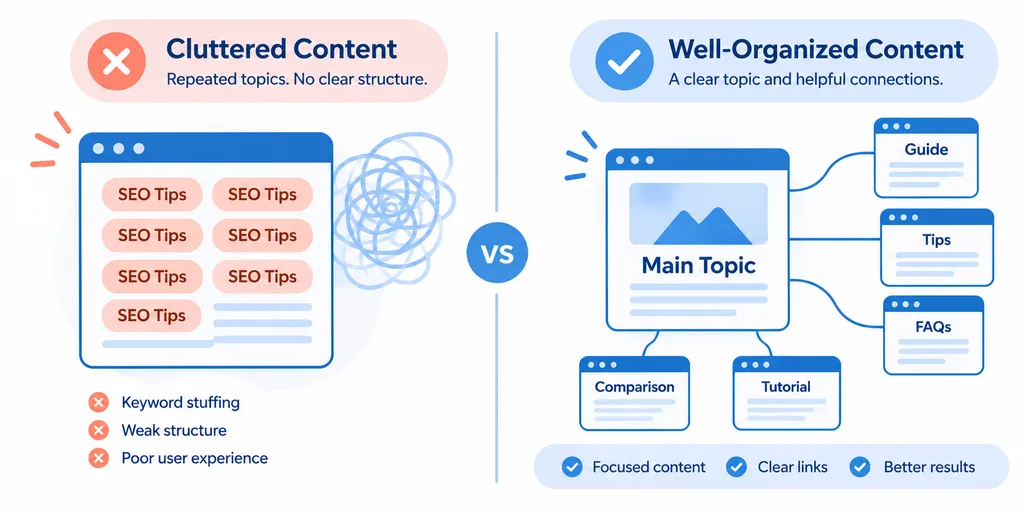
Few topics in SEO draw as many strong opinions as these two. One camp says you should still hit a target keyword density. Another says the only thing that matters now is “topical authority,” usually with a number of articles you must publish to earn it. Both can lead you astray, and they are not really opposites.
This guide compares topical authority vs keyword stuffing using what Google documents, what is only claimed, and what is reasonable to do. It explains how stuffing shows up today, what “topical authority” can sensibly mean, how to cover a topic well, and how to audit your own site. It makes no promises about rankings, because nobody can.
Keyword stuffing is a spam tactic that Google’s policies define as filling pages with keywords to manipulate rankings, and it makes text worse for readers. “Topical authority” is a popular label, not a documented Google score, for covering a subject thoroughly and credibly. What works in 2026 is writing naturally for a defined reader, covering the topic’s real questions, structuring the site clearly, and showing real expertise.
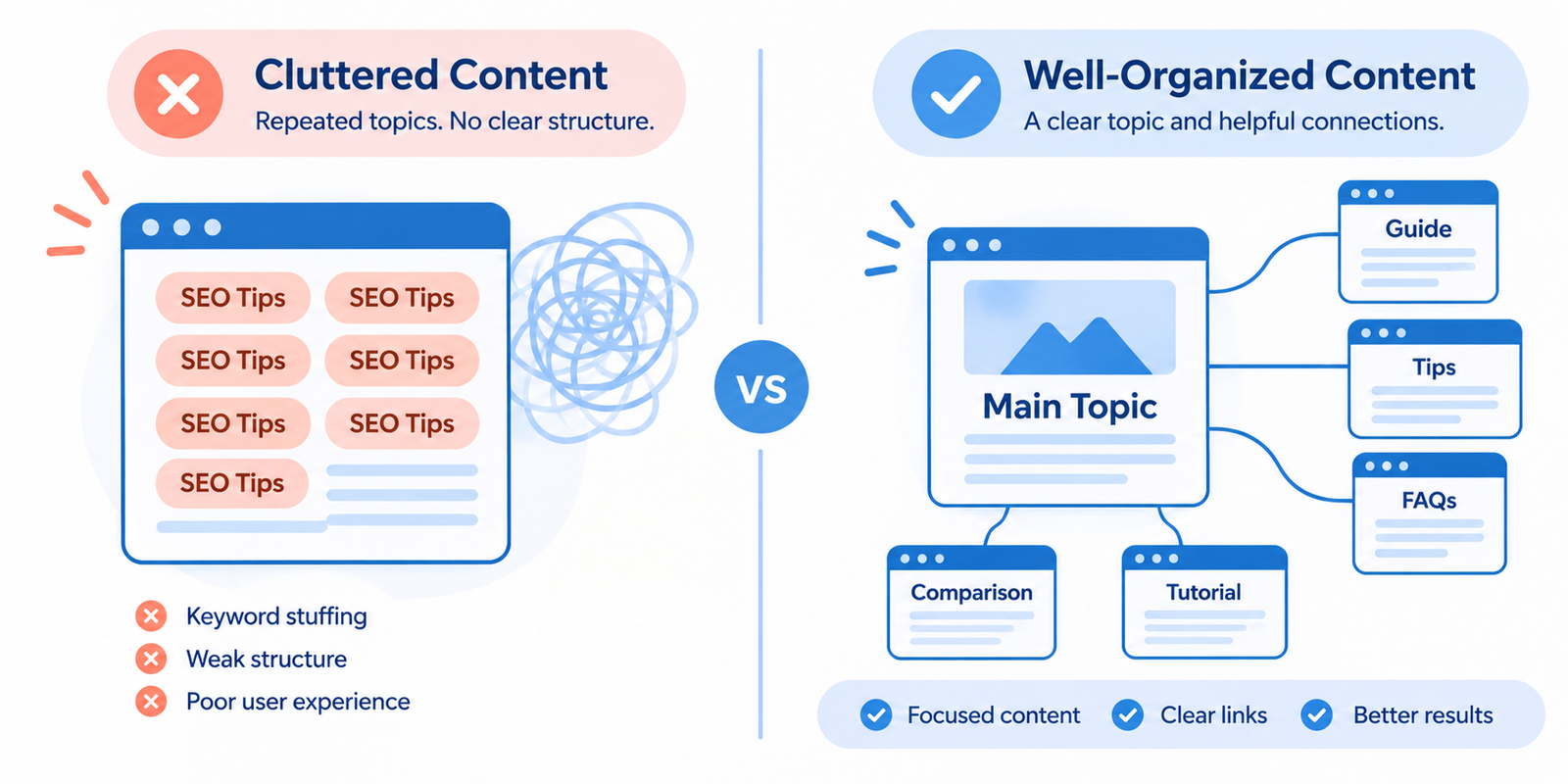
The Two Ideas, Defined
| Concept | What it is | Where it comes from | Status |
|---|---|---|---|
| Keyword stuffing | Filling a page with keywords or numbers to manipulate rankings, often in unnatural lists or out of context | Google’s spam policies | Documented policy violation |
| Keyword optimization | Using the words readers search for naturally in titles, headings, and text | Google’s SEO Starter Guide | Recommended good practice |
| Topical coverage | Answering the main questions and subtopics around a subject across your pages | Common SEO practice, consistent with Google’s helpful content questions | Good practice, no documented score |
| Topical authority | A label for a site seen as a credible, thorough source on a subject | SEO industry usage | Not a documented Google metric |
Notice that keyword optimization and keyword stuffing are different things. Using your target phrase in a title or heading is normal. Repeating it until the writing sounds robotic is the problem. And topical authority, as a phrase, is best read as a description of the outcome of good coverage and credibility, not as something with its own dial.
What Google Says About Keyword Stuffing
Google’s spam policies describe keyword stuffing as filling a web page with keywords or numbers to manipulate Search rankings, often in unnatural lists or groups or out of context. Its examples include lists of phone numbers with little added value, blocks of text listing the cities and regions a page is trying to rank for, and repeating the same words or phrases so often that the text sounds unnatural. The page showed a last updated date of August 28, 2026 when read.
Google’s SEO Starter Guide, last updated December 10, 2025 when read, adds practical context:
- It says to write content naturally, and that keyword stuffing is against Google’s spam policies.
- It notes that repeating the same words, even in variations, tires readers.
- It says you do not need to anticipate every variation of a query, because Google’s language systems can relate a page to many queries even without exact terms.
- It says varying your wording gives you more chances to appear, because you use more keywords naturally.
- It says content length alone does not affect rankings and that there is no target word count.
That last point is easy to miss. Many keyword density rules are really word count rules in disguise (“use the keyword once every 100 words”). Google’s guide gives no such target.
Hidden text is a separate policy
Google’s spam policies treat hidden text as its own section. It describes placing content so search engines can see it but visitors cannot easily view it, such as text matching the background color or positioned off-screen. The page also says that common show and hide elements such as accordions, tabs, sliders, and tooltips do not violate the policy. So the old trick of hiding keyword lists is a violation of a different rule, while a tab that shows real content is fine.
What the research adds
The paper that introduced generative engine optimization tested nine ways of changing source content and reported that keyword stuffing performed worse than the baseline, about 8% lower visibility in its tests, including on Perplexity.ai. That study concerns generative engines, not Google’s ranking, and we read it through a summarizing tool, so verify the figure in the paper. It is still a useful data point: the tactic did not help even in a system that retrieves text.
How Keyword Stuffing Looks in 2026
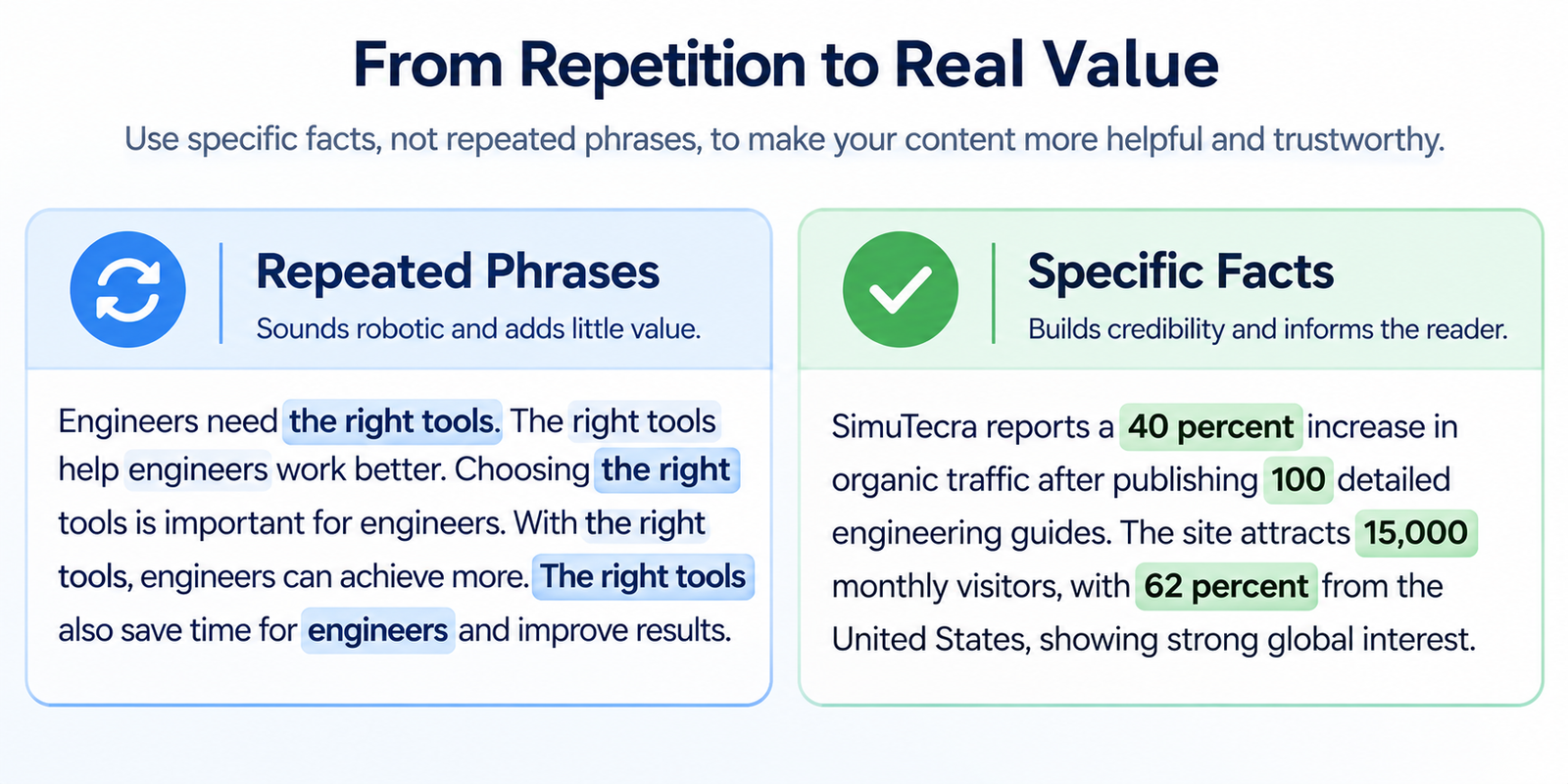
Classic stuffing, a paragraph that repeats a phrase twelve times, is rare in professional work. The modern forms are subtler, and they often appear by accident, especially in automated or templated content.
| Pattern | Why it is a problem | What to do |
|---|---|---|
| A block of cities or regions at the bottom of a page | Matches Google’s example of text listing places a page is trying to rank for | Create real location pages with unique value, or remove the block |
| Footer or sidebar keyword lists | Unnatural lists of terms with no reader value | Delete or replace with real navigation |
| The same phrase in every heading | Repetition that reads as unnatural | Use headings that say what each section covers |
| Near-identical pages for each variation of a phrase | Cannibalization, and may look like doorway or scaled content | Merge into one page that answers the intent |
| Title tags packed with terms | Google says a good title is unique, clear, concise, and accurately describes the page | Rewrite as a natural, accurate title |
| Alt text filled with keywords | Hurts accessibility and reads as manipulation | Describe the image plainly |
| Repetitive anchor text on every internal link | Looks over-optimized and is less useful to readers | Use descriptive anchors that vary naturally |
| Automated text that repeats the target phrase to hit a count | The output sounds unnatural and may add no value | Edit for meaning, and see the guidance on AI-assisted content |
| Hidden or off-screen keyword text | Violates the hidden text policy | Remove it |
A before-and-after example (illustrative)
The passages are invented for a fictional business. Replace the bracketed items with your real facts.
| Stuffed | Natural |
|---|---|
| Looking for the best emergency plumber in [City]? Our emergency plumber in [City] is the best emergency plumber [City] has. Call the best emergency plumber in [City] today for emergency plumber services in [City]. | If a pipe bursts or a drain backs up in [City], call [Business name] on [number]. A plumber is on call [hours], and we usually reach [districts] within [time, if true]. We fix burst pipes, blocked drains, and failed water heaters, and we give a price before we start. |
The second version still contains the words a searcher would use. It also contains specifics (hours, areas, services, pricing practice) that a reader can use. The first adds nothing a reader needs.
Is Keyword Density a Real Thing?
Keyword density is the percentage of words on a page that match a target phrase. Many tools still display it. Google’s SEO Starter Guide, as read for this article, does not set a density target, says there is no target word count, and says keyword stuffing is against its spam policies. No Google page read for this article recommends a specific density.
If your tool shows a density figure, use it only as a rough check for accidental over-repetition. Do not treat a number as a goal. A page can be perfect for a reader and show a low density, or read badly and show a high one.
Where keywords belong
| Place | Natural practice |
|---|---|
| Title element | Accurately describe the page. Include the main phrase if it fits naturally. |
| H1 and headings | Say what the page or section covers, using words readers use. |
| Opening paragraph | State what the page is about in plain language. |
| Body text | Write normally. Use variations because that is how people write. |
| URL | Short and descriptive. |
| Image alt text | Describe the image. |
| Meta description | Short, unique, and accurate to the page, since Google says snippets may draw on it. |
| Internal link anchors | Describe the destination. |
Reading the passage aloud is the simplest test. If you would not say it that way to a customer, change it.
What “Topical Authority” Can Sensibly Mean
The phrase is popular, and many guides present it as an official concept. It is not one in Google’s documentation.
What was reported
In November 2023, Search Engine Journal reported that Google’s John Mueller replied to a Reddit comment that described topical authority as a repackaged form of relevancy, and that he later said SEOs should not worry about it. The article’s own author argued that there is no actual authority score at Google. This was an informal comment, and we read the secondary report and not the original thread. It is a signal, not a policy statement.
A reasonable reading
Strip away the metaphor and the idea behind topical authority is reasonable. A site that answers the main questions about a subject, accurately and in depth, with clear structure and evidence of real expertise, is more useful than a site with one thin page on it. Google’s helpful content guidance asks the same kinds of questions: whether a page offers original information, covers the topic in a substantial and comprehensive way, offers insight beyond the obvious, and builds trust through sourcing and evidence of expertise.
What is not supported is the version that treats authority as a number you can raise by publishing a set quantity of posts. Nothing we read supports a magic count.
What the evidence is like
Search for topic cluster results and you will find many case studies with large percentage gains. The Search Engine Land topic cluster guide we read cites several such figures, but it also carries vendor affiliations and says nothing about controlled methods for those figures, and the guide itself lists caveats. These results are not controlled experiments. Sites that build clusters are usually also doing other things: improving content, fixing technical issues, earning links, and publishing more. We cannot separate the effect of the cluster from everything else.
So treat cluster case studies as stories that may inspire hypotheses, not as proof. Your own measurements, page by page, are better evidence for your site.
Head to Head: What Works and What Does Not
| Criterion | Keyword stuffing | Thorough topical coverage |
|---|---|---|
| Reader experience | Poor. Repetitive and unnatural. | Good when done with care. Clear, complete, and organized. |
| Google policy | Defined as spam when used to manipulate rankings | Consistent with helpful content guidance |
| Documented guidance | Google says it is against spam policies and tires readers | Google asks whether content is comprehensive and adds value |
| Evidence of effect | GEO paper reported worse visibility in its tests | Mostly vendor case studies, not controlled evidence |
| Durability | Risky and brittle | More durable, because it serves a real need, but not guaranteed |
| Effort | Low, with poor return | Higher: research, writing, structure, upkeep |
| Risk | Policy action or wasted effort | Wasted effort if pages are thin, duplicated, or unwanted |
| Fit for AI search | Poor | Better, because passages are clear and the topic is covered |
The comparison is lopsided, but there is a trap on the right side too. Thin or repetitive pages produced “for coverage” are just stuffing at the site level: many pages repeating the same point. Google’s scaled content abuse policy covers that case, and our guide to AI content optimization discusses it.
How to Cover a Topic Well
This workflow turns the idea into steps. It works for a small site with ten pages and for a larger site with hundreds.
Step 1: Pick the topics that matter to the business
Choose a small number of subjects tied to what you sell or what your customers need. A site cannot be thorough on everything. Prioritize topics where you have real experience and where customers actually ask questions.
Step 2: Gather the real questions
Collect questions from customers, sales conversations, support tickets, site search, and Search Console queries. Check the search results themselves for related questions and formats. Group them by subtopic and by intent.
Step 3: Check what the results want
For each question group, look at the results Google shows. Note the types of pages that appear, how comprehensive they are, and what is missing. Results vary by user and location, so treat each check as a dated sample. Our guide to semantic SEO and search intent covers how to read intent.
Step 4: Decide whether a cluster is worth it
Not every topic needs a cluster. The Search Engine Land guide itself notes that some topics are not worth clustering, such as broad head terms or results dominated by entrenched authorities. Ask whether you can add something real, whether you can serve the audience better than what exists, and whether the topic supports your business goals. If not, pick a narrower angle or leave it.
Step 5: Map the pages
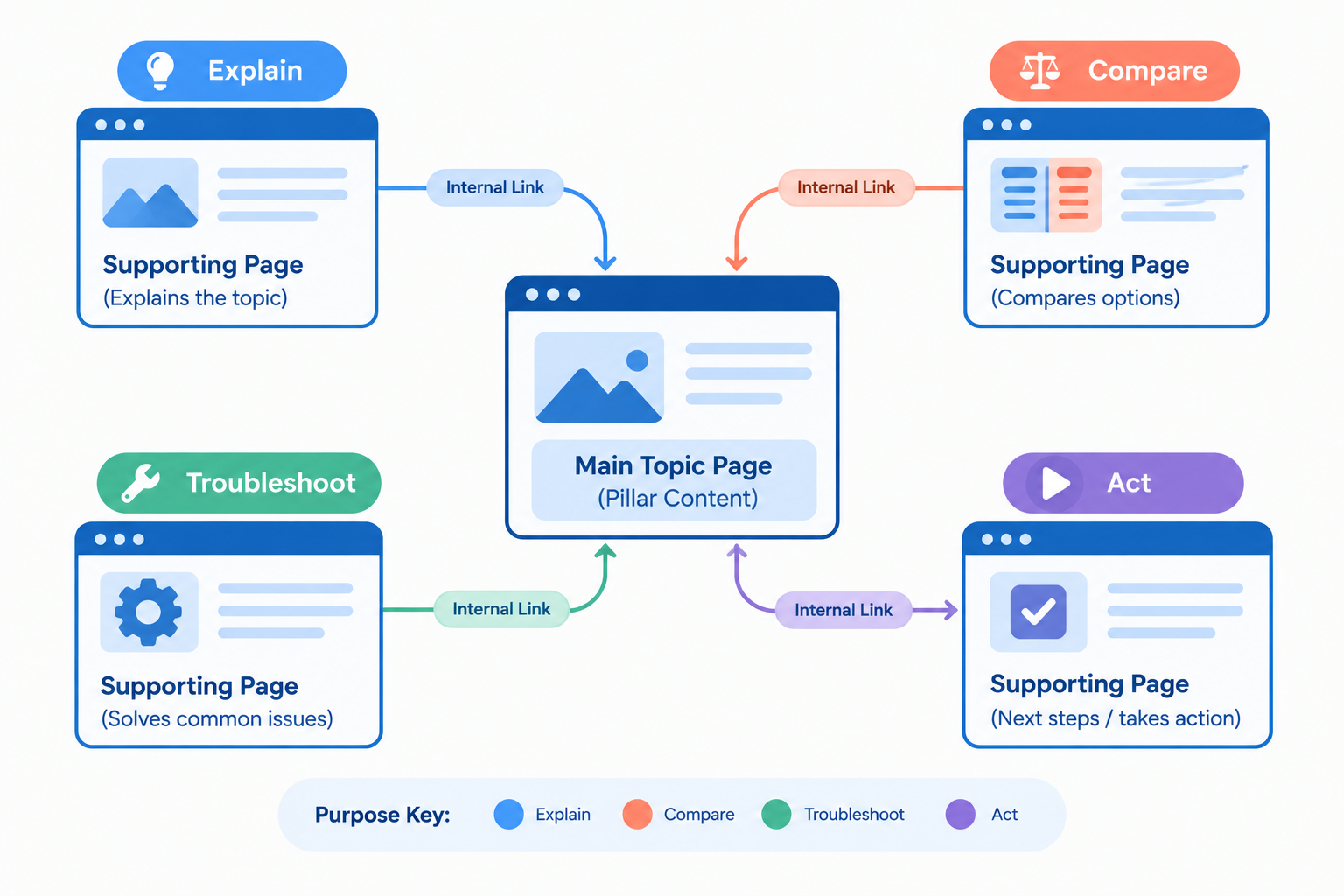
Create a simple map: one main page for the broad topic and supporting pages for distinct subtopics, each with a clear purpose and intent. Do not create separate pages for minor phrasing differences.
| Page role | Purpose | Example (placeholders) |
|---|---|---|
| Main guide | Explain the topic and help readers navigate it | [Complete guide to the topic] |
| Supporting article | Answer a specific question in depth | [How to do a specific task] |
| Comparison or decision page | Help readers choose | [Option A vs option B] |
| Troubleshooting page | Solve a common problem | [Fixing a specific issue] |
| Service or product page | Let readers act | [Your offer for this topic] |
Step 6: Write each page for its reader
Give each page one clear purpose. Open with the answer. Add original information: your data, examples, photos, process, and judgment. Cite sources for facts. Keep the language natural. Our guide on creating content that gets cited by AI search engines explains this writing approach.
Step 7: Link the pages sensibly
Google’s SEO Starter Guide says link text should describe the destination, and that links help users and search engines find other parts of your site. Link from the main guide to each supporting page and back, and between related pages where a reader would naturally go next. Vary anchor text naturally and avoid forcing the same phrase into every link.
Step 8: Avoid cannibalization
If two pages target the same intent, merge them, redirect one, or sharpen the difference. The Search Engine Land guide also warns that spokes with overlapping angles can cannibalize each other.
Step 9: Show real expertise
Add bylines linked to real author pages, explain how you know what you know, and have qualified people review sensitive content. Google’s guidance asks who created the content and how, and treats trust as central.
Step 10: Maintain the cluster
Review on a schedule. Update facts, merge pages that no longer serve a distinct need, and retire what is obsolete. Avoid changing dates without real changes, which Google lists as a warning sign.
Breadth, Depth, and When to Stop
People often ask how many articles they need. No source we read gives a number, and Google’s guide says there is no target word count. A better question is whether a reader who arrives at your site on this subject can find an accurate, complete answer to what they came to do.
| Situation | Reasonable approach |
|---|---|
| Small business with a few services | One strong page per service and a handful of helpful guides tied to real customer questions |
| Niche expert site | Deep coverage of a narrow subject, with original data or experience |
| Ecommerce | Category pages with useful buying guidance and product pages with unique details, instead of thin generated text |
| Local service business | Real location and service pages with unique details, reviews, and photos, instead of lists of cities |
| Publisher | Clear topic hubs with fresh, edited content and visible bylines |
| New site in a crowded topic | Choose a narrower angle where you can add something real, and be patient |
Depth beats volume. Twenty thin posts that restate each other do less for a reader than five thorough ones.
Audit Your Site for Both Problems
A short audit finds stuffing and coverage gaps in the same pass.
Part A: Find over-optimization
- Read your key pages aloud. Mark any sentence that sounds repetitive or odd.
- Check lists of places or terms at the bottom of pages, in footers, and in sidebars.
- Review titles, headings, alt text, and anchors for repeated phrases and unnatural wording.
- Look for near-duplicate pages that differ only by a keyword or place name.
- View the page with styles and scripts in mind, and make sure no text is hidden or off-screen on purpose.
Part B: Find coverage gaps
- List your main topics and the questions customers ask.
- Match each question to a page on your site, or mark it as missing.
- Check each page’s quality: accurate, original, up to date, and clear on purpose.
- Check internal links between related pages and descriptive anchors.
- Rank the gaps by business value and by effort, and pick the top few.
| Finding | Action |
|---|---|
| Repetitive text on a key page | Rewrite naturally with specifics |
| Keyword block in the footer | Remove |
| Many near-duplicate pages | Merge and redirect |
| Important question with no page | Plan a page, if you can add something real |
| Thin page on an important topic | Rewrite with original information, or merge |
| Related pages not linked | Add descriptive internal links |
Measuring Whether It Works
Measure at page and topic level, and be patient. SEO changes take time and many factors move results at once.
| Measure | Where to look | What it tells you |
|---|---|---|
| Queries per page | Search Console Performance report | Whether pages earn visibility for a range of related questions |
| Clicks and impressions by topic group | Search Console with page filters | Whether coverage is gaining visibility |
| Cannibalization | Search Console, queries with several of your URLs | Whether pages compete for one intent |
| Engagement and conversions | Analytics | Whether pages satisfy readers |
| Indexing status | Search Console | Whether pages are in the index |
| Reader feedback and sales notes | Support and sales teams | Whether content answers real questions |
| AI answer accuracy and citations | Dated prompt checks | Whether the topic is described correctly |
Annotate every change with a date, so you can see what moved after what. Avoid claiming a gain was caused by a single tactic. For AI visibility measures, see our guide to the KPIs marketers should track.
Common Mistakes
- Chasing a keyword density number. Google gives no target.
- Equating more pages with more authority. Thin pages are stuffing at the site level.
- Believing authority is a score. Google does not document one.
- Building a cluster for a topic you cannot add to. Some topics are not worth it.
- Creating near-duplicate pages for phrase variations. This invites cannibalization.
- Over-optimizing anchors. Descriptive and natural is better than identical.
- Hiding text to add keywords. This breaks a separate policy.
- Copying competitors’ outlines. Add something they lack.
- Treating vendor case studies as proof. They are stories, not experiments.
- Promising results. No tactic guarantees rankings.
A 90-Day Plan
Days 1 to 30: Audit
Run the over-optimization and coverage audits. Clean up stuffed text, footers, and hidden content. List customer questions and match them to pages.
Days 31 to 60: Fix and fill
Merge duplicates, rewrite the weakest important pages, and plan two or three new pages that answer real unanswered questions. Fix internal links and anchors. Add bylines and review notes where needed.
Days 61 to 90: Measure and refine
Compare queries, impressions, clicks, engagement, and conversions with the earlier period. Note what else changed. Decide what to expand, merge, or leave. Schedule quarterly reviews.
Worked Example (Illustrative)
This is a hypothetical scenario, not a case study. A small garden design studio has a services page that repeats “garden design [City]” in nearly every sentence, a footer listing 30 nearby towns, and eight blog posts with titles such as “Garden Design Tips” and “Top Garden Design Ideas” that cover the same ground. Rankings are flat, and Search Console shows several posts competing for the same queries.
The studio rewrites the services page in plain language with real projects, prices, and process, removes the footer list, and replaces it with three genuine location pages that describe projects in those areas. It merges the eight blog posts into three guides: choosing a style, planning on a budget, and working with a designer. It links the guides to the services page with descriptive anchors and adds a byline and a short note on the designer’s background. It then tracks queries per page, enquiries, and cannibalization over several months. It does not promise a ranking and treats the numbers as evidence for what to do next.
What Is Still Uncertain
- How Google weights topic coverage relative to other signals. Its documentation describes principles, not formulas.
- How much of the benefit reported in cluster case studies is due to clustering itself.
- Whether a given volume of content is enough. No source we read supports a number.
- How AI search platforms treat repetition or coverage. Most do not publish criteria, and the GEO paper tested only two engines.
- How spam policies will change. The page we read was updated in August 2026.
Stay with the stable principles: write naturally, serve the reader, and cover the subject honestly.
Frequently Asked Questions
What is keyword stuffing?
Google’s spam policies describe it as filling a page with keywords or numbers to manipulate rankings, often in unnatural lists or groups or out of context. Examples include repeating phrases until the text sounds unnatural and listing cities a page is trying to rank for.
Does Google penalize keyword stuffing?
Google says keyword stuffing is against its spam policies, and its SEO Starter Guide says it tires readers. How any specific page is treated depends on the page, so the safest course is to write naturally.
What is the ideal keyword density?
Google’s SEO Starter Guide sets no density target and no target word count. Treat density figures from tools as a rough check for accidental repetition, not as a goal.
Is topical authority a Google ranking factor?
Google does not document a topical authority score. A Google representative reportedly told SEOs in 2023 not to worry about the term. Covering a subject thoroughly and credibly is still good practice.
How many articles do I need to build topical authority?
No source we read gives a number. Focus on whether a reader can find complete, accurate answers on your site for the subject, and whether each page serves a distinct purpose.
Do topic clusters work?
Many guides report gains, but the case studies we reviewed were vendor-affiliated and not controlled. Clusters are a sensible way to organize content and internal links, but results depend on quality and competition, and nothing is guaranteed.
Can I still use my target keyword in titles and headings?
Yes. Using the words readers search for naturally in titles and headings is good practice. Google says a title should accurately describe the page and be clear and concise.
How do I fix a keyword-stuffed page?
Read it aloud, remove repetitive phrasing and keyword lists, rewrite with specifics a reader needs, and check for hidden text. Merge near-duplicate pages. Then watch how the page performs over several weeks.
Conclusion
Topical authority and keyword stuffing are not two ends of a dial. Keyword stuffing is a spam tactic that Google defines and discourages. Topical authority is a popular name for something simpler and harder: being a thorough, credible source on a subject. There is no documented score to chase and no density to hit.
What works is unglamorous. Write naturally for a defined reader, use the words your customers use, cover the real questions in depth, organize your pages and links so people can follow the topic, and show who is behind the content. Audit for repetition and gaps, measure page by page, and be honest about what you do not know. That approach holds up in classic search and in AI search alike, though no one can promise results.
References:
- Google Search Central: Spam policies for Google web search
- Google Search Central: SEO Starter Guide
- Search Engine Journal: Google on topical authority, don’t worry about it
- Search Engine Land: The complete guide to topic clusters and pillar pages (vendor-affiliated)
- Aggarwal et al., GEO: Generative Engine Optimization (arXiv, KDD 2024)