Ask whether AI content or human content performs better in search and you will get a confident answer from almost anyone, usually matching what they sell. Tool vendors say AI content ranks fine. Human-writing services say it does not. Both can point to a study.
This guide reads the studies side by side, including who ran them, what they measured, which detectors they used, and where they stop. It covers classic Google results and, separately, the sources AI search tools cite. It then explains why “AI versus human” is the wrong frame, what drives performance instead, and how to test the question on your own site. No source here proves what causes any gap, and nothing can guarantee a ranking.
In the studies reviewed, human-written pages are over-represented in top Google positions, and fully AI-generated pages appear less often there, but the studies are correlational, use imperfect detectors, and several come from vendors. Many top pages contain some AI, and about one in six cited sources in one AI search audit was classified as AI-generated. The practical conclusion is that quality, originality, accuracy, and accountability drive performance, not the authorship label.
The Evidence, Study by Study
Four main sources inform this article. They differ in method, so their numbers should not be added together or treated as one result.
| Study | Data and method | Reported findings | Main limits |
|---|---|---|---|
| Semrush data study (April 2026, vendor) | In November 2025, 20,000 keywords, top 10 Google results, only URLs containing “/blog/” (about 42,000 pages), classified by GPTZero as human, AI, or mixed. Plus a survey of 224 marketers. | Pure AI content held the top spot about 9% to 10% of the time versus about 80% for human-written content. The gap was largest at position 1 and narrowed from position 5 onward. In the survey, 72% said AI-assisted content ranks at least as well as human content. | Vendor with tools to sell. Detector error rates not reported. “Mixed” category loosely defined. Blog URLs only, single snapshot. Survey is small, with unstated sampling, and self-reported. |
| Ahrefs study (2026, vendor) | Ahrefs’ own detector on about 150,000 top-10 pages with enough text, from 100,000 SERPs in June 2026, plus indexation and impressions samples. | Between about 8.4% (position 1) and 11.7% (position 10) of pages were 80% or more AI. About 82% of top-3 pages were under 50% AI. Low-AI pages were indexed at about 49% versus about 40% for very high-AI pages, and low and moderate AI pages had two to three times the impressions of high and very high AI pages in the sample. | Vendor and own detector, which it says is imperfect. Correlation, not causation. Covers only pages already indexed and ranked. One month of ranking data. |
| Graphite study (reported by Axios, October 2025) | About 65,000 URLs sampled from Common Crawl with publish dates from January 2020 to May 2025, classified by Surfer. A second report covered citations. | About 48% of new articles were classified as AI-generated by May 2025. In Google results, about 86% were human-written and 14% AI-generated, and AI-generated articles that appeared tended to rank lower. In a second report, about 82% of sources cited by ChatGPT and Perplexity were human-written. | Graphite is an SEO firm, and the work is not independent or peer-reviewed. Surfer error rates reported on GPT-4o articles (about 4% false positive, under 1% false negative) may not apply elsewhere. Common Crawl is not the whole web. We read the Axios report, not the study. |
| “Synthetic Sources?” preprint (arXiv, May 2026) | 712 English queries on politics, health, and the environment across ChatGPT, Copilot, Gemini, and Perplexity, producing 2,848 responses and 26,266 unique cited URLs, about 73% of which were scraped and checked with the Pangram detector. | About 16% of the scraped cited sources were classified as AI-generated, treated by the authors as a lower bound. By engine: Copilot about 28%, Gemini about 15%, Perplexity about 9%, ChatGPT about 7%. About 28% of cited domains had at least one AI-generated source. | Preprint, not peer-reviewed. Single detector with a reported false negative rate above 30% on a test sample of news pages. Limited topics, English and U.S.-relevant queries only. The paper also describes the result as about one in five in places, which conflicts with 16%. |
What the studies agree on
- Human-written or mostly human pages dominate the top positions. Semrush and Ahrefs, using different detectors, both found that fully AI pages hold a small share of position 1, in the range of roughly 8% to 10%.
- AI-heavy pages are present, though. In the Ahrefs sample, roughly one in nine to one in twelve pages in the top 10 was 80% or more AI. They are not absent or invisible.
- AI search tools also cite human-written pages most of the time, but a meaningful minority of cited sources were classified as AI-generated in two separate sources (about 18% in the Graphite report as relayed by Axios, and about 16% as a lower bound in the preprint).
- Many practitioners say AI-assisted content performs adequately. In the Semrush survey, most respondents reported AI-assisted content ranking at least as well as human content, though these are perceptions, and a quarter of respondents had not tracked performance.
What they do not settle
- Whether AI authorship causes any ranking gap. None of these studies is an experiment.
- How accurate each detector is on mixed, edited, or short content. The studies themselves report non-trivial error rates or none at all.
- How Google itself classifies content. Ahrefs notes its method likely differs from Google’s, if Google uses one at all.
- How results hold outside blogs, in other languages, and in other industries.
Why “AI vs Human” Is the Wrong Question
Suppose the correlation is exactly as reported: human-written pages are more common in top positions. That still does not tell you that swapping AI for a human writer will move a page up. Several things travel together with authorship.
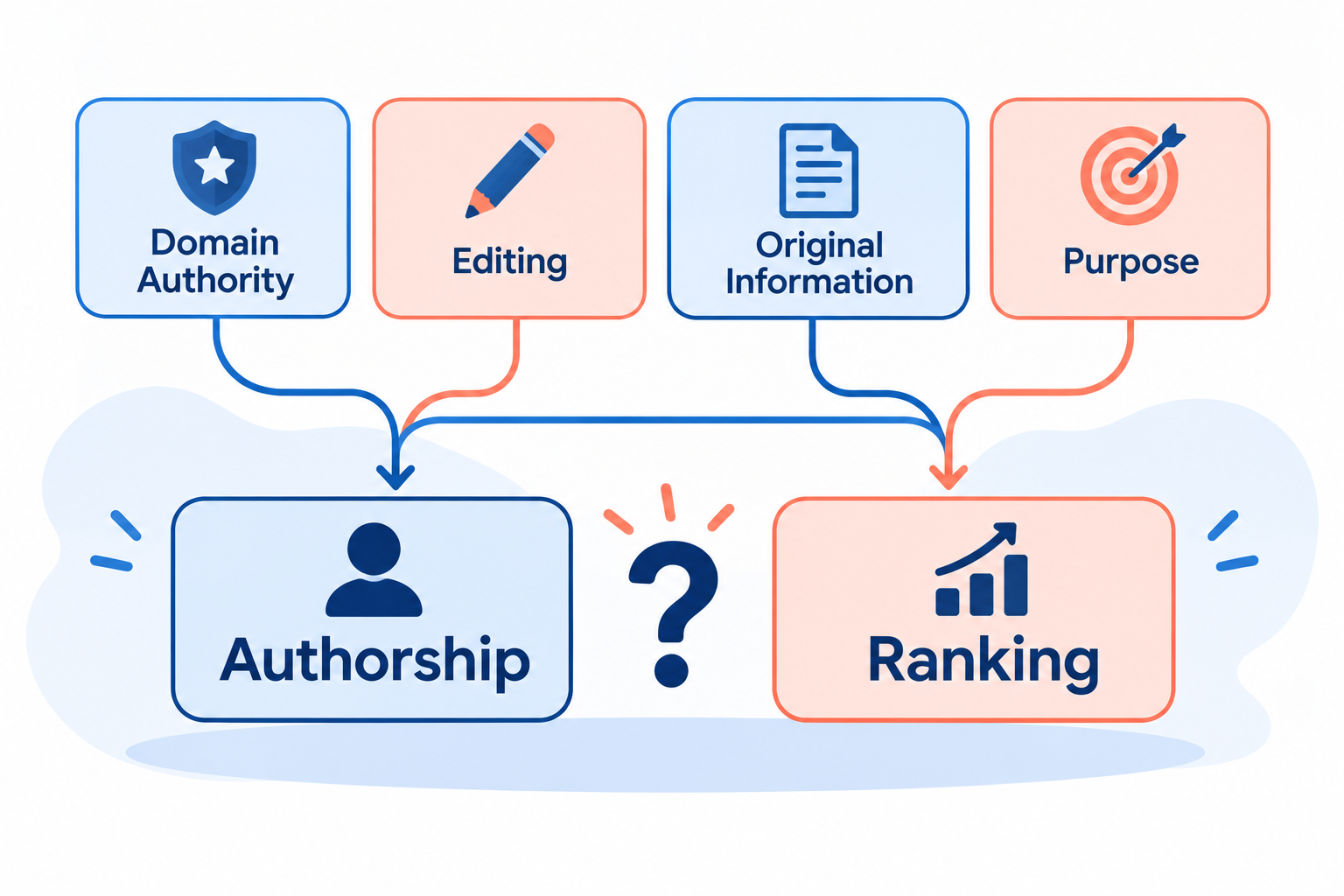
| Confounder | How it can create a gap without authorship being the cause |
|---|---|
| Domain authority and brand | Established sites with strong links and recognition may be more likely to employ editors and writers, and to rank. AI-heavy publishing may be more common on newer or lower-authority sites, as Ahrefs itself notes. |
| Editing and review | A human-written page is more likely to have had an editor. A page that is “100% AI” is more likely to have had none. |
| Original information | People can supply first-hand experience, interviews, and data. Unedited AI output often cannot. |
| Effort and purpose | Pages mass-produced with AI are more likely to be made for traffic than for readers, which Google’s policies target regardless of tool. |
| Survivorship | Studies of top results only include pages that already ranked and were indexed, so they cannot show how many AI pages never made it. |
| Detector error | Labels are probabilistic. A well-edited AI draft may be classified as human, and a plain human text as AI. |
| Topic and intent | AI-heavy content may cluster on certain query types, such as simple informational queries, which differ in difficulty. |
Google’s own guidance takes the same position. Its documentation says generative AI can help with research and structure, that producing many pages with AI without adding value may violate its scaled content abuse policy, and that the policy applies “no matter how it’s created.” Its helpful content guidance asks about original information, depth, trust, and who created the content and how. None of those questions is “was a human involved?” They are questions about the page.
That is why this article does not recommend a side. A better frame is to treat authorship as one input and ask what the page actually delivers.
What Actually Drives Performance
| Factor | Why it matters | AI-friendly? | Where people matter most |
|---|---|---|---|
| Original information | Gives readers and systems a reason to prefer your page. Google contrasts commodity and non-commodity content. | Poor on its own. A model cannot invent your data or experience. | Supplying the data, experience, and judgment |
| Accuracy | Errors erode trust. Google says models can be inaccurate and manual fact-checking is critical. | Risky without checks | Verification against primary sources |
| Clarity and structure | Readers and passage-level systems benefit from direct, well-organized answers. | Good, with editing | Deciding what to include and cut |
| Intent match | A page must fit what the searcher wants. | Moderate | Judging intent from live results and customer knowledge |
| Expertise and accountability | Bylines, review notes, and sourcing build trust. | Not applicable | Real authors and reviewers |
| Voice and brand | A recognizable voice helps recall and distinguishes you. | Moderate, with prompting and editing | Defining and protecting the voice |
| Freshness and upkeep | Outdated facts hurt usefulness. | Good for flagging, weak for deciding | Deciding what to update |
| Speed and scale | Faster production supports coverage and testing. | Strong | Ensuring speed does not replace quality |
| Technical SEO and links | Pages must be crawlable, indexed, and linked. | Unrelated to authorship | Site-level work |
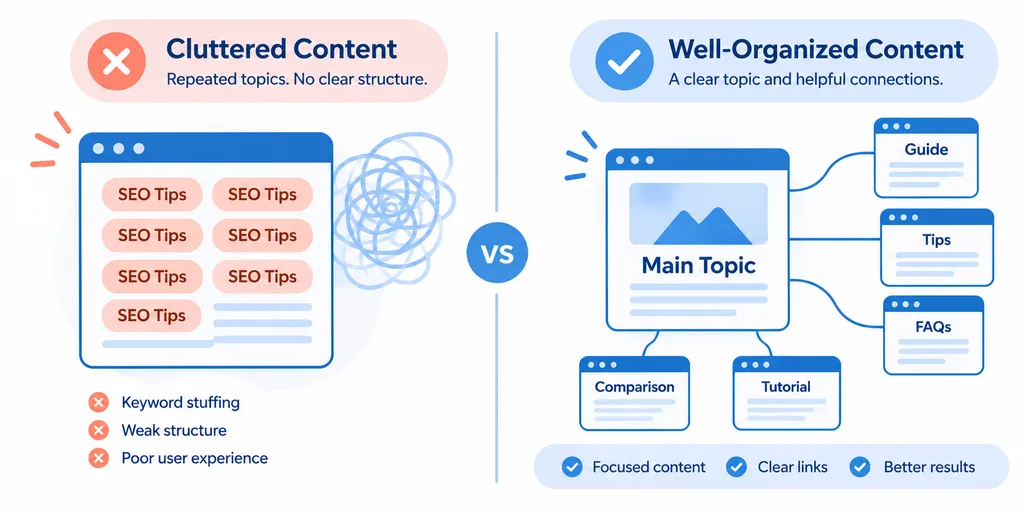
Read the table by rows. AI is strong on speed, drafting structure, and consistency, and it is weak on anything that requires something outside the model: your data, your customers, your experience, and the world after its training. People are strong exactly where AI is weak. The performance question becomes whether your process combines those strengths or relies on one. Read our related guide to topical authority vs keyword stuffing.
A Spectrum, Not a Switch
Most real content sits somewhere between fully human and fully AI. Naming the positions makes decisions and reporting clearer. The ratings below are judgment-based, not measured.
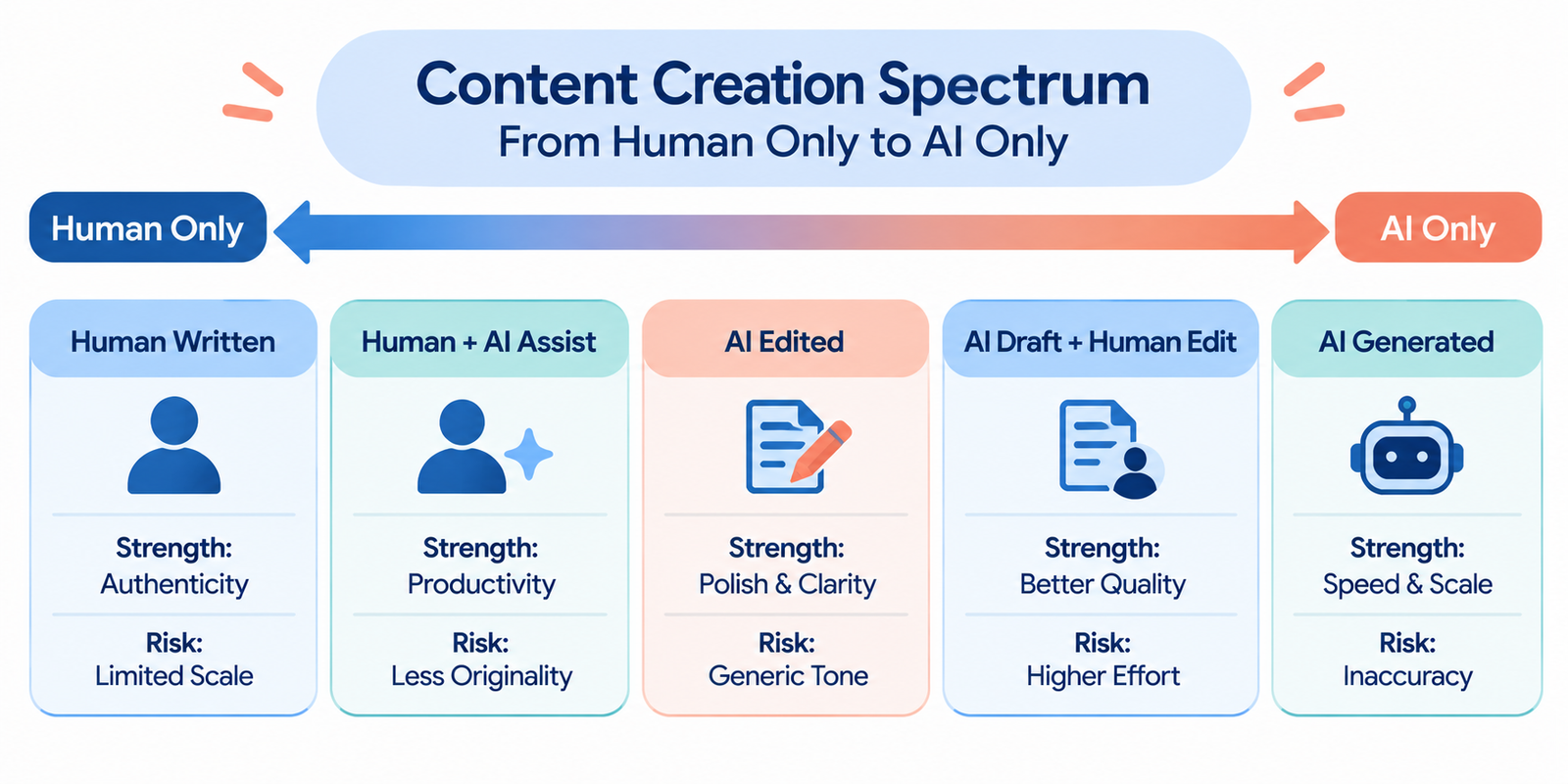
| Mode | Description | Typical strengths | Typical risks |
|---|---|---|---|
| Human only | Written and edited by people without AI | Voice, originality, accountability | Slower and costlier. Not immune to error or thinness. |
| Human-led, AI-assisted | A person writes from their own material and uses AI for research prompts, outlines, edits, or checks | Original with efficiency gains | Over-reliance on suggestions. Unchecked claims. |
| AI-drafted, human-edited | AI drafts from supplied material and a person adds evidence, edits, and fact-checks | Speed with controls | Generic text if inputs are thin. Skipped reviews. |
| AI-drafted, light review | AI drafts and a person skims | Fast and cheap | Errors, filler, and sameness. Closest to what policies target at scale. |
| AI only | Published without human review | Lowest cost | Highest risk of inaccuracy and low value. Does not meet Google’s fact-checking expectation. |
The studies cannot tell you which of these modes sits behind each page they classify, which is another reason to treat their labels with caution. For the working process in the middle rows, see our guide to AI content optimization.
AI Search: Do AI Tools Cite AI-Generated Pages?
Classic rankings are one question. Citations in AI answers are another, and the evidence is thinner.
The arXiv preprint by Allaham and Diakopoulos audited citations from four AI search tools on politics, health, and environment queries. Using one detector and treating the result as a lower bound, they classified about 16% of the scraped sources as AI-generated, with large differences between tools. About 28% of the cited domains had at least one AI-generated source, and for most of those domains, only one. The authors also noted that government sites and Wikipedia accounted for a large share of citations among the most-cited domains, which suggests that sources with established reputation get cited often.
The Graphite figures, as relayed by Axios, point the same way: about 82% of sources cited by ChatGPT and Perplexity were human-written and about 18% AI-generated.
How to read this
- AI tools do cite AI-classified pages. A meaningful minority appeared in two independent sources, using different detectors.
- The numbers should not be compared closely. The studies used different detectors, query sets, and tools.
- Topic matters. The preprint tested politics, health, and the environment, which are sensitive topics. Results may differ for product searches or local queries.
- This is not a recipe. Being cited depends on retrieval, relevance, and trust signals that platforms do not publish.
Our guides on creating content that gets cited by AI search engines and measuring AI search visibility cover what you can do and measure.
A Note on AI Detectors
Every study above rests on a detector, so detectors deserve a plain look. The studies themselves report the limits. Graphite’s detector, as relayed by Axios, had a reported false positive rate of about 4% and a false negative rate under 1% on one kind of test article. In the preprint, the authors chose a detector with a false negative rate above 30% on a sample of news pages from sites said to publish AI-generated material, and described their result as a lower bound. Ahrefs says that detection is not perfect and that results are best read as directional trends. Semrush did not report its detector’s error rates.
So for any single page, a detector score is a weak signal. It can mislabel edited AI text as human and plain human text as AI. Using detector scores to judge a writer, or to guarantee safety with Google, is not supported by anything we read. Google does not describe passing a detector as a goal, and its guidance concerns value, accuracy, and purpose.
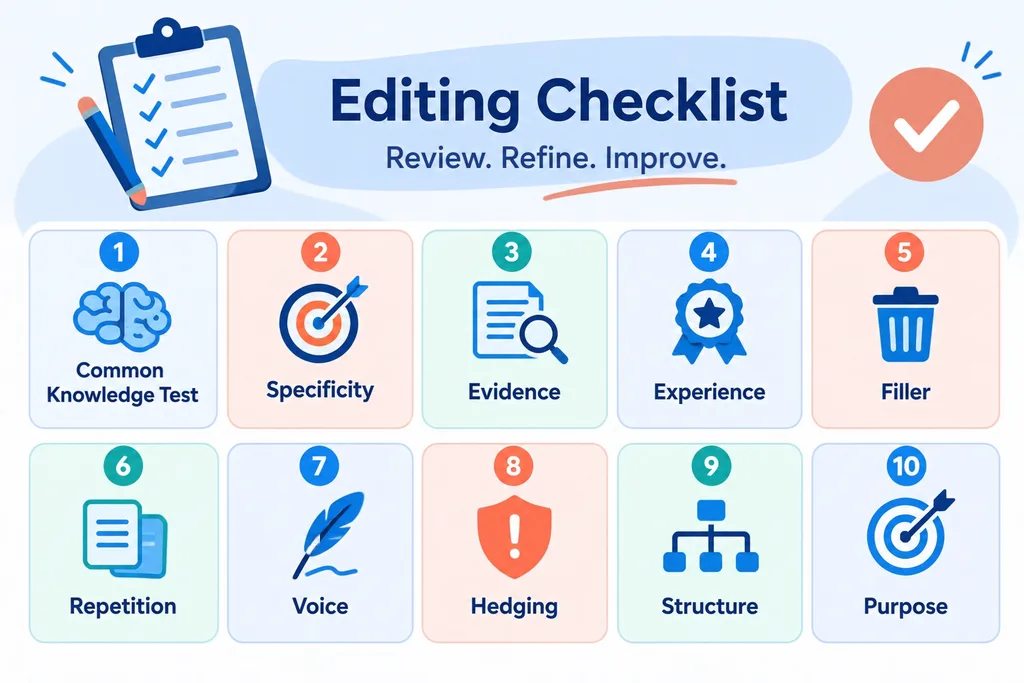
Ten Questions to Ask Any Study Before You Believe It
New headline statistics on this topic will keep arriving. This checklist applies to those, and to the ones above.
| Question | Why it matters |
|---|---|
| Who ran it, and what do they sell? | Vendors can be accurate, but they have an interest in the conclusion. Look for disclosure and for independent replication. |
| How big was the sample, and how was it chosen? | Only blog URLs, only top-10 results, or only crawled pages can all bias the picture. |
| Which detector labeled the content, and how accurate is it? | Every AI versus human label depends on it. Error rates should be reported. |
| What counts as “AI”? | Thresholds such as 50% or 80% change the results. “Mixed” categories are often undefined. |
| When was the data collected? | Search results and AI tools change quickly. A snapshot from a single month may not hold. |
| Is it an experiment or an observation? | Observation can show correlation only. Look for controls and matched comparisons. |
| What else differs between the groups? | Site authority, editing, topic, and purpose are common confounders. |
| Does it cover your content type and market? | A result for English blog posts may not apply to product pages or other languages. |
| Is the full report available? | Summaries and secondary reports can drop caveats. Check the original where possible. |
| Do the authors state limitations? | Honest limitations are a good sign. Their absence is a warning. |
By this checklist, the studies in this article are useful but incomplete. None is an experiment, each depends on a detector with limits, and several come from vendors. That is not a reason to dismiss them. It is a reason to hold the conclusions with the right amount of confidence.
Lower-Risk Ways to Use AI in Content Work
Not every use of AI carries the same risk. Where a person can easily verify the output and the output is not the final claim, the downside is small. The uses below are judgment-based examples, and each still needs a human check.
| Use | Why the risk is lower | Check to make |
|---|---|---|
| Brainstorming angles and questions | You choose what to keep, and nothing is published directly | Compare with real customer questions |
| Summarizing documents you supply | The source is in hand, so you can compare | Verify key points against the original |
| Suggesting outlines | You still decide the thesis and the unique contribution | Cut sections that only restate common knowledge |
| Tightening and clarifying your own draft | The facts and voice are yours | Make sure meaning did not change |
| Spotting inconsistencies and typos | Errors are easy to confirm | Accept only changes you have confirmed |
| Drafting title and meta description options | Short and easy to review | Make sure each is accurate and unique to the page |
| Translating or reformatting content you wrote | The source is known | Have a fluent reader check meaning and tone |
| Generating checklists or templates from your process | Based on your own material | Test them before publishing |
The common thread is that a person supplies the substance and judges the result. The higher-risk uses are the ones where AI supplies the claims, such as statistics, quotes, case studies, and advice, because those are the hardest to catch when wrong and the most damaging to trust.
How to Test This on Your Own Site
Averages across thousands of sites may not describe yours. A simple, careful test can. It will not give a perfect answer, but it will give better evidence than a headline.
Design
- Choose comparable topics. Pick pairs or small sets of topics with similar intent, difficulty, and search demand.
- Define the modes. For example, human-led and AI-drafted with human editing, with the same inputs, same editors, same standards, and a record of the process.
- Control what you can. Same site section, similar internal links, same publishing period, same promotion.
- Pre-register the measures. Decide before publishing what you will measure: indexing, impressions, clicks, position, engagement, conversions, edit time, and errors found.
- Wait long enough. Search results take time to settle. Several weeks to months is more realistic than days.
Measures
| Measure | Source | Why it matters |
|---|---|---|
| Indexing status and time to index | Search Console | Whether pages are included at all |
| Impressions, clicks, average position | Search Console | Visibility and traffic |
| Queries per page | Search Console | Breadth of relevance |
| Engagement and conversions | Analytics | Whether readers find it useful |
| Errors found in review | Your review log | Quality cost of each mode |
| Edit time and total cost per page | Workflow records | Efficiency |
| Citation and mention in prompt tests | Dated prompt audits | AI search visibility |
Limits of your own test
Small samples are noisy, topics are never perfectly matched, and rankings fluctuate. Treat results as evidence for your decisions and not as universal truths. Record dates and changes in the site so you can explain what happened. If AI-drafted, human-edited pages perform in line with human-led pages and cost less to produce, that is a useful finding for you. If they underperform or need heavy rework, that is useful too.
When Human-Led Matters Most
Some content carries more risk if it is wrong or generic. For these, favor human-led work with expert review and treat AI as a helper at most. The following is a judgment-based guide.
| Content type | Suggested approach | Reason |
|---|---|---|
| Health, medical, legal, financial advice | Human-led with qualified review | Errors can cause real harm. Google applies extra scrutiny to such topics. |
| Original research, data stories, opinion | Human-led | The value is the original material and judgment |
| Case studies and testimonials | Human-led, factual, with permission | AI must not invent them |
| Product reviews and comparisons | Human-led with real testing | Experience is the point |
| Pillar guides and thought leadership | Human-led, AI-assisted | Voice and expertise carry weight |
| FAQ pages, glossaries, support answers | AI-drafted, human-edited and fact-checked | Structured and repeatable, with review |
| Meta descriptions, alt text, summaries | AI-suggested, human-reviewed | Short, but Google says to review them |
| Product descriptions at scale | Template from real data, with review and unique details | Avoid thin, repetitive text. Ecommerce rules may require labeling AI-generated descriptions |
For regulated or sensitive topics, also follow your industry’s rules and have an accountable professional approve the content.
Cost, Speed, and Quality: An Honest Trade-Off
AI’s clearest advantage is speed. In the Semrush survey, 70% of respondents cited speed as the main benefit, but only 19% said it improved quality. That is a self-reported, vendor-run survey, so treat it as a pointer, not a measurement. The pattern it suggests is common sense: AI changes the economics of drafting more than the economics of knowing something worth saying.
That has a practical consequence. If the time AI saves is reinvested in research, interviews, testing, and editing, quality can rise. If the saved time is spent on more pages, quality tends to fall and the policy risk rises. Decide in advance what the savings are for.
| If you use savings to… | Likely effect (judgment) |
|---|---|
| Publish more pages with the same inputs | More generic pages and a higher risk of scaled content problems |
| Gather original material and fact-check more thoroughly | More distinctive and accurate pages |
| Update older pages regularly | Better freshness and trust |
| Test formats and measure outcomes | Better evidence for future decisions |
Common Mistakes
- Taking a headline statistic as proof. The studies are correlational and the detectors are imperfect.
- Choosing sides by commercial interest. Several sources sell tools or services.
- Equating authorship with quality. Human text can be thin and AI-assisted text can be excellent.
- Relying on detector scores. They are weak signals for a single page.
- Publishing unreviewed AI output. Google says manual fact-checking is critical.
- Using AI to scale pages without added value. This is the pattern spam policies target.
- Hiding the process. Where readers would want to know, explain how content was made.
- Not testing on your own site. Your audience and competition may differ from the studies.
- Expecting guarantees. No mix of AI and human work guarantees rankings or citations.
A 60-Day Plan
Days 1 to 15: Take stock
List which pages were made in which mode. Group them by topic and by performance. Note which have bylines, review notes, original material, and sources.
Days 16 to 30: Set rules and design the test
Write a short policy on allowed uses, review, and disclosure. Choose comparable topics and define the two or three modes you will test. Decide measures and dates.
Days 31 to 60: Run and review
- Produce the test pages with the same inputs and standards, and log time, cost, and errors.
- Publish them in a similar period, with similar internal links.
- Record indexing, impressions, clicks, and engagement at regular intervals.
- Review the first results with caution, and plan a longer follow-up.
Then decide, page type by page type, which mode to use. Revisit the decision after three to six months of data.
Worked Example (Illustrative)
This is a hypothetical scenario, not a case study. A small online retailer wants to know whether to use AI for its buying guides. It picks six comparable guide topics and produces three in a human-led mode, from product testing and staff knowledge, and three in an AI-drafted, human-edited mode, from the same test notes. Each guide gets a byline, a review note, and a fact-check log. It records the hours spent and the errors found in review.
After three months, the retailer compares indexing, impressions, clicks, and conversions. It finds that the pages are broadly similar in visibility, that the AI-drafted guides took less time but needed careful correction of several claims, and that the human-led guides led to more questions from customers, which the team then used to improve them. The retailer concludes that AI drafting from solid inputs is workable for guides, that every claim needs checking, and that the savings should go into more product testing. It does not generalize beyond its own site and plans a larger test.
What Is Still Uncertain
- Whether AI authorship causes any ranking difference. None of the studies reviewed is an experiment.
- How accurate detectors are on edited and mixed content, and how Google itself evaluates it.
- Whether results hold outside blogs, in other languages, and across industries.
- How AI search tools weigh AI-generated pages as the share of such pages grows.
- How the numbers will change. The studies are snapshots from 2025 and 2026.
Watch for experiments and replications, favor independent work, and always check the methods.
Frequently Asked Questions
Does AI content rank on Google?
It can. In Ahrefs’ 2026 sample, roughly 8% to 12% of top-10 pages were 80% or more AI, and Semrush found pure AI content held position 1 about 9% to 10% of the time. Both found human-written pages more common at the top. The studies are correlational and no ranking is guaranteed.
Is human content better than AI content for SEO?
Human-written pages are over-represented at the top in the studies reviewed, but those studies cannot show why. Editing, original information, and site authority travel with authorship. Google’s guidance concerns value and accuracy, not the tool.
Can Google detect AI content?
Google does not describe a detection goal in the documents we read. Its guidance concerns value, accuracy, and spam. Third-party detectors are imperfect, and several studies report non-trivial error rates.
Do AI search engines cite AI-generated content?
Sometimes. A May 2026 preprint classified about 16% of scraped cited sources as AI-generated, as a lower bound, with large differences between tools. Graphite, as reported by Axios, found about 18% for ChatGPT and Perplexity.
Should I use AI to write blog posts?
You can use it for research, structure, and drafting from your own material, with human editing and fact-checking. Google says AI can help with research and structure, and that scaled pages without added value may violate spam policy.
Do I need to disclose AI use?
Google suggests explaining how content was created where readers would reasonably want to know. It does not prescribe a format. Be honest and consistent.
What is the best mix of AI and human work?
It depends on the content type and risk. Favor human-led work for sensitive topics, original research, and reviews, and use AI-assisted drafting with review for structured, repeatable content. Test on your own site.
How do I test AI versus human content on my site?
Pick comparable topics, define the modes, control what you can, decide measures in advance, and wait several weeks to months. Track indexing, impressions, clicks, engagement, conversions, errors, and cost.
Conclusion
What performs better, AI content or human content? In the studies reviewed, human-written pages are more common at the top of Google, fully AI pages are less common there, and a meaningful minority of AI-cited sources are AI-generated. None of that proves that authorship is the cause, and the detectors behind the numbers are imperfect.
The more useful conclusion is that performance follows qualities you can control: original information, accuracy, clarity, expertise, accountability, and fit with intent. AI can speed up some of the work and cannot supply what it does not have. Decide the mode by content type and risk, test on your own site, and be honest about how the work is done. Nobody can promise rankings or citations from either approach.
Next step: Read our guide to Is SEO dead in 2026.
References:
- Semrush: Does AI content rank well in search? (vendor data study)
- Axios: AI writing hasn’t overwhelmed the web yet (reporting on Graphite)
- Allaham and Diakopoulos: Synthetic Sources? (arXiv preprint)
- Ahrefs: Google Doesn’t Punish AI Content; It Punishes Bad Content
- Google Search Central: Guidance on using generative AI content
- Google Search Central: Spam policies for Google web search
- Google Search Central: Creating helpful, reliable, people-first content