Every few months, someone declares SEO dead. The latest round points to AI Overviews, chatbots, and falling click-through rates. If you run a business or a marketing team, the question is not a debate to enjoy. It decides whether you keep your budget, your job, or your traffic.
The honest answer needs more than a slogan. This guide sets out the strongest evidence that something big is changing, the strongest evidence that SEO still matters, and what is simply unknown. It then explains what AI search means for SEO in practical terms and gives a framework to decide what to do on your own site. Where a source is secondary or a vendor, we say so.
Is SEO dead in 2026? No. The evidence points to a change in what SEO produces and how it is measured, not its end. Click-through rates on queries with AI Overviews are lower in several studies, but Google reports growing Search revenue, AI chatbots send a small share of traffic in the one study we reviewed, and Google says standard SEO still applies to its AI features. The work has widened, and the old playbook of ranking for informational clicks is weaker.
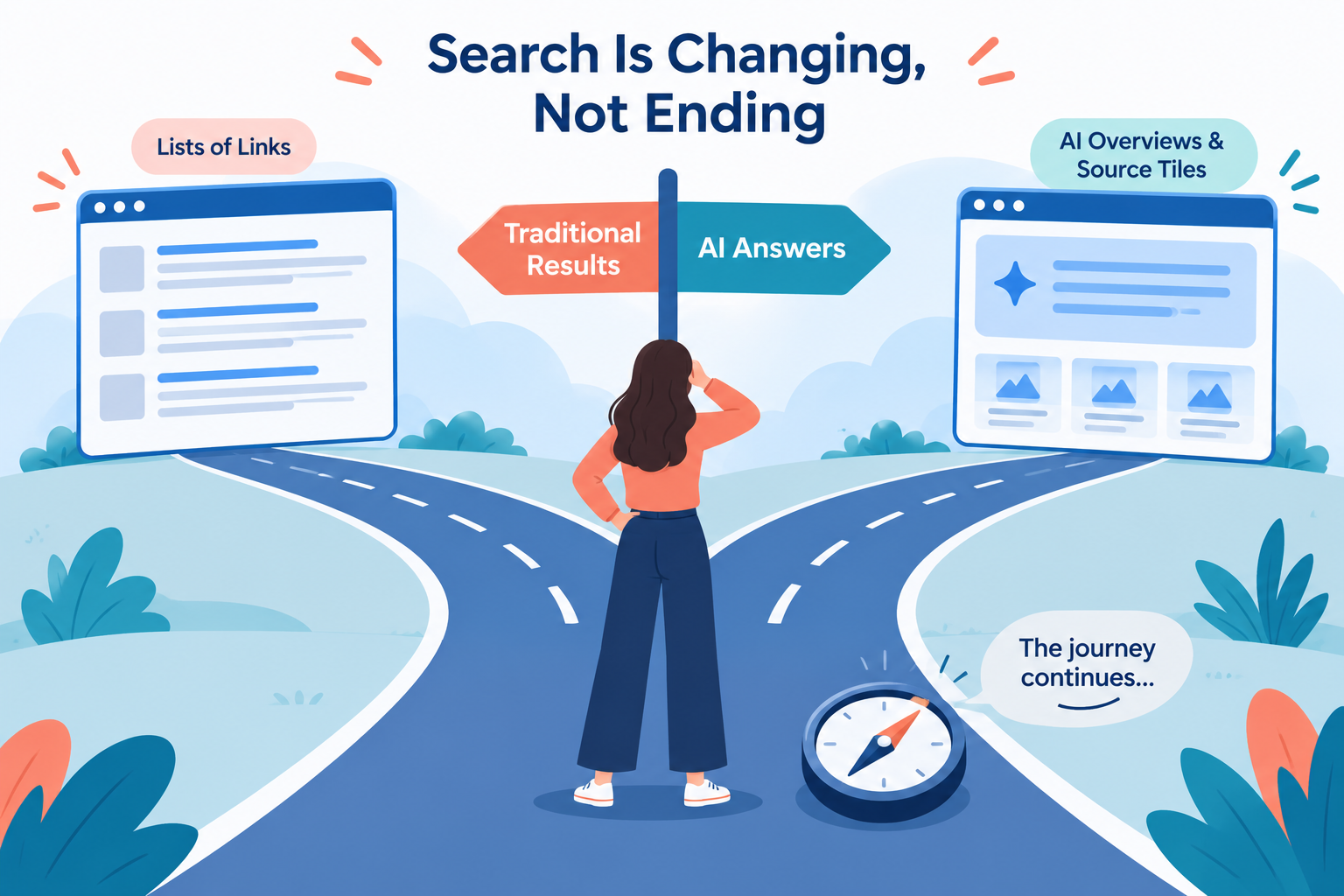
Why People Say SEO Is Dead
The claim is not baseless. These are the observations behind it, with the strength of the evidence noted.
| Observation | Evidence (as reported) | How strong |
|---|---|---|
| Lower click-through where AI Overviews appear | Ahrefs, using December 2025 data, reported position 1 CTR about 58% lower for keywords with an AI Overview. Seer Interactive reported organic CTR of 1.31% with an AI Overview versus 3.16% without in December 2025, and 2.36% versus 3.82% in February 2026. | Consistent direction in several studies. Mostly correlational. Sizes vary by method. |
| More searches end without a click | Advanced Web Ranking reported a zero-click rate of about 74% on tracked desktop SERPs with an AI Overview versus about 54% without (July 2026 snapshot). Pew, as reported secondhand, found fewer clicks on results when an AI summary appeared. | Direction consistent. Individual figures come through summaries and secondary reports. |
| People ask chatbots instead of searching | Gemini and other assistants report large user numbers, and ChatGPT referral traffic exists. | Usage is real, but usage does not equal replacement of search. |
| Informational content is easy to summarize | AI answers can reproduce common knowledge without a visit. | Logical and supported by the CTR studies, though not proven for every site. |
| Prominent predictions | Gartner predicted in 2024 that search engine volume would drop 25% by 2026 due to AI chatbots and other virtual agents. | A forecast, not a measurement. See below. |
For the click-through studies in more detail, including methods and why the numbers differ, see our guide to how AI Overviews are changing SEO and organic traffic in 2026.
Why SEO Is Not Dead
The other side of the ledger is just as real.
| Observation | Evidence (as reported) | How strong |
|---|---|---|
| Google Search is still growing in revenue | Search Engine Journal reported that Alphabet’s Google Search and other revenue was $63.27 billion in Q2 2026, up 17% year over year, after $60.4 billion in Q1 2026, up 19%. Alphabet’s CEO said in the earnings release that popular AI features are driving Search query growth. | Company-reported figures, relayed by a trade publication. Revenue is not organic traffic, and the article says so. |
| AI chatbots send little traffic compared with Google | MarTech reported on a Marie Haynes analysis of 100 websites and more than 145 million sessions over 12 months of GA4 data: ChatGPT sent about 0.62% as many sessions as Google organic search, or about 0.73% including other LLMs. | One study, one author, relayed secondhand. Exact dates and industry mix were not specified. |
| Google organic still drives most conversions | In the same analysis, Google organic drove about 27 times as many conversions as all LLMs combined across the 55 sites that tracked conversions, even though ChatGPT visitors converted at a higher rate (13.8% versus 3.02%). | Same caveats. Describes today’s scale, not the future. |
| AI features rely on the web and standard SEO | Google says there are no additional requirements to appear in AI Overviews or AI Mode, that pages must be indexed and eligible to appear in Search with a snippet, and that SEO fundamentals continue to apply. | Google’s own documentation, which is authoritative about its own systems. |
| Demand still exists for pages that people choose to visit | Transactions, local visits, tools, comparisons, and research still require a destination. | Reasonable inference, which varies by query type. |
How to read the two ledgers together
The two ledgers do not contradict each other if you read them carefully. Click-through per query can fall on certain results pages, while Google’s revenue grows because people search more, in more ways, and advertisers pay for new formats. Chatbot traffic can be small today and still be growing in influence. And Google can say that SEO fundamentals apply while the value of a ranking on informational queries declines.
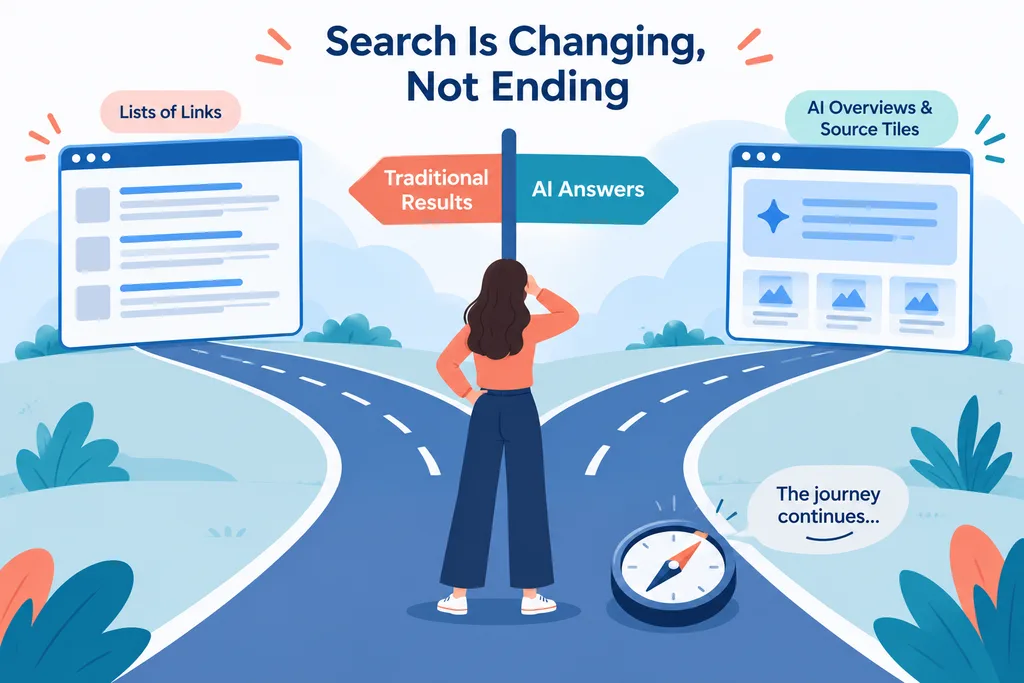
That is why “dead” is the wrong word. The industry that SEO serves, helping people find useful pages, is alive. What changed is how much of the value arrives as a click on an informational query, and how many places you need to be visible.
What About the Gartner Prediction?
In February 2024, Gartner published a press release titled “Gartner Predicts Search Engine Volume Will Drop 25% by 2026, Due to AI Chatbots and Other Virtual Agents,” as quoted in Search Engine Journal’s critique of it. We did not read the release itself, so we cannot describe its methodology.
Search Engine Journal’s Roger Montti argued in March 2024 that AI chatbots at that time were layered over traditional search and did not replace it, that chatbot queries were more expensive to serve, and that the forecast assumed traditional search would stay static. That is one author’s opinion, and some of his supporting examples were anecdotal.
We did not find a source in this research that verified whether the prediction came true. Alphabet’s reported Search revenue growth, noted above, does not suggest a collapse in Google Search activity, but revenue and query volume are different things, and we make no claim either way. The practical point is this: a forecast is not a fact, and neither is a rebuttal. Plan for uncertainty instead of a headline.
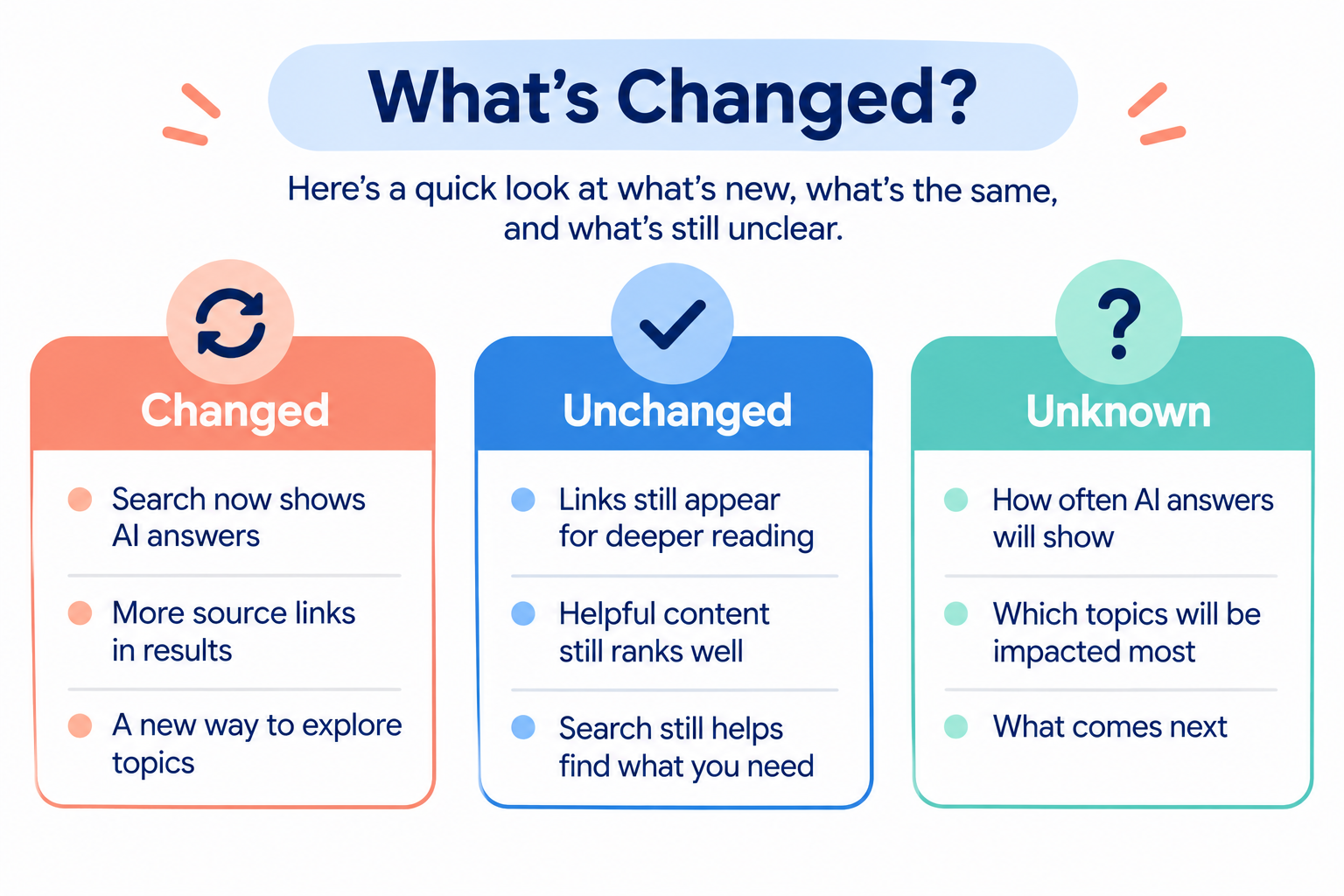
What Has Changed, What Has Not, and What Nobody Knows
| Category | Item |
|---|---|
| Changed (supported by multiple sources) | Click-through on queries with AI Overviews tends to be lower. More results pages answer questions directly. Google shows AI features that cite sources. Measurement is harder, since AI feature impressions are counted in existing totals, and the dedicated Search Console report does not show clicks. |
| Unchanged (per Google’s documentation) | Pages must be crawlable, indexed, and eligible to appear with a snippet. Helpful, original, people-first content is the standard. No special files or markup are required for AI features. |
| Probably changed (reasonable inference) | The value of informational content that only restates common knowledge. The need for brand recognition independent of a click. The importance of being visible on more than one platform. |
| Unknown | How fast AI chatbot usage will replace or add to search. How Google will balance AI answers and clicks. How much influence without a click affects later purchases. How stable current CTR figures are. |
Use this table as a reminder to label your own claims. When someone tells you SEO is dead, ask which row they are describing.
What SEO Includes Now
If “SEO” means only ranking pages for keywords to earn informational clicks, then it is weaker than it was. If it means helping people and machines find, understand, and trust your content wherever they look, the job has grown. Here is the widened scope.
| Area | Classic emphasis | Added or sharper emphasis in 2026 |
|---|---|---|
| Technical | Crawling, indexing, speed, mobile | Access for multiple crawlers, rendering, snippet eligibility, clean structured data that matches the page |
| Content | Keyword-targeted pages | Original information, clear answers, specific passages, honest evidence, human review |
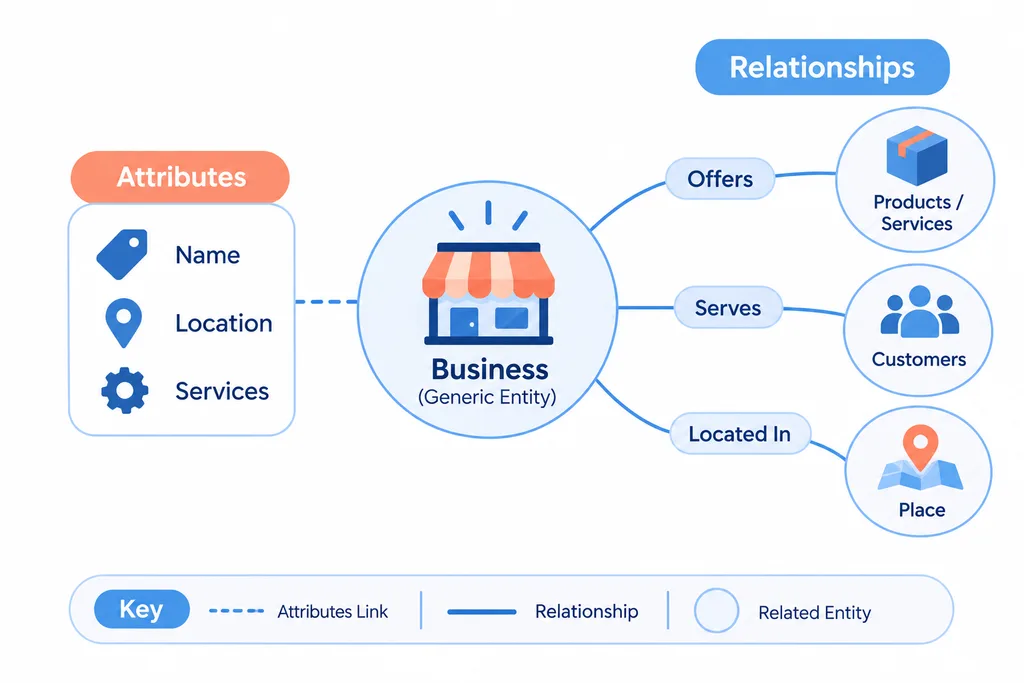
| Topics and entities | Keyword lists | Topic coverage, consistent naming of entities, intent matching |
| Links and brand | Link building | Brand mentions and reputation across sources AI systems and users trust |
| Measurement | Rankings, sessions, organic conversions | Impressions in AI features, citation and mention rates from prompt tests, branded demand, identified AI referrals |
| Channels | Google and Bing | Google AI features, ChatGPT search, Perplexity, Copilot, and others |
| Reporting | Rank and traffic charts | Scorecards with ranges, method notes, and conversions |
Our guides on GEO vs SEO and semantic SEO explain the concepts behind this scope.
A Decision Framework: What Does AI Search Mean for You?
The answer depends on how your traffic and revenue arise. Use these questions to place yourself.
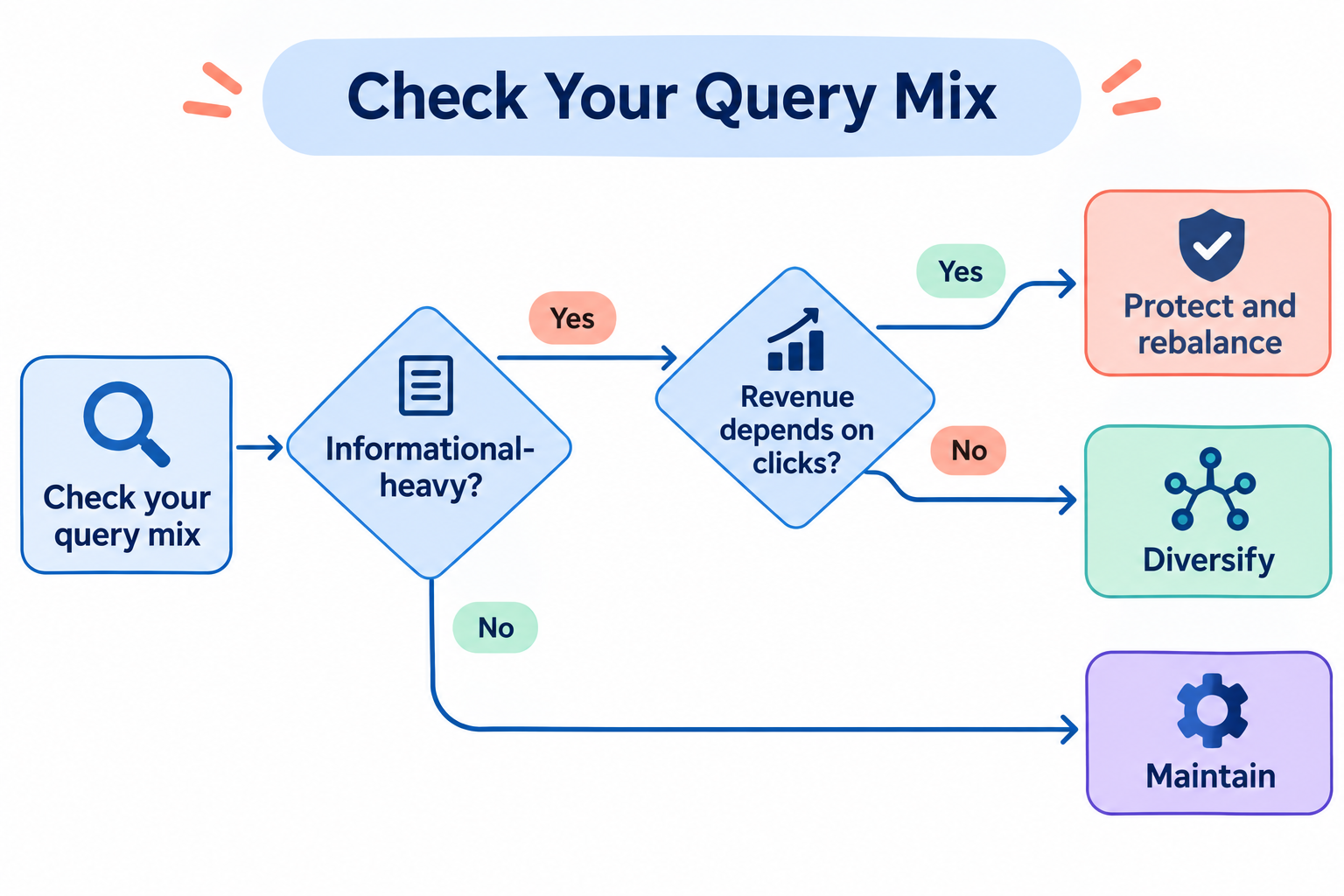
Question 1: How much of your organic traffic is informational?
Open Search Console and group your top queries by intent. If most of your clicks come from “what is” and “how to” queries, you are more exposed to AI summaries. If most come from branded, local, or transactional queries, you are less exposed. These are judgments, and you should check them against your own data.
Question 2: How do your visitors turn into revenue?
If informational traffic mostly fuels advertising revenue, a fall in clicks hits directly. If it mostly feeds leads or sales through later visits, the impact may be smaller than the traffic chart suggests. Compare organic conversions, not only sessions.
Question 3: What can a summary not replace?
Tools, calculators, inventories, local services, proprietary data, community, and expert judgment give people a reason to visit. List what you have that an answer box cannot deliver.
Question 4: How strong is your brand?
Seer Interactive’s data suggests brands cited in AI Overviews fared better on organic CTR than those not cited, though it cannot claim causation. Whether it is cause or effect, recognized brands are likelier to be named and clicked.
Placing your business
| Business profile | Exposure (judgment) | Suggested emphasis |
|---|---|---|
| Publisher or blog monetized by ads on informational content | Higher | Original reporting and data, newsletters and community, diversified traffic, careful measurement |
| B2B software or service with a long sales cycle | Moderate | Comparison and decision content, brand mentions in trusted sources, branded search demand, sales-assisted measurement |
| Ecommerce | Moderate | Category and product quality, accurate product data, reviews, feeds, local inventory where relevant |
| Local service business | Lower to moderate | Accurate Business Profile, real photos and reviews, service and location pages with unique detail |
| Tools and calculators | Lower | Maintain and promote the tool, and publish the data behind it |
| Agency or consultancy | Moderate | Original research, expert content, case-based credibility, reputation |
What to Do: Seven Moves
1. Diagnose before you react
Compare year over year Search Console clicks, impressions, CTR, and position. Split queries by type and branded versus non-branded. Check the live results for your biggest declines. Many traffic drops have causes unrelated to AI, such as seasonality, technical faults, or lost rankings. Our AI Overviews guide gives a seven-step process.
2. Protect the foundation
Make sure priority pages are crawlable, indexed, fast, accurate, and snippet-eligible. Google states that these are the requirements for appearing in its AI features. This is the least glamorous and most reliable work.
3. Rebalance content toward what earns the visit
Keep concise reference pages for common questions, but invest more in content people choose to visit: original data, tools, comparisons with transparent methods, expert opinion, and first-hand experience. Merge or retire thin pages that only restate common knowledge.
4. Write for passages and for people
Open sections with a direct answer, back claims with sources, and show who wrote and reviewed the content. This helps readers and may help AI systems, though no one can promise a citation. See our guide to creating content that gets cited by AI search engines.
5. Build brand and reputation off your site
If answers are delivered on the results page, being known matters more. Earn mentions in trusted sources, maintain accurate profiles, and give customers reasons to talk about you. See how to get your brand mentioned in ChatGPT and other AI search engines.
6. Update measurement
Add AI feature impressions, branded demand, identified AI referrals, and sampled citation and mention rates to your reporting, and label what is exact and what is sampled. See the KPIs marketers should track.
7. Diversify without abandoning search
Email, community, partnerships, video, and other channels reduce dependence on any single platform. They add to search work and do not replace it.
What Not to Do
| Reaction | Why it is a mistake |
|---|---|
| Stop investing in SEO entirely | Evidence reviewed shows Google organic still drives far more traffic and conversions than chatbots, and AI features depend on indexed pages. |
| Rename SEO to GEO and change nothing | A new label does not change the work. Do the work: access, content quality, entities, measurement. |
| Buy tools that promise AI rankings | Research reported that AI answers vary a great deal between runs, so fixed rankings are unreliable. Ask vendors to show their method. |
| Mass-produce AI content | Google’s policy on scaled content abuse targets pages made at scale with little value, however they are made. |
| Block all AI crawlers without thinking | Blocking can reduce visibility. Decide deliberately for each crawler and each business goal. |
| Panic over one month of data | CTR figures swung substantially over time in the studies we read. |
| Promise clients guaranteed citations | No technique can guarantee them. |
Is SEO Still a Good Career?
We found no solid data on SEO job demand in this research, so we do not make claims about it. What can be said is that the skills that matter in the widened scope are not new inventions: technical understanding of how sites are crawled and rendered, clear writing, research and analysis, an understanding of audiences and intent, and honest measurement. People who can combine them and explain results to non-specialists are likely to stay useful. People who rely on one tactic, such as mass keyword pages or link schemes, are more exposed.
If you work in SEO, a sensible plan is to learn how AI search products retrieve and cite sources, practice designing and reading prompt audits, strengthen content and editing skills, and get comfortable with uncertainty in data.
How to Explain This to Your Boss, Client, or Board
Non-specialists often hear only the headline. A short, honest script helps. These talking points are built from the evidence above, and each can be backed by a source or by your own data.
| Concern you may hear | A grounded response |
|---|---|
| “Is SEO dead? Should we cut the budget?” | Studies report lower click-through on queries with AI Overviews, but Google organic still drove far more conversions than chatbots in the one analysis we reviewed, and Google says AI features rely on indexed pages. We recommend measuring our own exposure before changing the budget. |
| “Our traffic fell. Is it AI?” | It may be part of it. We will compare impressions, clicks, CTR, and position by query type, and check other causes first, such as seasonality or technical faults. |
| “Competitors say they can guarantee AI citations.” | No one can guarantee them. AI answers vary between runs, and platforms do not publish how they choose sources. We can improve access, content, and reputation and report rates with ranges. |
| “Should we move everything to AI search optimization?” | We would add to SEO, not replace it. The fundamentals that make pages eligible for Google’s AI features are the same ones that serve classic search. |
| “How will we know it is working?” | We will report clicks, conversions, branded demand, identified AI referrals, and sampled citation rates, with method notes, and review them quarterly. |
Notice that none of these responses promises a result. That is deliberate. A leader who hears realistic claims today is more likely to trust the report next quarter.
Three Possible Futures, and What You Would Do in Each
Nobody can say how the next few years will go, so planning for a range is wiser than betting on one outcome. The scenarios below are judgment-based, are not forecasts, and carry no probabilities.
| Scenario | What it could look like | Sensible response |
|---|---|---|
| AI answers take a larger share of information queries | Click-through on informational queries keeps falling. More discovery happens inside AI interfaces. | Shift effort toward content that earns the visit, brand recognition, direct channels like email, and visibility measurement across platforms. |
| Balance shifts back and forth | CTR on AI Overview queries swings, as Seer’s data did over fourteen months. Google adjusts how and when it shows AI answers. | Avoid overreacting to single months. Use ranges and annotated trends, and keep a diversified plan. |
| Search remains the dominant way people find sites, with AI features added | Google’s growth continues, AI referral traffic stays small, and fundamentals dominate. | Keep investing in technical quality, helpful content, and measurement. Treat AI visibility as an addition. |
The three plans overlap heavily. In every scenario, accurate pages, original information, clear structure, a recognized brand, and honest measurement are useful. That overlap is the best argument for acting now on the fundamentals instead of waiting to see which future arrives.
Signals to Watch Over the Next Quarters
Instead of reacting to headlines, set up a short watchlist of signals and review it on a schedule. Each of these is something you can check yourself or find in public reporting.
| Signal | Where to look | What a change might mean |
|---|---|---|
| Click-through by query type on your site | Search Console, compared quarter to quarter | Whether exposure on informational queries is growing or stabilizing |
| Generative AI impressions for your pages | Search Console generative AI report, where available | Whether your content is shown in AI features, and which pages |
| Identified AI referral sessions and conversions | Analytics with a custom channel or source filter | Whether AI platforms are becoming a meaningful source for you |
| Branded search demand | Search Console branded segment | Whether recognition of your brand is rising or falling |
| Google’s documentation and Search Console updates | Google Search Central and Search Console pages | Whether guidance, eligibility, or reporting changes |
| Independent studies and company results | Trade publications and primary sources | Whether the broader picture is shifting. Prefer primary sources and note sample sizes and dates |
| Accuracy of AI answers about your brand | Dated prompt checks | Whether facts about you are correct in AI answers |
Write down your current reading of each signal and the date. Six months from now, the notes will show you what actually changed, which is far more useful than memory.
Where to Put Your Time and Money
There is no universal budget split, and no source we read provides one. These principles are judgment-based starting points.
- Fund the foundation first. Technical health, accurate pages, and clear content structure underpin both classic and AI search, and they are the cheapest to verify.
- Spend on original material, not on volume. Research, data, expert interviews, and tools are harder to copy than another round of generic posts.
- Reserve a modest, fixed share for measurement. A small prompt audit and a clean analytics setup cost far less than decisions made on bad data.
- Invest in brand and reputation work you can sustain. Mentions and reviews build slowly and compound.
- Test new channels in small experiments. Email, community, and video can reduce dependence on any one platform, but start small and measure.
- Be wary of vendors who promise rankings in AI answers. Ask how many prompts and runs they use and how they handle variance.
Review the allocation each quarter against your signals. If exposure is low and conversions are healthy, you may need little change. If exposure is high and revenue depends on clicks, diversify sooner.
A 90-Day Plan
Days 1 to 30: Understand your exposure
- Compare clicks, impressions, CTR, and position year over year in Search Console.
- Group queries by intent and by branded versus non-branded.
- Check live results for your top declining queries and record what you see.
- Check Search Console for the generative AI report, and note what it shows.
- Compare organic conversions with sessions to see business impact.
Days 31 to 60: Fix and focus
- Verify crawl, index, and snippet eligibility on priority pages.
- Rank pages by business value and exposure, then improve the top few with original information and clear structure.
- Merge or retire thin informational pages.
- Set up AI referral tracking in analytics and a small, stable prompt set.
Days 61 to 90: Report and plan
Publish a one-page scorecard with ranges and method notes. Write a short plan for the next quarter that states the exposure, the actions, and the uncertainties. Revisit it quarterly, since the evidence is changing.
Worked Example (Illustrative)
This is a hypothetical scenario, not a case study. A software review site earns most of its revenue from ads on informational articles. Its organic clicks have fallen 30% year over year, mostly on definition and how-to queries, while its comparison pages and its pricing tracker hold steady. A competitor has told the owner that SEO is dead and that they should move everything to chatbot optimization.
The owner follows the diagnosis steps. Search Console shows stable impressions and falling clicks on informational queries, and live checks show AI Overviews on many of them. The comparison pages and tracker are unaffected. AI referral traffic is real but small. The owner decides not to abandon search. Instead, the site shortens its definition pages, invests in original test data and the tracker, builds an email list to reduce platform dependence, adds bylines and method notes, and reports clicks, conversions, email growth, and sampled citations together. The owner makes no promise about recovering lost traffic and treats the results as evidence for the next decision.
What Is Still Uncertain
- How quickly AI chatbot use will grow relative to classic search. The traffic study we read describes the current scale, and the author did not measure future trends.
- Whether recent CTR levels are stable. Seer’s data moved substantially over fourteen months.
- How Google will balance AI answers and clicks to websites.
- How much value brand exposure without a click creates for later purchases.
- How reliable secondary statistics are. Several figures in this article come from trade reports of studies we did not see in full.
Hold your conclusions loosely, check your own data, and revisit the question regularly.
Frequently Asked Questions
Is SEO dead in 2026?
No. Studies report lower click-through on queries with AI Overviews, but Google reports growing Search revenue, one study found chatbots send a small share of traffic compared with Google organic, and Google says standard SEO still applies to its AI features. SEO has widened and the old informational-click playbook is weaker.
Is SEO still worth it for a small business?
For most businesses with customers who search, yes, though the mix of work may change. Local, transactional, and brand-driven search are generally less exposed to AI summaries than informational queries. Check your own Search Console data before deciding.
Will AI replace Google?
Nobody knows. Gartner forecast in 2024 that search volume would drop 25% by 2026, but we found no source verifying that, and critics argued chatbots were layered on top of search. Alphabet reported growing Search revenue in 2026.
Is GEO replacing SEO?
Not on the evidence we reviewed. GEO and related terms describe work on visibility in AI answers, which overlaps with SEO fundamentals. Google says there are no additional requirements for its AI features beyond standard SEO.
How much traffic do AI chatbots send compared with Google?
One analysis of 100 websites, reported by MarTech, found ChatGPT sent about 0.62% as many sessions as Google organic search over 12 months. It is one study, relayed secondhand, with unspecified dates, so check your own analytics.
Do AI Overviews reduce clicks?
Several studies report lower click-through on queries where they appear, with estimates varying widely and most being correlational. Our AI Overviews guide covers methods and limits in detail.
What should I change first?
Diagnose your own data by query type, protect priority pages, rebalance content toward what earns visits, and update your reporting to include AI visibility and conversions.
Should I stop SEO and focus only on AI search?
We would not. Google organic drove far more conversions than LLMs in the one analysis we reviewed, and AI features depend on indexed pages. Treat AI search as an addition to SEO.
Conclusion
SEO is not dead, but the version that promised steady clicks for ranking on informational queries is weaker than it was. The evidence points to lower click-through where AI Overviews appear, continued strength in Google’s business, a small but growing source of AI referrals, and Google’s own statement that standard SEO still applies. Add the uncertainty, and the sensible position is neither panic nor complacency.
Start by measuring your own exposure. Protect the foundation, invest in content that earns the visit, build a brand people look for, and report with more than sessions. Do that, and you will be better placed whichever way the numbers move. Nobody can promise rankings, citations, or traffic, and anyone who does is selling something.
Next step: Read our complete guide to generative engine optimization
References:
- Search Engine Journal: Google Search Revenue Growth Eases After a Year of Acceleration
- MarTech: ChatGPT sends less than 1% of Google’s traffic
- Search Engine Journal: Why prediction of 25% search volume drop due to chatbots fails scrutiny
- Google Search Central: AI features and your website
- Seer Interactive: AIO Impact on Google CTR, 2026 Update
- Ahrefs: AI Overviews Reduce Clicks (update)
- Advanced Web Ranking: Organic CTR study