
What Is Social SEO? How to Get Found on Instagram, TikTok and YouTube
People no longer look for things only on Google. They open Instagram to find a cafe, TikTok to see how a product looks in use, and YouTube to learn a skill. Each of those apps has a search box, and each has its own way of deciding which posts and videos to show.
That is the territory of social SEO. This guide explains what it is, how it differs from website SEO, how search works on Instagram, TikTok, and YouTube according to the best sources we could read, and what to do about it. It also marks what is official and what is practitioner opinion, because the second kind is often passed off as the first. Nothing here guarantees visibility.
Social SEO is the practice of making your social content easy for a platform to understand and easy for people to find through that platform’s search, and sometimes through Google. It uses keywords in captions, titles, on-screen text, and profile fields, plus clear topics and useful content. Platforms rank differently, and no method guarantees reach.
What Social SEO Means
Social SEO, also called social media SEO or social search optimization, applies search thinking to social platforms. In classic SEO, you help a search engine match a page to a query. In social SEO, you help a platform match a post, video, or profile to a query typed into its own search bar.
Two ideas are worth separating, because they are often blended.
- Search inside the platform. Someone types “standing desk setup” into TikTok or YouTube. The platform returns videos and accounts. Optimizing for this is the core of social SEO.
- Social content in outside search. A post or video appears in Google or another engine. YouTube is owned by Google, and some Instagram content has been made available to search engines (covered below). This is a related but separate goal.
Social SEO is not the same as general social media marketing. A post can be widely shown in a feed, and the feed is a recommendation system. Search is a different mode: the person states what they want. Content that does well in a feed does not necessarily do well in search, and the reverse also holds.
Why Social SEO Matters Now
Search behavior is spread across more places than it used to be. Shopify’s guide to TikTok search says, citing a TikTok Ads blog post that it does not date, that 57 percent of TikTok users use search and 23 percent search within 30 seconds of opening the app. We could not open the original TikTok source, so treat the figures as unconfirmed. Shopify also cites an Adobe survey for Gen Z usage, which we did not read either.
Without leaning on any single figure, the reasoning is straightforward. If your audience searches on a platform, your content has a chance to be found there at the moment of need, when interest is high. And since people increasingly use several tools to look things up, being easy to understand across platforms can compound. This is a reasoned view and not a measured result.
Social SEO vs Website SEO
| Area | Website SEO | Social SEO |
|---|---|---|
| Where people search | Google, Bing, and other engines | Search bars inside Instagram, TikTok, and YouTube, plus outside engines |
| What is ranked | Web pages | Posts, Reels, videos, accounts, hashtags, sounds |
| Main text signals | Page title, headings, body text, links, structured data | Captions, titles, descriptions, on-screen text, spoken words, profile fields |
| Link signals | Backlinks matter | Not the main mechanism inside apps |
| Engagement signals | Indirect and debated | Often central, such as watch time (YouTube says engagement is part of ranking) |
| Documentation | Extensive public guidance from Google | Varies by platform. YouTube explains its search. Others say less. |
| Content lifespan | Pages can rank for years | Varies. YouTube videos can keep being found. Feed-driven content can fade quickly. |
| Control | You own the site | You rent space on a platform that can change rules |
The lifespan row is a general observation, not a measured fact for every account. Test it in your own analytics.
How Search Works on Each Platform: What We Know
Evidence quality differs widely across these three, so each subsection starts with what the source is.
YouTube: the best documented
YouTube Help has a page titled “How YouTube search works.” It shows no date, so confirm the current wording. It says search ranking weighs three elements, and that their importance can vary by search type:
- Relevance: how well the title, tags, description, and video content match the query.
- Engagement: viewer behavior, such as watch time for a given query, as an indicator that others found the video relevant to that query.
- Quality: signals that identify channels showing expertise, authoritativeness, and trustworthiness on a topic.
The page also says YouTube does not accept payment for better placement in organic results, and that results may be personalized when search and watch history are on, so two people can see different results for the same query. The page gives no explicit creator tips. It follows that clear titles, descriptions, and content that matches what viewers want are sensible, but that is our inference.
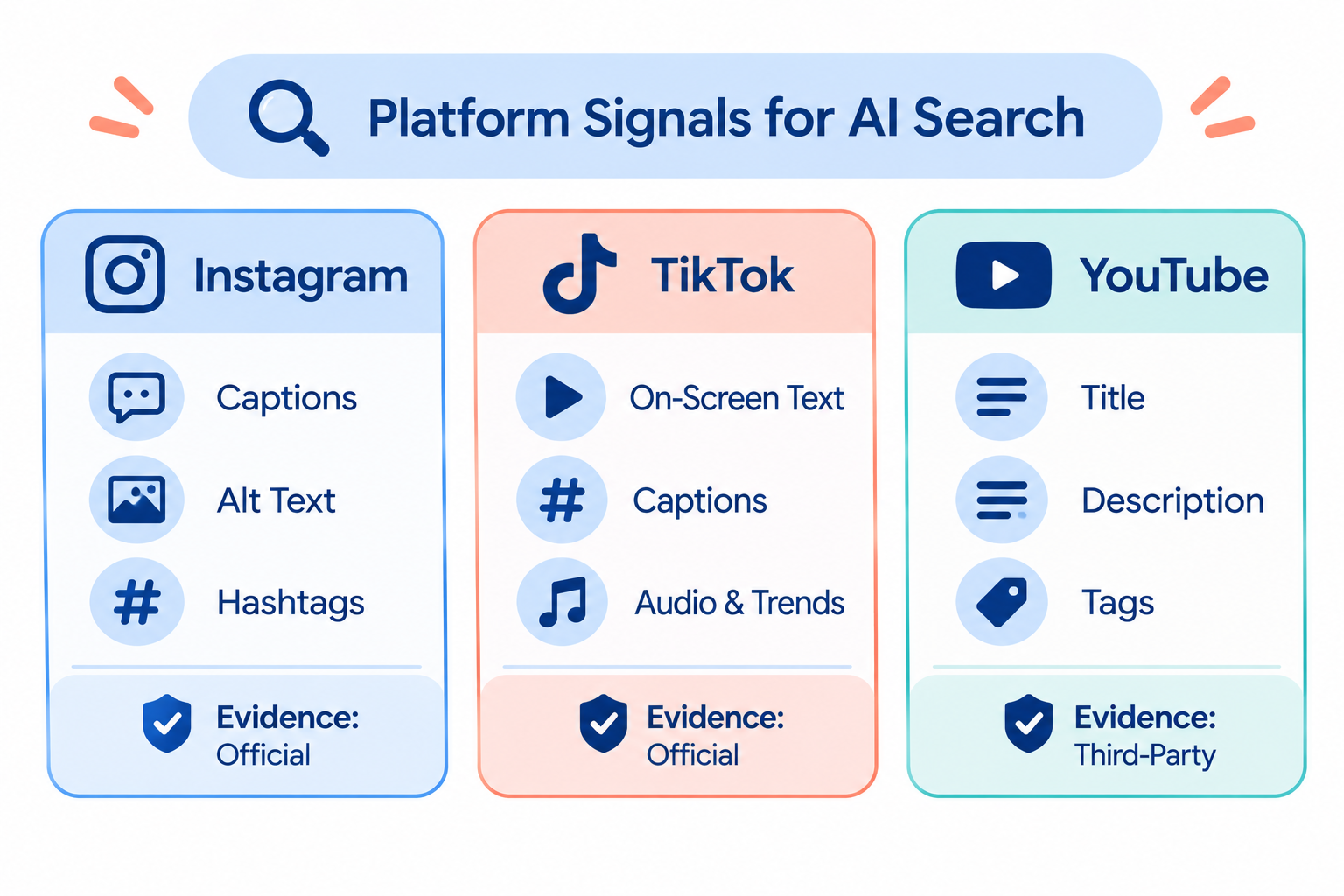
Instagram: partial and mostly secondhand
We did not read an Instagram help page on search ranking. The most detailed source we read was a Kontentino Q&A (published July 8, 2026, updated July 20, 2026), which is a social media tool vendor’s guide. According to it:
- Captions are treated as text signals, and it recommends naming the topic in plain words.
- Descriptive alt text provides one more text signal about an image, although it is meant first for accessibility.
- Account text is weighted heavily for account searches, so the name field and bio should say what you do and where.
- Hashtags give context and do not “hack distribution.”
- Visual content itself is a signal, which suggests on-topic visuals matter even when captions are thin.
The article also attributes statements to Instagram head Adam Mosseri from a July 2026 Q&A. We could not verify those attributions from the page, so we do not rely on them. Treat the points above as practitioner understanding, not Instagram’s published rules.
TikTok: mostly practitioner opinion
We found no official TikTok statement on how search ranks results in the pages we read. The CapCut guide (a video editing brand’s marketing post, June 29, 2026) says the platform reads captions alongside on-screen text, spoken audio, and hashtags, and does not rely on one field alone. It admits it contains no official TikTok claims and that its ranking statements are interpretations of third-party sources. The Shopify guide (December 24, 2025) quotes an agency founder who says search ranking depends on intentional keyword use in captions, on-screen text, transcribed audio, and keyword-based hashtags, and that search differs from the For You feed.
Shopify also describes how search looks to users: keyword suggestions as you type, result categories (Top, Videos, Users, Shop), and filters such as date posted. Those are interface details and could change.
| Platform | Best source we read | Evidence level | Cautions |
|---|---|---|---|
| YouTube | YouTube Help, how search works | Official, undated | Gives factors, not weights |
| Kontentino Q&A, July 2026 | Third-party vendor | Not official, attributions unverified | |
| TikTok | CapCut guide and Shopify guide | Third-party marketing pages | No official ranking statement found |
Can Social Content Show Up in Google?
Sometimes. YouTube videos are part of Google’s ecosystem and can appear in Google results, though appearance depends on the query and results format. For Instagram, PPC Land reported that starting July 10, 2025, public content from professional accounts (business and creator accounts held by adults) became eligible to appear in Google and other search engines. It described public photos, videos, carousels, and Reels, and a setting under Privacy that can turn this off (“Allow public photos and videos to appear in search engine results”). The page did not quote Instagram directly and was inconsistent about whether the feature was opt-in or on by default, so check Instagram’s current settings and help pages yourself.
We did not verify how often social posts appear in results or whether they rank well. Do not plan on Google traffic from social posts until you have seen it in your own data.
A Shared Method for Every Platform
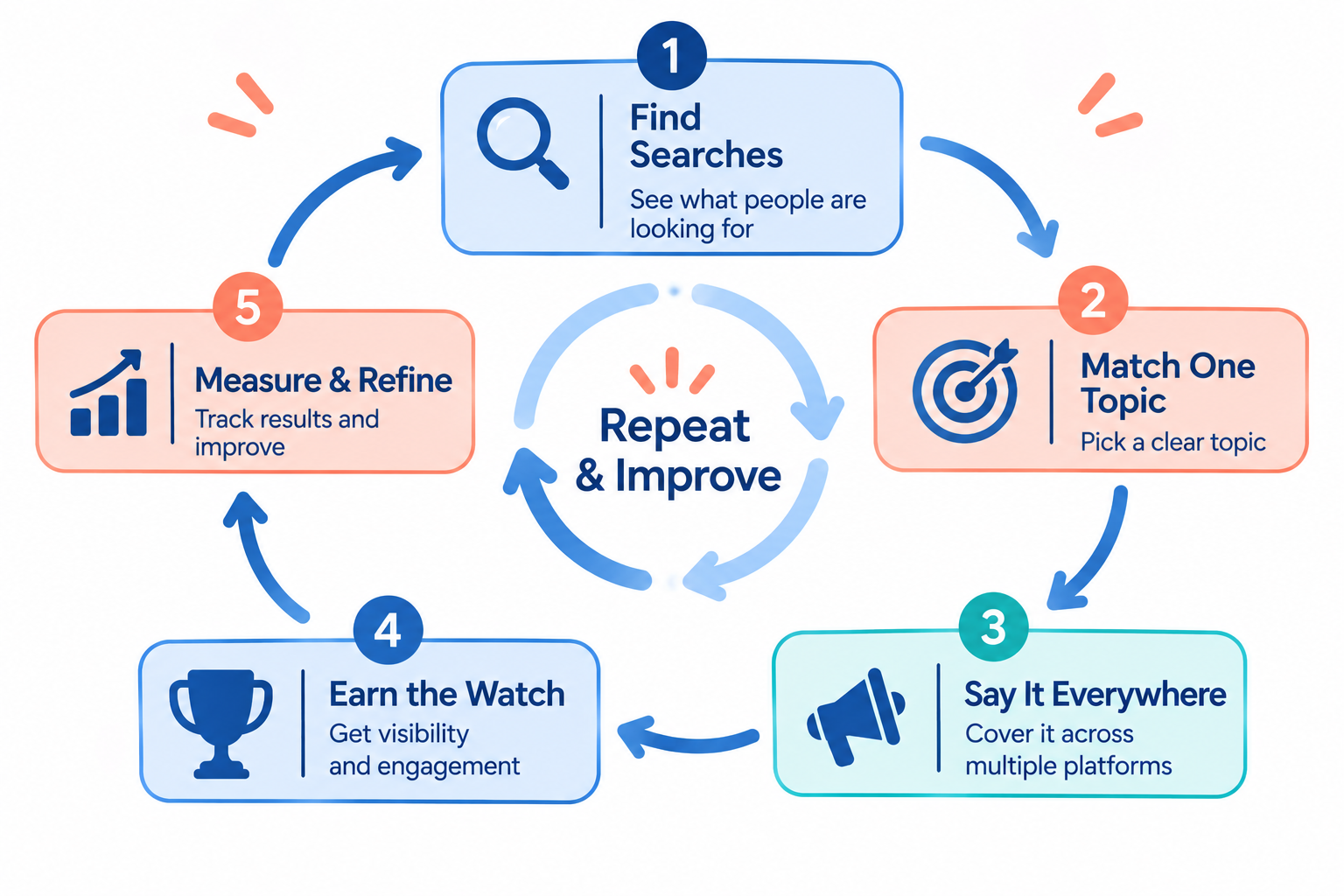
The details differ, but the work follows the same five steps.
- Find the searches. List the phrases your audience types. Use the platform’s own search suggestions, your comments and messages, customer questions, and your website search data.
- Match one topic to one post. Each piece should answer one clear query, not several.
- Say it in every visible and hearable place. Put the phrase naturally in the title or caption, on-screen text, and spoken script, and in alt text and description fields where they exist.
- Earn the click and the watch. A clear thumbnail or opening, a direct answer, and good pacing support the engagement that platforms such as YouTube say they weigh.
- Measure and refine. Review platform analytics for search-driven views and update what works.
Keyword research on social platforms
| Source | How to use it | Caution |
|---|---|---|
| Search bar suggestions | Type a seed phrase and note the suggestions | Suggestions are a sign of interest, not measured volume |
| Comments and direct messages | Collect questions and wording | Small samples |
| Competitor and peer content | Note titles, topics, and gaps, without copying | Do not assume their approach works |
| Your site search and Search Console | Reuse queries that already work | Search behavior differs by platform |
| Platform trend tools | Spot rising topics (Shopify mentions a TikTok trend tool) | Not verified here |
| Customer service and sales notes | Find the real language of buyers | Anonymize any personal data |
Instagram: A Practical Checklist
Based on the vendor guidance above and general good practice, not official rules.
- Profile: put your main topic in the name field and a plain-language bio, with your location if you serve one.
- Captions: name the subject in plain words in the first line, so people and systems both understand it.
- Alt text: write a short, honest description of the image. Do not stuff keywords. Its first job is accessibility.
- Hashtags: use a few relevant ones for context, and do not expect them to drive reach.
- On-screen text and spoken words in Reels: match the topic of the caption.
- Visuals: make the subject clear. If the platform does read images, clear subjects help.
- Settings: if you want posts to be eligible for search engines, check the privacy setting on a professional account. If you do not, switch it off.
TikTok: A Practical Checklist
Again based on third-party guidance, which we could not confirm with TikTok.
- Plan around a search phrase: pick a question people ask, and answer it in the video.
- Say it and show it: speak the phrase in the opening seconds, and show it as on-screen text.
- Caption: put the main phrase early, since only the first words may show before expansion (CapCut’s observation). Write naturally.
- Hashtags: use a few that describe the topic. The “three to five” figure that circulates comes from practitioners, not from TikTok.
- Retention: a clear hook and payoff support watch time, which short-form platforms generally use as a signal.
- Series: a set of videos on related questions shows your topic focus.
- Avoid stuffing: keyword lists in captions read badly and may not help.
YouTube: A Practical Checklist
This list leans most on the one official source we read.
- Title: state the topic clearly, using the phrase viewers use, and write for a human first.
- Description: explain what the video covers in plain language, with links and context. YouTube names the description as a relevance signal.
- Tags: YouTube lists tags among relevance signals, so add accurate ones. Do not add unrelated tags.
- Content: say the topic in the video itself, since content is part of relevance.
- Engagement: make the opening deliver what the title promised, to support watch time.
- Quality: build a channel around a defined area where you have real expertise and show it.
- Captions and transcripts: accurate captions help viewers and make spoken content readable by systems. This is general practice, and YouTube’s page did not discuss it.
Content That Works Across Platforms
Reuse the thinking, not the file. One research effort can feed several formats if each is adapted to the platform’s norms.
| Source idea | TikTok | YouTube | |
|---|---|---|---|
| One customer question | A carousel or Reel with the answer in the first line | A short video that answers it in the opening seconds | A longer explainer with chapters |
| A how-to | Step images with clear alt text | A quick demonstration with on-screen steps | A full walkthrough with a detailed description |
| A comparison | A side-by-side carousel | A one-minute verdict | A detailed review |
| A myth | A single-image correction | A direct “myth vs fact” clip | A longer evidence-based video |
Keep the same terminology across platforms for the same topic, since consistent language helps both people and systems link your accounts to a subject.
Connecting Social SEO to Your Website and AI Search
Social profiles are often among the first things a brand name search turns up, so keep your name, description, and links consistent with your website. Link your website from profiles, and link your social accounts from your website. A consistent entity story supports the semantic understanding discussed in our semantic SEO guide.
AI search tools may draw on many sources. Whether social content is used for citations is not something we could verify, and claims that LLMs rely on social signals in Shopify’s guide are not supported by an official source there. Treat it as a possibility to test, not a plan. Our AI search visibility KPI guide covers how to run dated prompt checks.
Measuring Social SEO
| Metric | Where to find it | What it tells you |
|---|---|---|
| Views from search | Platform analytics, where traffic sources are shown | Whether searches are finding you |
| Watch time or retention | Platform analytics | Whether content satisfies the query |
| Profile visits and follows after views | Platform analytics | Interest in the account |
| Clicks to your website | Analytics with tagged links | Business impact |
| Branded search growth | Google Search Console and trends | Indirect awareness |
| Comments and questions | Platforms and inbox | Language to reuse |
Availability of the traffic-source breakdown differs by platform and account type. Check what yours offers, and keep a simple log of what you changed and when.
Choosing Which Platform to Start With
Trying to optimize for three platforms at once usually spreads effort thin. Pick one first, using your audience and your resources as the guide rather than trends.
| Question | If yes, lean toward | Why (reasoned, not measured) |
|---|---|---|
| Do you have the time to produce longer, instructional videos? | YouTube | Its documented ranking factors reward content that matches a query and holds attention, and videos can stay findable |
| Is your offer visual, such as food, design, or products? | Photos and short video suit visual discovery, and profile text helps account searches | |
| Can you produce frequent, short, quick-answer videos? | TikTok | The format suits direct answers, though official ranking detail is limited |
| Do you serve a local area? | Instagram or YouTube | Profile location text and clear local descriptions can help people find you |
| Does your audience ask detailed how-to questions? | YouTube | Longer formats can answer in depth |
Ask your own customers where they look things up. A short survey or a question at checkout gives a better answer than any general statistic.
Writing Captions, Titles and Descriptions
Text is the part of social SEO you control most directly. A simple structure keeps it clear for people and systems alike.
| Field | What to do | Example (illustrative) |
|---|---|---|
| Title or first caption line | Name the subject in plain words, with the phrase people use | Gluten free birthday cake: how long it stays fresh |
| Second line | Give the direct answer or the promise of the piece | Two days at room temperature, longer in the fridge, if stored as described |
| Body | Add context, steps, or details that a viewer would want | Storage steps and what to avoid |
| Call to action | Say what to do next, once | Questions? Ask in the comments |
| Hashtags | A few relevant ones, placed after the body | Relevant topic tags only |
| Alt text or description | Describe what is shown honestly | A round cake with white frosting on a wooden table |
The example is invented to show structure, and the storage times in it are not advice. Always use facts you have verified for your own product.
Read each caption aloud. If it sounds like a list of keywords, rewrite it. The goal is that a person understands the topic in the first line, and that the phrase appears the way a person would naturally say it.
Accessibility and Social SEO
Several of the habits that support discoverability also make content usable for more people. Alt text exists first to describe images to people who use screen readers. Accurate captions on videos help viewers who are deaf or hard of hearing, and anyone watching without sound. Clear on-screen text helps in noisy places. When these are done well, any search benefit is a side effect, which is the right order of priorities.
That order also protects you from bad advice. If a tip asks you to make alt text worse for people in order to add keywords, it is the wrong tip.
Social SEO for Different Types of Business
| Business type | Search phrases to consider | Content ideas |
|---|---|---|
| Local service | Service plus area, “near me” style questions | Before-and-after photos with plain descriptions, short answers to common questions |
| Online store | Product type plus use case | Demonstrations, comparisons, care instructions |
| Software or B2B service | Problem statements and how-to questions | Short tutorials, walk-throughs, explainers |
| Educator or consultant | Topic plus question words | Series that answer one question each |
| Restaurant or cafe | Dish names, dietary needs, area | Menu items, behind the scenes, location details |
These are starting ideas. Validate each phrase with the platform’s own search suggestions before you build content around it.
A Quick Pre-Publish Checklist
- Does the first line or title say what the piece is about, in the words your audience uses?
- Does the piece answer one clear question or topic?
- Is the phrase present in spoken words and on-screen text where it fits?
- Is alt text or a description honest and useful?
- Are hashtags few and relevant?
- Does the opening deliver what the title promised?
- Are the profile name, bio, and links consistent with your website?
- Have you logged the date and the changes so you can compare results later?
Common Mistakes
- Treating hashtags as the main lever. Even the vendor guide we read says they provide context and do not hack distribution.
- Stuffing keywords. Lists of terms read poorly and add little.
- Copying one platform’s content to another unchanged. Norms and formats differ.
- Ignoring the opening seconds. Engagement matters, and platforms such as YouTube say they weigh it.
- Repeating unverified claims. Many tips come from practitioners, not the platform.
- Chasing every trend. Topic focus helps build a recognizable subject area.
- Neglecting alt text and accessibility. It helps people first.
- Expecting overnight results. No method guarantees reach.
Our guide on topical authority covers more details
A 30-Day Social SEO Plan
Week 1: Research
Choose one platform. Collect 30 searches your audience might use from suggestions, comments, and customer questions. Group them by topic.
Week 2: Profile and templates
Rewrite the profile text in plain language with your topic. Create caption and description templates that name the topic early and naturally.
Week 3: Publish
Publish four to six pieces, each built around one search phrase. Check the opening seconds of each against the promise it makes.
Week 4: Review
Check analytics for search-driven views and watch time. Keep what worked, drop what did not, and plan the next month. Add a second platform only after the first has a working routine.
Worked Example (Illustrative)
This is a hypothetical scenario, not a case study. A small bakery wants to be found for “gluten free birthday cake.” On Instagram, it puts “Gluten free bakery in [city]” in its name field and bio, and writes a first caption line that says “Gluten free birthday cake, made to order.” Photos get plain alt text describing the cake. On TikTok, a short video answers “how long does a gluten free cake stay fresh?” with the question on screen and spoken in the first seconds. On YouTube, a longer video shows how it makes the cake, with a clear title and a description that explains the steps, ingredients list, and ordering information.
The bakery tracks search-driven views, watch time, and website clicks each month. It makes no assumption about ranking and adjusts based on what the numbers show.
What Is Still Uncertain
- How Instagram and TikTok actually rank search results. We found no official detail in what we read.
- How much hashtags, alt text, and on-screen text each contribute on any platform.
- How often social content appears in Google and AI answers, and how that changes.
- How platform settings and features will change. Recheck before acting.
- Whether tactics that worked for other accounts will work for yours.
Test, record results, and revisit regularly.
Frequently Asked Questions
What is social SEO?
Social SEO is the practice of making social content easy for a platform to understand and easy for people to find through that platform’s search, and sometimes through outside search engines. It uses keywords in captions, titles, on-screen text, and profile fields, along with clear topics and useful content.
Is social SEO different from social media marketing?
Yes. Social media marketing covers the whole effort of building an audience, including feeds, ads, and community. Social SEO focuses on being found when someone searches on a platform.
Do keywords matter on Instagram?
The sources we read, which are third-party, say captions, alt text, and profile text act as text signals, so naming your topic in plain words is sensible. Instagram’s own documentation was not read, so this is practitioner understanding.
How does TikTok search work?
We found no official TikTok explanation. Third-party guides say TikTok reads captions, on-screen text, spoken audio, and hashtags, and that retention still matters. Treat these as informed opinions.
How does YouTube rank search results?
YouTube Help says search ranking weighs relevance, engagement, and quality, and may be personalized based on history. Titles, tags, descriptions, and content contribute to relevance. YouTube does not accept payment for better organic placement.
Do hashtags still help?
They can give context, but the guide we read says they will not hack distribution. Use a few relevant ones and do not rely on them for reach.
Can Instagram posts appear in Google?
PPC Land reported that public content from professional accounts became eligible for search engines from July 10, 2025, with a privacy setting to turn it off. Check Instagram’s current help pages, since we did not verify how often posts appear.
How long does social SEO take to work?
There is no reliable timeline. Results depend on your topic, competition, and platform. Track search-driven views over time and adjust.
Conclusion
Social SEO is search thinking applied where your audience already looks. The shared method is simple: find the phrases people use, answer one clearly per piece, say it in every visible and audible place, deliver on the promise, and measure. The platform details differ, and the evidence behind them ranges from an official YouTube page to vendor opinion for Instagram and TikTok.
Start with one platform and one month of focused work. Be honest about what you know, avoid stuffing and shortcuts, and keep your profiles consistent with your website. Nothing here guarantees reach or rankings, but it does make your content easier to understand and easier to find.
Next step: Read our guide to ChatGPT for SEO with Prompts